Ruflo v3.5 Orchestrates 60+ Agents in Fault-Tolerant Swarms — But Swarm Intelligence Still Needs a Persistent Memory Layer

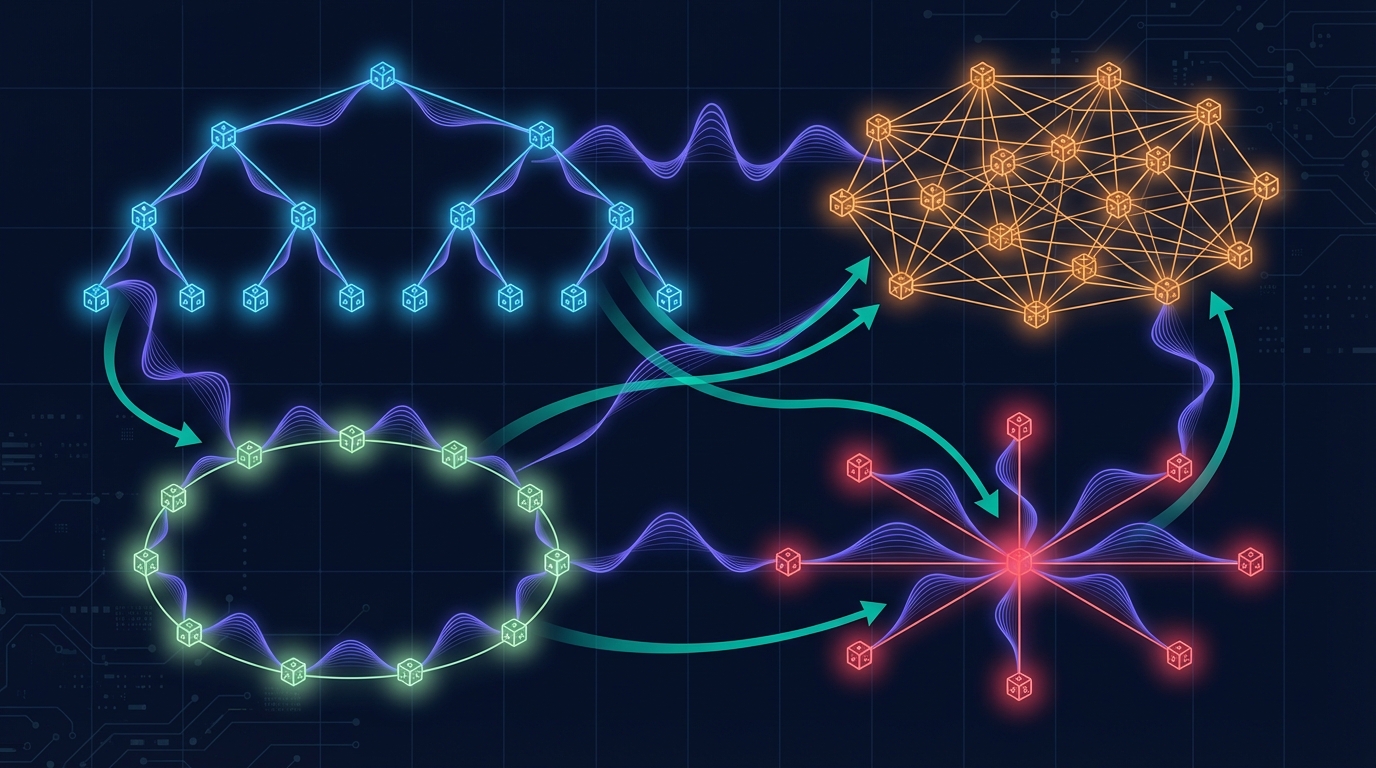
Ruflo v3.5 just graduated from alpha to production-ready after ten months and 5,800+ commits. The platform orchestrates 60+ specialized AI agents through swarm topologies — hierarchical, mesh, ring, and star patterns — with five distributed consensus protocols including Raft and Byzantine Fault Tolerance. Its SONA self-learning system uses nine reinforcement learning algorithms with HNSW vector indexing for fast pattern retrieval. For enterprises deploying complex multi-agent systems, Ruflo represents real engineering maturity.
But there is a foundational layer that even the most sophisticated swarm orchestration still depends on — persistent memory that accumulates across swarm deployments and evolves with the organization.
Ruflo v3.5: What Everyone's Getting Right (And Missing)
Ruflo gets coordination complexity right. The five consensus protocols handle real distributed systems challenges — what happens when agents disagree, when nodes fail, when network partitions occur. Intelligent task routing across three compute tiers (WebAssembly for simple tasks, Haiku/Sonnet for medium, Opus for complex) extends API budget by up to 2.5x. This is thoughtful systems engineering for multi-agent deployments.
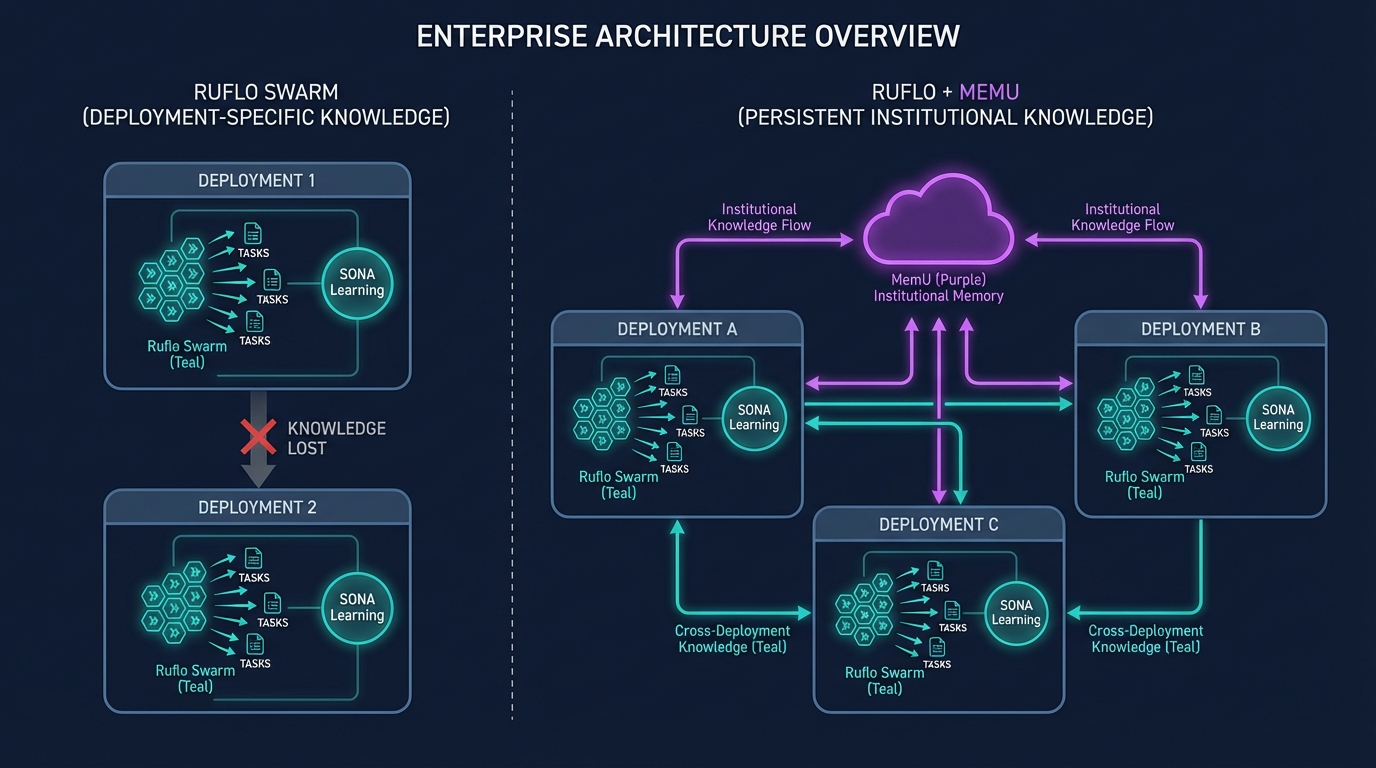
What Ruflo's SONA system addresses partially — but not architecturally — is the persistence of learned patterns across deployment boundaries. SONA's reinforcement learning adapts within a deployment lifecycle, but organizational knowledge that spans months of agent operations, evolves with team changes, and connects insights across different swarm configurations requires a dedicated memory architecture. Ruflo coordinates swarms brilliantly; long-term institutional memory needs a dedicated layer.
Other orchestration platforms — CrewAI, AutoGen, LangGraph — share this same architectural boundary. They manage agent coordination; the persistent knowledge layer sits outside their scope.
The MemU Agentic Memory Framework: Institutional Memory for Agent Swarms
The MemU Agentic Memory Framework provides the persistent layer that complements swarm orchestration. Where Ruflo manages how agents coordinate, MemU manages what the organization's agents collectively know.
Consider a sixty-agent swarm handling enterprise customer onboarding. With MemU, the research agents recall that similar company profiles had integration challenges with legacy ERP systems, the compliance agents remember that this industry requires specific data residency configurations, and the implementation agents know that the last three onboardings in this vertical benefited from a particular migration sequence. This institutional knowledge persists across deployments, team changes, and platform upgrades.
The MemU Agentic Memory Framework provides:
- Drop-in integration: A simple API that works alongside Ruflo, CrewAI, or any orchestration platform. Add memory calls to agent workflows; swarm intelligence gains institutional depth.
- Dual-mode retrieval: Semantic search for finding relevant past experiences plus a structured memory graph for tracking organizational knowledge relationships. Not just pattern vectors — actual institutional topology.
- Cross-deployment persistence: Memory survives across swarm reconfigurations, agent updates, and infrastructure migrations. Institutional knowledge compounds regardless of the orchestration layer.
Swarm intelligence without institutional memory is collective coordination without collective learning. The MemU Agentic Memory Framework gives agent swarms the organizational knowledge that makes coordination purposeful.
Retrieval operates across 10,000+ memory entries with sub-100ms latency, compatible with Ruflo's real-time consensus protocols.
Head-to-Head: Swarm Orchestration Alone vs. With MemU
Ruflo alone: Sixty agents coordinate through consensus protocols. SONA learns within deployment cycles. But when the swarm is redeployed for a new project, institutional knowledge from previous projects does not transfer. The swarm is coordinated but amnesiac across deployment boundaries.
Ruflo + MemU Agentic Memory Framework: Every agent in the swarm reads from and writes to persistent institutional memory. Knowledge from previous deployments informs current operations. Agent specializations deepen over time. The swarm becomes not just coordinated but cumulatively intelligent.
Cross-swarm knowledge transfer: With MemU, insights from a customer support swarm inform a sales swarm's understanding of customer pain points. Without MemU, each swarm operates as an isolated intelligence.
Empowering Ruflo: Better Together
MemU does not replace Ruflo — it makes swarm orchestration dramatically more valuable:
- Enterprise onboarding: Ruflo coordinates the multi-agent workflow; MemU provides institutional knowledge about similar customers, common challenges, and proven implementation sequences.
- Research and analysis: Ruflo distributes research across specialized agents; MemU ensures each agent's findings compound into organizational knowledge rather than evaporating when the swarm terminates.
- Continuous improvement: Ruflo optimizes task routing for cost and speed; MemU tracks which agent configurations and strategies produced the best outcomes historically, informing future swarm design.
Get Started with MemU
Add persistent institutional memory to your agent swarms in minutes. The MemU Agentic Memory Framework works with any orchestration platform — one API, zero lock-in, immediate organizational intelligence. Visit memu.pro to explore the Agentic Memory Framework API, or check out the GitHub repository to start building agents that remember.
Tags: Ruflo, agent swarm orchestration, multi-agent coordination, enterprise AI agents, agentic memory, LLM memory, MemU AI