Runway Gen-4.5 Tops Every Video Benchmark — But Each Generation Starts Cold

Runway just claimed the top spot in AI video generation — again. Gen-4.5, backed by a fresh $315 million raise at a $5.3 billion valuation, holds 1,247 Elo points on the Artificial Analysis Text-to-Video benchmark — surpassing every competitor. The model achieves physical accuracy that previous generations couldn't: realistic object motion, proper liquid dynamics, coherent fine details sustained across time.
Beyond generation, Runway launched GWM-1 (General World Models) — a family of models that simulate reality in real time. GWM Worlds creates interactive explorable environments. GWM Avatars powers conversational video agents. GWM Robotics simulates physical robotic interactions. Partnered with NVIDIA's Rubin platform, Runway is building infrastructure for real-time, long-form, high-fidelity video at scale.
But here's what every filmmaker, game developer, and content creator discovers after their first week with Runway Gen-4.5: the model doesn't remember what you made yesterday.
Runway Gen-4.5: What Breakthrough Video AI Achieves (And Loses)
The quality leap is real. Gen-4.5 produces videos where physics behaves correctly — water splashes realistically, fabric drapes naturally, objects maintain consistent proportions through motion. Prompt adherence is dramatically improved: what you describe is what you get, with fewer hallucinated elements or ignored instructions.
The GWM-1 family extends this into interactive territory. Generated worlds aren't static videos — they're explorable environments that maintain spatial consistency. This opens applications from game prototyping to architectural visualization to film pre-production.
For individual video generation tasks, Runway Gen-4.5 delivers. The gap appears across projects. A filmmaker generating scenes for a short film needs visual consistency — the same lighting mood, color grade, character proportions, and environmental style across dozens of shots. Gen-4.5 treats each generation independently. The dark, desaturated palette you carefully specified for Scene 1 requires re-specification for Scene 2. Character consistency across shots requires manual reference image management rather than accumulated style understanding.
How Runway Gen-4.5 Handles Creative Context
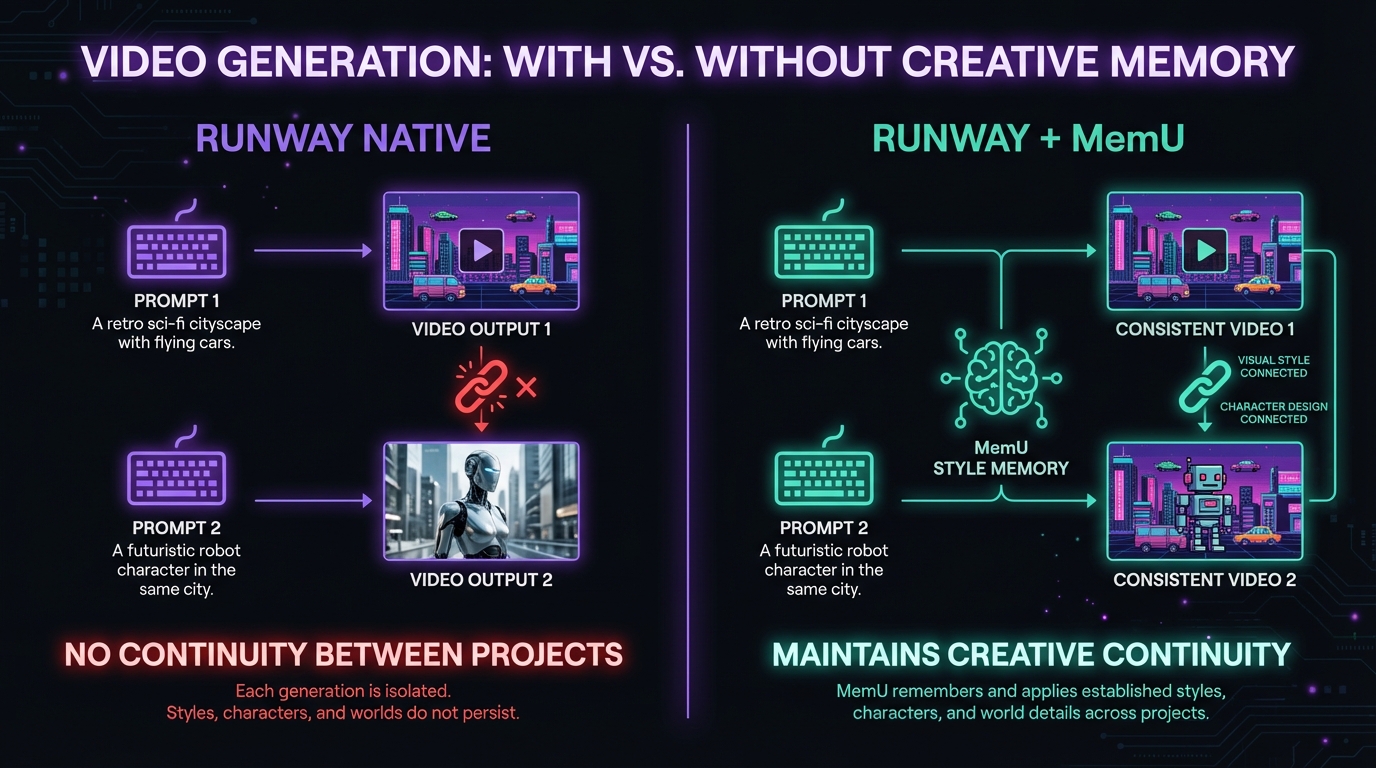
Runway Gen-4.5 processes each generation request with the context provided in that request — text prompts, reference images, style parameters. The model applies its training to produce the highest-quality output matching those inputs. Within a single generation, quality is exceptional.
The Gen-4 architecture introduced character and environment consistency features through reference images. Feed the model a character reference, and it maintains that character's appearance across generations. This helps but requires manual reference management and doesn't capture the broader creative context — mood, pacing, narrative visual language — that defines a project's aesthetic.
Project-level creative memory doesn't persist. The lighting decisions from yesterday's session don't inform today's. The color relationships that worked for the first act don't automatically carry into the second. Style evolution across a project requires the creator to maintain and re-specify everything manually — effectively serving as human memory for the AI.
This challenge isn't unique to Runway — Pika, Kling, Sora, and every video generation platform shares it. Generative AI tools are stateless by design.
The MemU Agentic Memory Framework: Creative AI That Evolves With Your Vision
The MemU Agentic Memory Framework provides the creative memory that generative video tools like Gen-4.5 currently lack. Rather than treating each generation as independent, MemU captures creative decisions, style parameters, and aesthetic preferences into persistent memory that informs future generations.
Consider a studio producing a 12-episode animated series using Gen-4.5. Each episode requires hundreds of generated shots maintaining consistent visual identity. With Runway alone, art directors manually specify style parameters for every generation. With the MemU Agentic Memory Framework, the visual language developed across early episodes becomes retrievable context — "match our established style" draws on accumulated aesthetic decisions rather than requiring exhaustive re-specification.
The architecture enables three capabilities for creative workflows:
- Style persistence: The MemU Agentic Memory Framework captures creative decisions — lighting moods, color relationships, composition preferences, motion styles — as structured memory that persists across sessions and projects.
- Character and world continuity: Beyond simple reference images, MemU stores relationship context — how characters interact, how environments connect, how visual elements relate to narrative elements.
- Collaborative consistency: Multiple artists working on the same project share creative memory. New team members inherit the project's accumulated visual language without manual style guides.
MemU transforms generative video from isolated creation into a creative process that accumulates visual intelligence over time.
Integration works alongside existing Runway workflows: the MemU Agentic Memory Framework provides APIs that capture generation context and retrieve relevant creative memory for new requests.
Head-to-Head: Stateless vs. Memory-Enhanced Video Generation
Runway Gen-4.5 alone: Benchmark-leading video quality, physics accuracy, and prompt adherence. But each generation is independent — no accumulated style understanding, no project-level creative continuity, no progressive refinement of visual language.
Runway Gen-4.5 + MemU: Same generation quality plus persistent creative memory. Previous generations inform future ones. Style decisions accumulate into project-specific understanding. Retrieval across thousands of past generations with sub-100ms latency. Creative consistency becomes systematic rather than manual.
Runway Gen-4.5 provides the generation quality. The MemU Agentic Memory Framework provides the creative memory that makes that quality consistently on-brand.
Empowering Video Creation: Better Together
The MemU Agentic Memory Framework isn't a replacement for Gen-4.5 — it's the memory layer that makes AI video generation viable for professional production.
- Series production: Visual consistency across episodes without manual style re-specification. The aesthetic DNA established in the pilot informs every subsequent episode.
- Brand content: Marketing teams maintain visual identity across campaigns. Brand guidelines become memory-backed rather than document-dependent.
- Film pre-production: Directors build visual language through iterative generation. Early concept explorations inform later production design automatically.
Adding creative memory takes a single integration. The MemU Agentic Memory Framework handles style capture, storage, and retrieval — your Runway workflows just become more consistent.
Get Started with MemU
Runway Gen-4.5 represents the state of the art in AI video generation. The quality, speed, and versatility make professional-grade AI video a reality. Add GWM-1's world simulation capabilities, and Runway is building the infrastructure for a new creative medium.
The next step is creative memory — generation that builds on what you've already established rather than starting fresh every time. Projects where visual language evolves deliberately. Teams where AI-generated content stays on-brand automatically.
The MemU Agentic Memory Framework provides that foundation. Drop-in integration with video generation workflows means you can add creative memory without changing your process. Structured style graphs capture the relationships that make aesthetics coherent. And retrieval scales to support years of accumulated creative decisions.
Visit memu.pro to explore the Agentic Memory Framework API, or check out the open-source repository on GitHub to start building persistent memory into your video generation workflows today.