Semantic Kernel Orchestrates Agents Across Five Patterns — But Orchestrated Agents Without Memory Cannot Retain Intelligence Between Runs


Semantic Kernel has emerged as Microsoft's answer to the agent orchestration challenge. The SDK now supports five distinct orchestration patterns — Concurrent, Sequential, Handoff, Group Chat, and Magentic (inspired by MagenticOne) — giving developers a unified API for switching between coordination strategies without rewriting agent logic. The runtime manages the full agent lifecycle: instantiation, communication, message routing, and graceful termination. Available in C# and Python, with Java on the roadmap, Semantic Kernel provides async invocation with configurable timeouts, human-in-the-loop callbacks, and a pattern-switching architecture that lets teams experiment with different orchestration approaches on the same agent pool. As part of the broader Microsoft Agent Framework, Semantic Kernel is positioned as the orchestration layer for enterprise AI — still experimental but already demonstrating that agent coordination is as much an engineering discipline as agent construction.
But Semantic Kernel's orchestration intelligence resets between runs. When a Handoff pattern discovers the optimal agent sequence for customer onboarding — which agent handles document verification, which manages compliance, where human review is most effective — that knowledge disappears at run completion. Orchestrated agents that cannot retain pattern effectiveness data must rediscover optimal coordination from scratch every time.
Semantic Kernel: What Everyone's Getting Right (And Missing)
Semantic Kernel's five-pattern model addresses a real limitation in the agent ecosystem. Most frameworks force a single coordination paradigm — sequential chains, parallel execution, or fixed topologies. Semantic Kernel recognizes that different tasks need different strategies: the same agents might work best in Sequential for document processing, Group Chat for brainstorming, and Handoff for customer service. The unified API means switching patterns is a configuration change, not an architecture rewrite.
The Magentic pattern is particularly noteworthy. Inspired by Microsoft Research's MagenticOne, it introduces a lead agent that dynamically plans and delegates tasks to specialists, adjusting strategy based on intermediate results. This adaptive orchestration goes beyond static workflow definitions — the lead agent decides at runtime which agents to involve, in what order, and with what inputs. Combined with human-in-the-loop callbacks and async invocation with timeout handling, Semantic Kernel provides production-ready orchestration that balances autonomy with control.
What Semantic Kernel does not preserve across runs is pattern effectiveness data. A Sequential orchestration that processed a hundred loan applications might achieve a 94% success rate while Handoff achieves 97% — but that comparative data is lost between runs. The system cannot learn that Magentic outperforms Group Chat for research but underperforms for structured extraction. Other orchestration frameworks — including LangGraph's workflow engine and CrewAI's process types — face the same limitation. They execute patterns within runs; none retain the intelligence needed to select and optimize patterns based on historical performance.
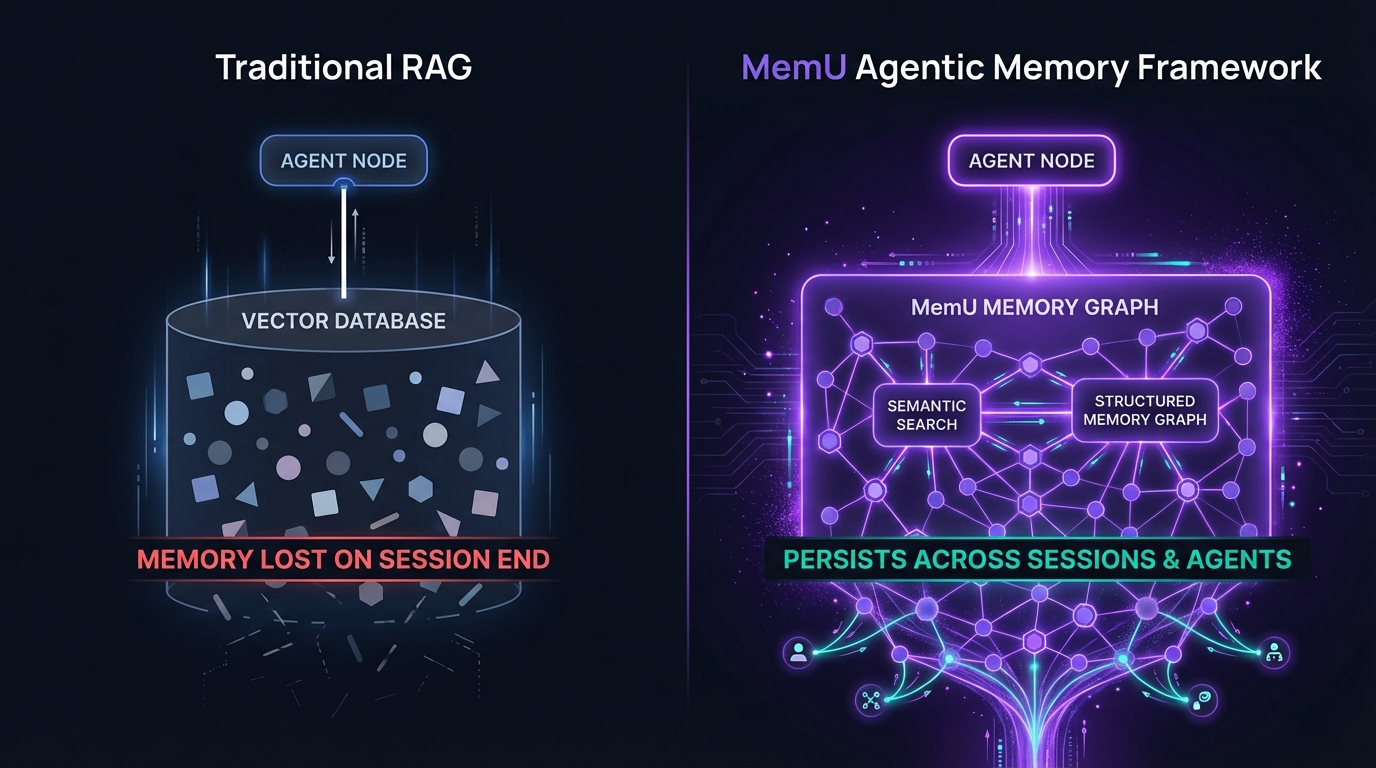
The MemU Agentic Memory Framework: Orchestration Intelligence That Compounds
The MemU Agentic Memory Framework provides the persistent memory layer that orchestration SDKs like Semantic Kernel do not include natively. Instead of treating each run as an isolated coordination event, MemU captures pattern selection decisions, agent sequencing effectiveness, handoff timing, and outcome quality, storing them in a structured memory graph that persists across runs, pattern changes, and system versions.
Consider a Semantic Kernel deployment that orchestrates insurance claim processing. Without persistent memory, each run uses the default pattern regardless of claim complexity. With the MemU Agentic Memory Framework, the system recalls orchestration history: simple auto claims process fastest with Sequential using three agents, complex liability claims achieve higher accuracy with Magentic where a lead agent dynamically delegates to specialists, and fraud-flagged claims benefit from Group Chat where multiple analysts cross-examine evidence simultaneously. That accumulated intelligence transforms a static workflow into an adaptive system that selects the optimal pattern before execution begins.
The framework addresses three core limitations of run-bounded agent orchestration:
- Pattern selection optimization: Which pattern works best for which task category is learned through accumulated outcome data. The MemU Agentic Memory Framework tracks pattern-to-outcome correlations, enabling automatic selection of the highest-performing strategy for each incoming task.
- Agent sequencing refinement: Within each pattern, agent order significantly affects quality. Persistent memory discovers that the compliance agent should run before pricing — because compliance constraints eliminate options pricing would otherwise waste cycles evaluating.
- Handoff timing intelligence: The Handoff pattern depends on knowing when to transfer control. The MemU Agentic Memory Framework learns optimal triggers — transferring from research to analysis when the agent has gathered three corroborating sources, not just one, produces significantly better outcomes.
Five orchestration patterns give you coordination flexibility. Persistent memory tells you which pattern to use and how to configure it. The MemU Agentic Memory Framework gives Semantic Kernel the historical intelligence that turns pattern selection from guesswork into data-driven optimization.
Integration with Semantic Kernel uses the framework's REST APIs through the SDK's plugin system. Before orchestration, accumulated pattern performance data informs selection. During execution, intermediate results and handoff metrics stream to persistent memory. At completion, outcome scores are stored alongside the configuration used, building the dataset that powers future optimization. The memory layer works within Semantic Kernel's extensibility model, adding intelligence without modifying the orchestration runtime.
Head-to-Head: Stateless Orchestration vs. Memory-Enhanced Pattern Selection
Semantic Kernel alone: The most pattern-rich orchestration SDK, with five strategies, unified switching API, async execution, human-in-the-loop support, and cross-language availability. Developers get flexible primitives for sophisticated agent workflows. But each run uses statically-configured patterns — no learning from previous executions, no pattern optimization, no intelligence accumulation.
Semantic Kernel + MemU: The same five patterns, now informed by persistent performance data. Pattern selection is driven by historical outcome analysis. Agent sequencing reflects proven effectiveness. Handoff timing is optimized based on accumulated correlations. The orchestration system gets measurably more effective with every run.
For enterprise deployments processing thousands of tasks daily — where a 3% improvement in pattern selection translates to measurably better outcomes — the compounding effect of persistent orchestration memory is substantial. After ten thousand runs, the system operates with sophistication that would take years of manual tuning to achieve through static configuration.
Empowering Semantic Kernel: Better Together
The combination of Semantic Kernel's orchestration framework and MemU's persistent memory unlocks capabilities that neither achieves alone:
- Adaptive pattern selection: Instead of hardcoding patterns per task type, the system dynamically selects based on accumulated data. As the memory graph grows, selection becomes increasingly precise — routing complex tasks to Magentic, routine tasks to Sequential, and ambiguous tasks to Group Chat with measurable confidence.
- Cross-pattern learning: Insights from one pattern inform others. When Group Chat reveals that a particular agent combination produces exceptional analysis, that insight improves Handoff and Sequential configurations that include the same agents.
- Orchestration regression detection: Persistent memory tracks effectiveness over time. When a pattern that achieved 97% success drops to 91% — perhaps from a model update or data shift — the system detects the regression and switches to a better alternative.
Persistent memory transforms Semantic Kernel from a flexible orchestration SDK into an intelligent system that learns which strategies work best and continuously optimizes coordination based on empirical evidence.
Get Started with MemU
Semantic Kernel has built the most pattern-rich agent orchestration SDK available — five strategies, unified switching, human-in-the-loop support, and the backing of Microsoft's Agent Framework initiative.
The next step is giving those patterns persistent performance memory. Runs where selection is informed by historical outcome data. Workflows where sequencing improves with accumulated analysis. Organizations where orchestration intelligence compounds across every execution.
The MemU Agentic Memory Framework provides that foundation. Plugin-based integration within Semantic Kernel's extensibility model, dual-mode retrieval with semantic search and structured memory graphs, and cross-execution persistence that turns agent orchestration into compounding coordination intelligence.
Visit memu.pro to explore the Agentic Memory Framework API, or check out the GitHub repository to start building agents that remember.
Tags: Semantic Kernel, agent orchestration, Microsoft AI, agent memory, MemU AI, LLM memory, multi-agent