Sim Mothership Delivers a Central Intelligence Layer for Agent Orchestration — But Persistent Tables Without Compounding Memory Limit Long-Term Intelligence


Sim has launched Mothership in v0.6 (March 2026), a control plane and orchestrator that provides full context over workflows, tables, knowledge bases, files, and tools — creating a central intelligence layer for agent orchestration that executes end-to-end tasks from a single prompt. Tell Mothership to create a CRM table, seed it with leads, build a sync workflow, and schedule it daily, and it handles the entire chain autonomously. With over 100 integration tools spanning CRM platforms, Slack, Linear, and email-driven automation via Sim inbox, Mothership provides the connective tissue that turns isolated agent capabilities into coordinated multi-step operations with concurrent execution and smart routing.
But orchestration is not intelligence. Persistent tables in Mothership provide structured data storage with typed columns — string, number, boolean, date, JSON — and ten or more operations for managing that data. Yet tables store what agents produce, not what agents learn. An orchestrator coordinating agents across workflows without capturing the intelligence those agents develop creates systems that execute efficiently but never grow smarter from the work they perform.
Agent Orchestration: What Sim Mothership Gets Right (And What It Misses)
Mothership's architectural position as a control plane with complete context is the right abstraction for agent orchestration. Rather than requiring developers to manually wire individual tools and data sources, Mothership maintains awareness of all available resources and reasons about how to combine them for complex requests. This full-context awareness eliminates integration friction that makes multi-step workflows brittle in platforms where each step operates in isolation.
The table system addresses a genuine gap. Most orchestration platforms treat data as transient — passing values through ephemeral context windows or temporary variables that evaporate when workflows complete. Mothership's persistent tables with typed columns provide a durable data layer where agents store, query, and update information across executions. This is meaningfully better than context-window-only approaches forcing agents to re-derive information from scratch every cycle.
The breadth of integrations amplifies capability. With connectors to CRM platforms, Slack, Linear, and email automation through Sim inbox, Mothership coordinates actions across the full enterprise tool spectrum without custom integration code. Concurrent execution and smart routing ensure independent branches run in parallel, reducing total execution time for complex operations.
The limitation is the distinction between data persistence and intelligence persistence. Tables store structured records — customer names, deal amounts, sync timestamps. They do not store the meta-knowledge agents develop through repeated execution: which CRM sync strategies produce the fewest conflicts, which lead scoring patterns correlate with conversions, which workflow configurations fail under specific conditions. This operational intelligence is generated during every agent orchestration cycle but disappears when the workflow completes.
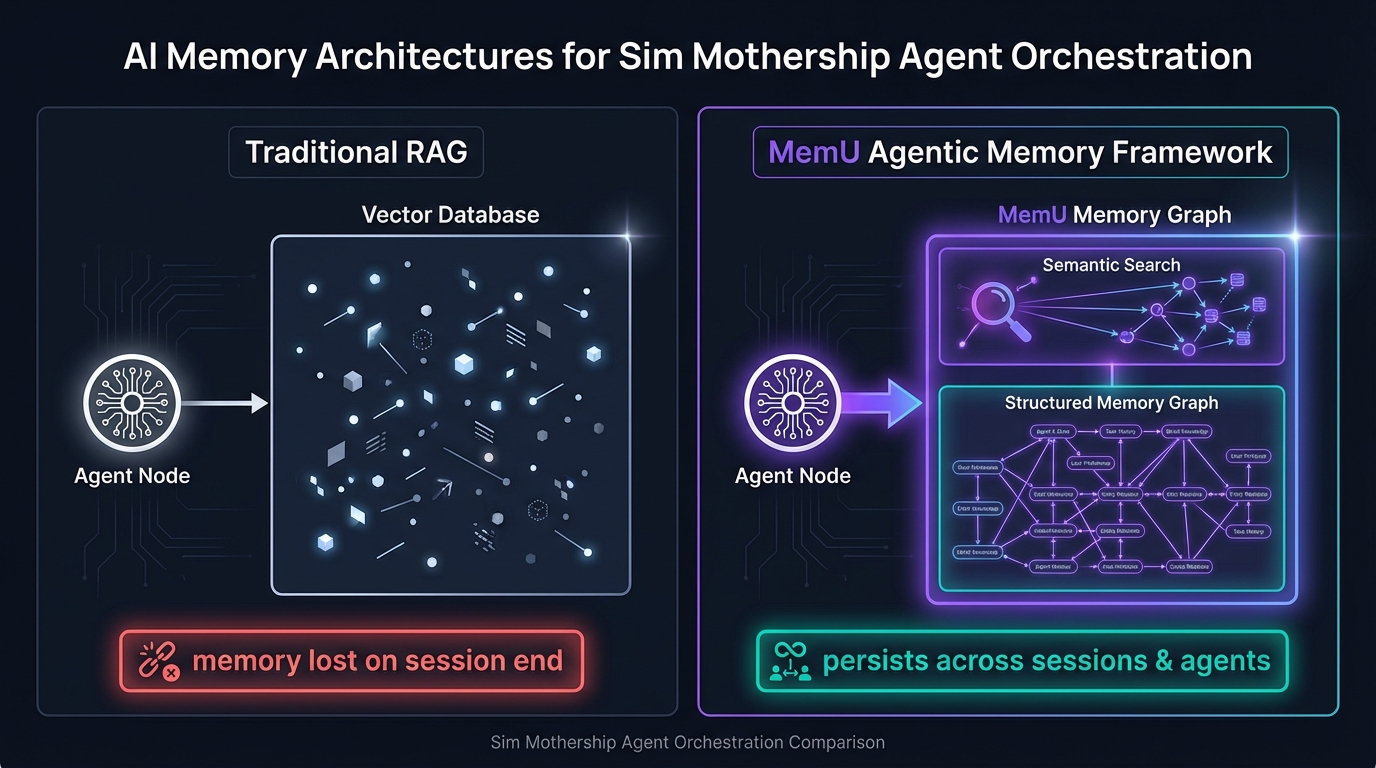
The MemU Agentic Memory Framework: Persistent Intelligence for Agent Orchestration
The MemU Agentic Memory Framework bridges the gap between data storage and intelligence storage. Where Mothership's tables persist outputs of agent work, MemU persists the intelligence agents develop while doing that work — creating a compounding knowledge layer that makes every future agent orchestration cycle smarter because agents carry forward lessons from previous executions.
Consider a sales operations team using Mothership to orchestrate lead enrichment, CRM sync, and outreach scheduling. Every week, agents execute the same workflow: pull leads, enrich profiles, score, sync to CRM, schedule outreach. After twelve weeks, the tables contain rich lead data. But agents have also implicitly learned that leads from certain industries convert at higher rates when contacted on Tuesdays, that one enrichment provider is more reliable than another, and that sync conflicts correlate with specific CRM field configurations. With MemU, this intelligence persists and informs future executions. Without persistent memory, agents execute with the same naive assumptions in week thirteen as in week one.
The MemU Agentic Memory Framework provides capabilities that directly enhance agent orchestration:
- Workflow intelligence persistence: Every orchestration cycle generates implicit knowledge about optimal execution paths, integration reliability, and error correlations. MemU captures this as structured memories the orchestrator queries when planning future executions — transforming Mothership from a coordinator that follows instructions into an orchestrator optimizing based on accumulated experience.
- Cross-workflow knowledge transfer: Intelligence learned in one workflow automatically benefits others operating on similar data or tools. A CRM sync workflow that discovers optimal conflict resolution strategies shares that knowledge with other workflows touching the same CRM instance, eliminating redundant learning.
- Smart routing enhancement: Mothership's routing selects paths based on current context; MemU enriches routing with historical performance data — which integrations have lowest latency at different times, which concurrent patterns produce fewest race conditions, and which branches benefit most from parallelization based on measured outcomes.
Tables store what agents produce. The MemU Agentic Memory Framework stores what agents learn — transforming orchestration from efficient coordination into intelligent coordination compounding with every cycle.
Head-to-Head: Sim Mothership vs. Other Orchestration Platforms
Sim Mothership alone: Workflows execute with full-context awareness, persistent tables store structured output, and 100-plus integrations connect enterprise tools. But each execution starts with the same baseline intelligence regardless of how many prior runs completed. The orchestrator coordinates without learning from outcomes — operationally competent but unable to improve coordination strategies from accumulated experience.
Sim Mothership + MemU Agentic Memory Framework: Every workflow deposits intelligence that future executions withdraw and build upon. The orchestrator learns which paths produce the best outcomes, which integrations need retry logic under specific conditions, and which agent orchestration patterns scale most efficiently. Tables store structured data while MemU stores the meta-intelligence making the orchestrator progressively more effective.
Compared to other agent orchestration platforms — n8n, Zapier, LangGraph, CrewAI — Sim Mothership offers the most comprehensive single-prompt orchestration with its full-context control plane. But all share the same intelligence limitation: workflow outputs persist while workflow intelligence evaporates. MemU uniquely provides the persistent intelligence layer capturing operational knowledge that workflows generate but do not retain.
Orchestrating Smarter: Better Together
MemU does not replace Mothership's orchestration capabilities — it ensures every cycle contributes to growing agent intelligence:
- Table intelligence: Mothership tables store structured records; MemU stores the context around those records — why specific values were chosen, which alternatives were evaluated, and what patterns informed current data — enabling better decisions about the data agents produce and consume.
- Integration reliability: With 100-plus tools, failures are inevitable; the MemU Agentic Memory Framework persists failure patterns, retry outcomes, and recovery strategies — enabling proactive error handling that anticipates issues based on historical patterns rather than reacting after cascading failures.
- Prompt optimization: Mothership executes tasks from single prompts; MemU captures which prompt structures produce the most reliable agent orchestration outcomes — enabling suggestions that improve first-attempt success rates based on thousands of prior requests.
Get Started with MemU
Give your orchestrated agents persistent memory to transform agent orchestration from efficient coordination into intelligent coordination compounding with every workflow execution. The MemU Agentic Memory Framework integrates with any orchestration platform — one API, instant persistence, zero changes to existing configurations. Visit memu.pro to explore the Agentic Memory Framework API, or check out the GitHub repository to start building agents that remember.
Tags: Sim, Mothership, agent orchestration, workflow automation, control plane, persistent tables, agent intelligence, MemU AI