Slack AI Summarizes and Searches Workspace — But Workplace Agents Without Conversation Memory Can't Build Context

Slack AI has brought artificial intelligence directly into the communication layer where teams already work. The platform offers natural language search that answers questions about workspace content with citations to original messages, channel recaps that summarize activity over custom date ranges with key decisions and action items highlighted, and thread summaries that distill long discussions into digestible takeaways. Pilot customers reported saving an average of 97 minutes per user per week — nearly two hours of daily time recovered from manually scrolling through channels and threads. Available on paid plans in English, Spanish, and Japanese, Slack AI processes workspace data without using it for model training, addressing enterprise data privacy concerns directly.
But Slack AI's intelligence is bounded by what it can surface from message history in real time. The AI that summarized your team's architecture decision yesterday cannot connect that decision to the three related conversations from last month, the technical constraint discussed in a different channel two weeks ago, or the user feedback thread that motivated the change in the first place. Workplace agents without conversation memory provide summaries without institutional context.
Slack AI: What Everyone's Getting Right (And Missing)
Slack AI's integration approach is sound. Rather than requiring users to switch to a separate AI tool, it embeds intelligence directly into the communication flow. The search feature understands natural language queries — "What did the product team decide about the mobile redesign?" returns a synthesized answer with links to the relevant messages. Channel recaps reduce the overhead of catching up after time off or cross-time-zone collaboration. For teams drowning in message volume, these features provide genuine relief from information overload.
The privacy-first architecture also differentiates the platform. By processing data within the workspace context and committing to not training models on customer data, Slack AI addresses the primary concern that enterprise teams have about AI access to internal communications. This architectural decision enables adoption in industries — financial services, healthcare, government — where data handling policies would otherwise block AI features entirely.
What Slack AI does not build is accumulated institutional intelligence. Each summarization and search query operates on the raw message history — the AI surfaces relevant messages but doesn't retain the relationships between decisions, the evolution of projects over time, or the institutional context that makes individual conversations meaningful. A team's decision to migrate from PostgreSQL to CockroachDB exists as scattered messages across channels and threads. Slack AI can find those messages, but it cannot construct the narrative arc — the performance bottlenecks that motivated the migration, the vendor evaluation process, the team's concerns and how they were resolved. Other workplace AI tools — including Microsoft Copilot for Teams and Google Workspace AI — face the same structural constraint. They search and summarize; none build persistent institutional knowledge.
The MemU Agentic Memory Framework: Institutional Intelligence That Compounds
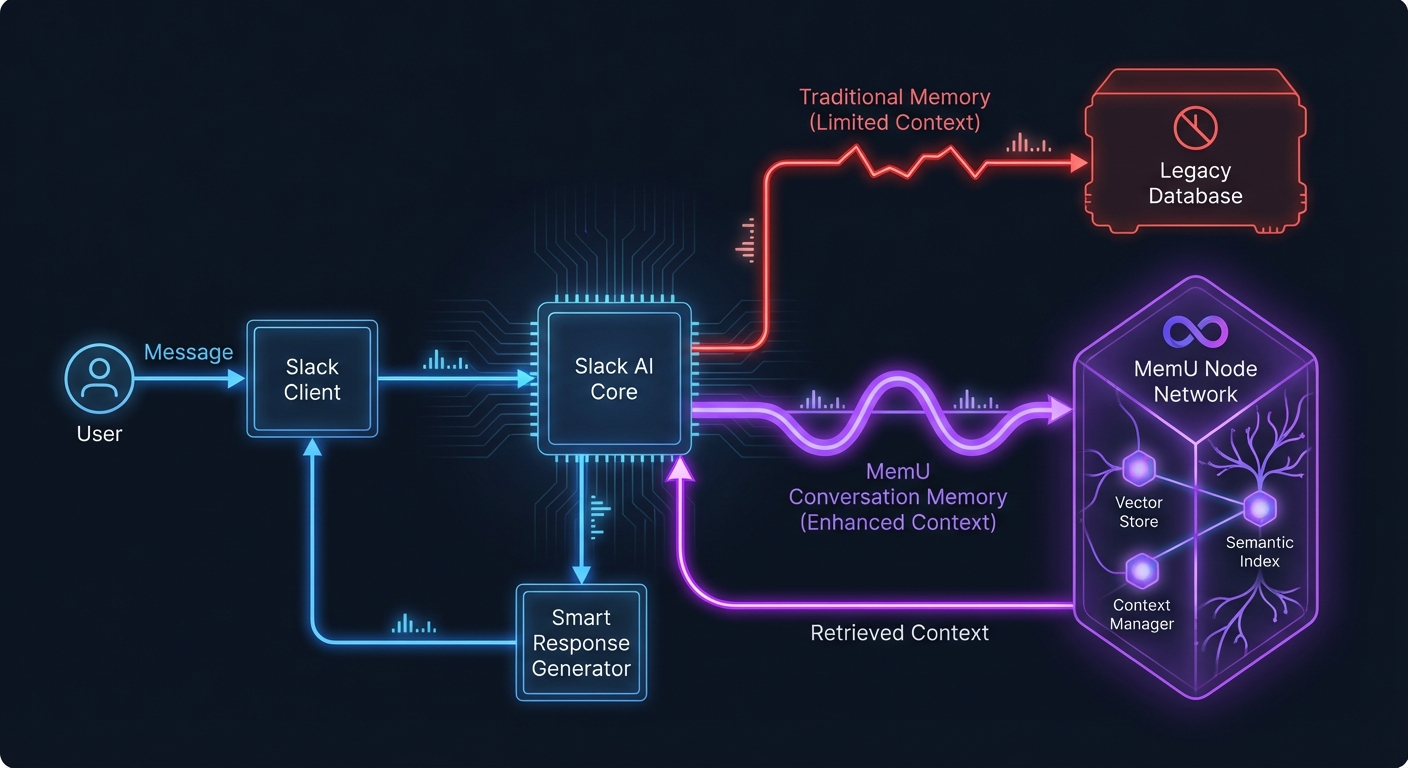
The MemU Agentic Memory Framework provides the persistent memory layer that workplace AI tools like Slack AI do not include natively. Instead of treating each search query and summarization as an isolated retrieval operation, MemU captures the relationships between conversations, decisions, and outcomes and stores them in a structured memory graph that persists across channels, time periods, and organizational contexts.
Consider a product team using Slack AI to summarize their sprint retrospective channel. Without persistent memory, the AI generates a summary of recent messages — what was discussed, what action items emerged. With the MemU Agentic Memory Framework, the AI connects this retrospective to the three previous retrospectives, identifying recurring themes: deployment bottlenecks appeared in three of the last four sprints, the team's request for better staging environments was raised twice before without resolution, and the testing coverage concern correlates with the two incidents reported in the ops channel last month. That contextual intelligence transforms a message summary into an institutional analysis.
The framework addresses three core limitations of session-bounded workplace AI:
- Decision history persistence: Every significant decision discussed in Slack — technical choices, process changes, strategic pivots — is captured with its full context: who proposed it, what alternatives were considered, what concerns were raised, and what the outcome was. The MemU Agentic Memory Framework builds a queryable decision history that spans months and years of organizational conversations.
- Cross-channel intelligence: Related conversations often span multiple channels — a customer feature request in #support, a technical discussion in #engineering, a prioritization decision in #product. Persistent memory connects these threads into a coherent narrative that no single channel summary can provide.
- Onboarding acceleration: New team members face weeks of channel archaeology to build context about ongoing projects and past decisions. Persistent memory provides instant access to the institutional knowledge embedded in months of team conversations, reducing onboarding time from weeks to days.
Summarizing messages is useful. Understanding the relationships between decisions, recognizing recurring organizational patterns, and building institutional knowledge that compounds over time — that requires persistent memory. The MemU Agentic Memory Framework turns workplace conversations into organizational intelligence.
Integration with Slack AI workflows uses the MemU Agentic Memory Framework's REST APIs. Decision context is stored when significant conversations are summarized, and institutional memory is retrieved when users ask questions that require historical context beyond what message search can provide. The memory layer enriches Slack's native AI capabilities without replacing them.
Head-to-Head: Search-Based Workplace AI vs. Memory-Enhanced Communication
Slack AI alone: Effective natural language search and summarization embedded in the communication platform where teams already work. Channel recaps and thread summaries save significant time daily. But each query operates on raw message history without accumulated institutional context — the AI surfaces relevant messages without understanding the relationships between decisions over time.
Slack AI + MemU: The same search and summarization capabilities, now enriched by persistent institutional memory. Queries return not just relevant messages but the full context around decisions — what was considered, what was decided, and how those decisions connected to outcomes. Channel recaps include trend analysis, recurring theme identification, and connections to related discussions across the organization.
The value increases with organizational tenure. A team that has been building institutional memory for six months has a rich decision graph that makes every search query, every summary, and every new team member's onboarding dramatically more effective than message-level search alone can provide.
Empowering Slack AI: Better Together
The combination of Slack AI's embedded workplace intelligence and the MemU Agentic Memory Framework's persistent memory unlocks organizational capabilities that neither achieves alone:
- Decision intelligence: Beyond summarizing what was discussed, persistent memory enables analysis of how the organization makes decisions — which types of decisions produce good outcomes, which concerns are consistently raised and ignored, and which team dynamics lead to effective resolution. This meta-level intelligence helps organizations improve their decision-making processes.
- Knowledge continuity during transitions: When team members leave, their institutional knowledge typically evaporates. Persistent memory captures the context, reasoning, and relationships embedded in their conversations, ensuring organizational continuity that survives personnel changes.
- Proactive insight surfacing: Rather than waiting for users to search, memory-enhanced workplace AI can proactively surface relevant historical context when new conversations touch on previously discussed topics. A thread about API rate limiting can automatically surface the team's previous discussion about rate limiting strategy and its outcomes.
Persistent memory transforms Slack AI from a powerful search and summarization tool into an organizational intelligence platform that accumulates institutional knowledge and makes it actionable across every conversation.
Get Started with MemU
Slack AI has made meaningful progress in reducing information overload — the 97 minutes per week saved per user reflects genuine value in making workplace communication more manageable. The privacy-first architecture enables adoption in organizations where data sensitivity would otherwise block AI features.
The next step is giving workplace AI the ability to build institutional memory that compounds. Communication platforms where decisions are connected across channels and time periods. Organizations where onboarding new team members leverages accumulated contextual intelligence. Teams where recurring problems are identified and surfaced proactively rather than rediscovered.
The MemU Agentic Memory Framework provides that foundation. Drop-in API integration, dual-mode retrieval with semantic search and structured memory graphs, and cross-session persistence that turns every workplace conversation into compounding organizational intelligence.
Visit memu.pro to explore the Agentic Memory Framework API, or check out the GitHub repository to start building agents that remember.
Tags: Slack AI, workplace agents, agentic AI, agent memory, MemU AI, LLM memory, enterprise AI