Smolagents by HuggingFace Puts Agent Logic in 1,000 Lines of Code — But Code Agents Without Memory Re-Write Solutions from Scratch


Smolagents has become the lightweight agent framework the AI community rallied behind, accumulating over 26,100 GitHub stars by proving that powerful agent logic does not require massive frameworks. Built by HuggingFace, the library puts its entire core agent logic in approximately 1,000 lines of code. The CodeAgent — its signature innovation — writes Python code for actions rather than producing JSON tool calls, enabling composable logic through nesting, loops, and conditionals that structured tool calling cannot express. Execution happens in local or sandboxed environments including Modal, Blaxel, E2B, Docker, and WebAssembly. The framework is model-agnostic, supporting local models through Transformers and Ollama, HuggingFace Inference API, and external providers via LiteLLM. It is equally tool-agnostic, working with MCP servers, LangChain tools, Hub Spaces, and custom implementations.
But the code-first approach that makes Smolagents powerful also amplifies the cost of missing memory. When a CodeAgent writes Python to solve a problem — parsing a complex CSV format, orchestrating a multi-step API workflow, implementing a data transformation pipeline — that generated code represents a discovered solution. Without persistent memory, the next session facing the same problem generates code from scratch. The same edge cases are rediscovered. The same workarounds are re-invented. Code agents without memory do not just forget facts — they forget solutions.
Smolagents: What Everyone's Getting Right (And Missing)
The architecture makes a philosophical argument through engineering: agents should think in code, not in tool call schemas. When an agent needs to process a dataset, filter by multiple criteria, transform the results, and output a summary, expressing that logic as JSON tool calls creates artificial boundaries. The CodeAgent writes a Python function that handles the full workflow with the expressiveness of a real programming language — variables, error handling, conditional branching, and iterative refinement. This is why code-based agents achieve stronger benchmark performance: code is a more expressive action space than structured schemas.
The minimalism is equally principled. At approximately 1,000 lines of core logic, the entire agent implementation is inspectable — a developer can read it in an afternoon and modify behavior with confidence. The sandboxed execution model ensures generated code runs safely. Model agnosticism means the same agent works with a local Ollama model during development and a cloud-hosted model in production.
What the framework does not preserve across sessions is the code intelligence agents generate through operation. A CodeAgent that spent 15 seconds writing and debugging a function to parse a malformed JSON API response has produced a tested, working solution. That solution — including edge case handling that required iterative refinement — exists only in the current session. The next session encountering the same API generates a new function from scratch. Other code-generating frameworks — OpenAI Code Interpreter, Claude Artifacts, Devin — share this limitation. They generate code effectively; none remember solutions across sessions.
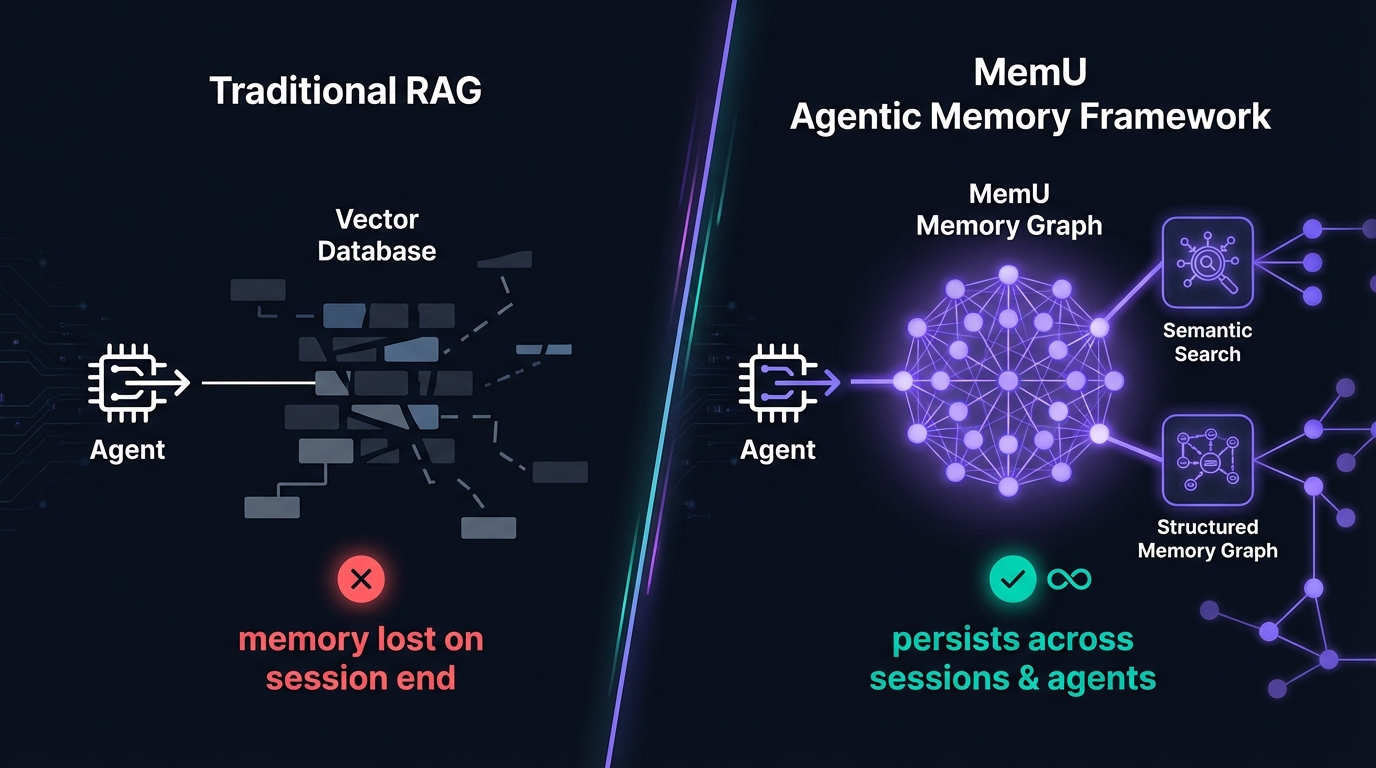
The MemU Agentic Memory Framework: Solution Memory for Code Agents
The MemU Agentic Memory Framework provides the persistent solution memory layer that code-generating agent frameworks need to avoid re-inventing solutions. Instead of treating each generated code block as ephemeral, MemU captures solution patterns, debugging strategies, API interaction recipes, and data transformation approaches in a structured memory graph that persists across sessions, agents, and projects.
Consider a CodeAgent used for data science workflows. Without persistent memory, each session starts with generic code generation — pandas transformations, matplotlib visualizations, and sklearn pipelines from training data. With the MemU Agentic Memory Framework, the agent retrieves solution memory: the custom date parser that handles a company's legacy timestamp format, the matplotlib styling function matching brand guidelines, the feature engineering pipeline that improved model accuracy by 12% on similar datasets last month. The agent retrieves proven implementations and adapts them to the current context.
The MemU Agentic Memory Framework addresses three limitations of memoryless code generation:
- Solution pattern persistence: When a CodeAgent discovers a working solution through generation, testing, and debugging, that pattern is captured with its context: what problem it solved, what edge cases it handles, and what alternatives failed. Future sessions retrieve proven solutions rather than regenerating from scratch.
- Debugging intelligence accumulation: Code agents learn through failure — a generated function fails, the error is analyzed, the code is revised. That debugging trajectory represents expensive intelligence. The framework captures error-to-resolution patterns, enabling agents to avoid known failure modes in future code generation.
- Cross-project code intelligence: Solutions discovered in one project often apply to others. A data transformation pattern that works for one client's financial data may apply to another client's similar dataset. Persistent memory enables transferring solution intelligence across projects while maintaining appropriate access boundaries.
A senior developer's value comes from the library of solutions they carry in their head — patterns proven across dozens of projects. The MemU Agentic Memory Framework gives CodeAgents that same compounding solution intelligence.
Head-to-Head: Stateless Code Generation vs. Memory-Enhanced Solution Agents
Without MemU: A lightweight, powerful code agent framework with approximately 1,000 lines of core logic, composable Python code generation, sandboxed execution, model agnosticism, and tool flexibility across MCP, LangChain, and custom implementations. CodeAgents write expressive Python that outperforms structured tool calling. But each session generates code from scratch — no recall of proven solutions, no debugging intelligence from prior sessions.
With MemU: The same minimal, powerful CodeAgent framework, now backed by persistent solution memory. Agents begin each session with accumulated code intelligence. The CSV parser that took three iterations to get right last week is retrieved in seconds. The API orchestration pattern handling rate limiting is recalled immediately. Code quality improves through accumulated solution experience that prevents re-inventing proven approaches.
For developers using the framework for recurring tasks — data processing pipelines, API integrations, report generation — the difference compounds rapidly. After six months, a memory-backed CodeAgent operates with the solution library of a developer who has been solving similar problems for years.
Empowering Smolagents: Better Together
The combination of the code-first agent framework and MemU's persistent memory creates capabilities that neither achieves independently:
- Progressive solution refinement: Persistent memory tracks not just solutions but their quality over time. When a CodeAgent retrieves a prior solution and the user provides feedback, the refined version updates the memory. Solutions evolve through accumulated usage, becoming more robust with each cycle.
- Collaborative code intelligence: When multiple developers use the framework with shared persistent memory, solutions discovered by one developer's agent become available to others. A data engineering pattern one team perfected propagates to other teams facing similar challenges.
- Sandbox-aware execution memory: Different execution environments — Docker, E2B, Modal, WebAssembly — have different capabilities and constraints. Persistent memory tracks which code patterns work best in each sandbox, enabling environment-optimized code generation.
Get Started with MemU
Smolagents has proven that powerful agent logic fits in 1,000 lines of code — CodeAgents that write Python, composable logic, sandboxed execution, and model agnosticism that has earned over 26,100 GitHub stars.
The next step is giving those CodeAgents persistent solution memory. Sessions where agents retrieve proven code patterns instead of generating from scratch. Projects where debugging intelligence compounds across hundreds of iterations.
The MemU Agentic Memory Framework provides that persistence layer. Solution pattern graphs for code retrieval, debugging intelligence accumulation, and cross-project code memory that transforms every CodeAgent session into compounding development expertise.
Visit memu.pro to explore the Agentic Memory Framework API, or check out the GitHub repository to start building agents that remember.
Tags: Smolagents, HuggingFace, CodeAgent, code generation, agent memory, MemU AI, LLM memory, Python agents