Sonnet 4.6 Doubles Context to 1 Million Tokens — But Large Context Windows Don't Replace Persistent Memory


Anthropic just made Claude Sonnet affordable with a million-token brain. Sonnet 4.6, released February 17, 2026, brings the 1 million token context window — previously available only on the premium Opus tier — to the most popular Claude model. At $3 per million input tokens and $15 per million output tokens, it's the most cost-effective way to process entire codebases, legal portfolios, or research libraries in a single request.
Users preferred Sonnet 4.6 over Sonnet 4.5 approximately 70% of the time, and some even preferred it over the previous flagship Opus 4.5. Benchmark improvements span coding consistency, instruction-following, computer use, and autonomous agent workflows. With 60.4% on ARC-AGI-2, Sonnet 4.6 punches well above its weight class in abstract reasoning.
A million tokens means 750,000 words in a single context. But there's a common misconception worth addressing: a larger context window is not the same as persistent memory.
Sonnet 4.6: What 1 Million Tokens of Context Actually Means
The 1M context window is genuinely useful for specific workloads. Loading an entire codebase into context enables whole-project analysis without chunking or RAG pipelines. Legal teams can compare dozens of contracts simultaneously. Research teams can synthesize entire literature reviews in one pass. The model processes everything at once, finding relationships and patterns across the full scope of provided material.
Sonnet 4.6's improvements in coding and instruction-following make this large context practically useful rather than theoretically impressive. The model maintains coherence across the full window — instructions given early in the context still influence behavior at the end. SWE-Bench scores and computer use capabilities demonstrate that Sonnet 4.6 acts effectively on what it reads, not just comprehends it.
But context is not memory. A million tokens represents what the model can process right now, in this session. It's working memory — like a desk covered with open documents. When the session ends, the desk is cleared. Tomorrow's session starts with an empty desk, regardless of how productively today's million tokens were used.
How Large Context Windows Create the Illusion of Memory
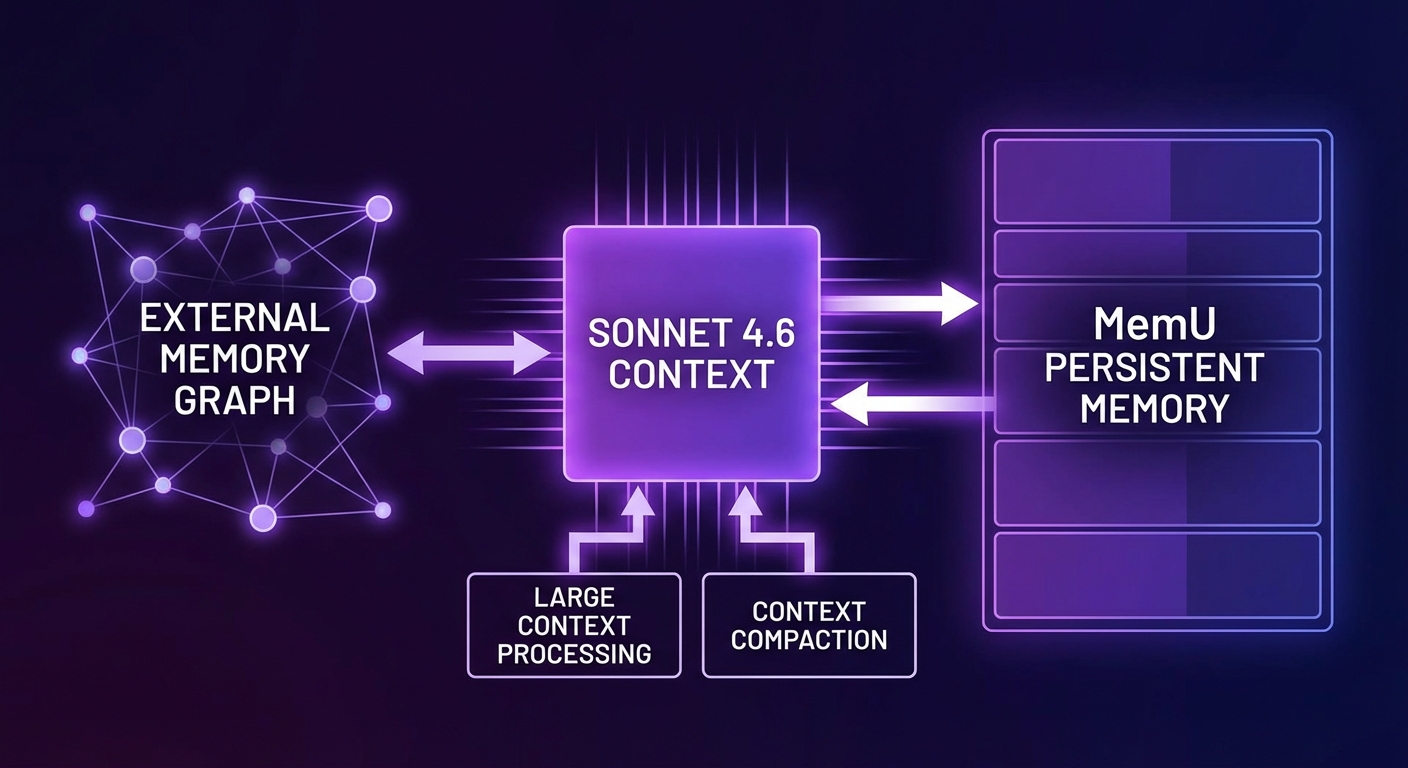
Large context windows enable impressive within-session capabilities that can feel like memory. Load a project's entire history and the model "remembers" decisions made months ago — because those decisions are in the current context. Provide a conversation history and the model "remembers" previous discussions — because those discussions are explicitly included.
This creates a practical workflow: maintain long transcripts, reload previous context, and approximate continuity through manual context management. Some teams build sophisticated context loading pipelines that reconstruct relevant history at the start of each session.
This approach has fundamental limitations. First, it's expensive — loading a million tokens of context every session has direct cost implications. Second, it's manual — someone (or some system) must decide what to include and exclude. Third, it doesn't scale — eventually, the relevant context exceeds even a million tokens. A team that has used Sonnet 4.6 daily for six months has generated far more relevant context than any window can hold.
The fourth limitation is subtlest: context loading provides information but not understanding. A million tokens of raw conversation history is less useful than a structured knowledge graph that captures the key decisions, patterns, and insights from those conversations. Memory requires not just storage but synthesis.
The MemU Agentic Memory Framework: Beyond Context Windows
The MemU Agentic Memory Framework provides what large context windows can't — persistent, synthesized, efficiently retrievable memory that grows over time without hitting window limits.
Consider a development team that has used Sonnet 4.6 daily for three months on a complex project. Hundreds of sessions have produced insights about the codebase architecture, debugging approaches, and team conventions. Loading all that context would exceed even a million tokens. With the MemU Agentic Memory Framework, those three months of insights are structured into a queryable knowledge graph — today's session retrieves the specific relevant context for the current task, not the entire history.
The architecture complements Sonnet 4.6's context window through three capabilities:
- Synthesized knowledge: Rather than raw conversation history, the MemU Agentic Memory Framework stores structured insights — decisions made, patterns discovered, approaches that worked. Memory is more useful than transcripts.
- Efficient retrieval: Instead of loading everything, MemU retrieves the relevant memories for the current task. This uses a fraction of the context window, leaving the rest available for actual work.
- Infinite timeline: Context windows have fixed limits. MemU's knowledge graph grows indefinitely. Three months of accumulated insights are as accessible as three days'.
MemU is what happens after you realize a million tokens still isn't enough for true continuity — structured memory that scales where context windows can't.
Head-to-Head: Large Context vs. Persistent Memory
Sonnet 4.6 alone: 1M token context window with excellent comprehension and reasoning. Powerful for single-session analysis. But context must be manually managed, history eventually exceeds the window, and the cost of reloading context every session is substantial.
Sonnet 4.6 + MemU: Same context window plus persistent structured memory. Relevant knowledge retrieved efficiently. Timeline extends indefinitely. Context budget focuses on current work rather than history reconstruction. Sub-100ms retrieval makes memory access imperceptible.
Get Started with MemU
Sonnet 4.6's million-token context window is a genuinely useful capability. For workloads that benefit from processing large document sets simultaneously, it's transformative. Anthropic has made this power accessible at Sonnet-tier pricing.
The MemU Agentic Memory Framework provides what context windows can't — persistent, synthesized, scalable memory. Use Sonnet 4.6's large context for analysis and MemU for continuity. Together, they create AI sessions that are both deeply contextual and genuinely persistent.
Visit memu.pro to explore the Agentic Memory Framework API, or check out the open-source repository on GitHub to start building persistent memory that goes beyond what context windows provide.