Speakeasy MCP Platform Manages Enterprise Tool Infrastructure — But Managing Servers Without Tracking Tool Usage Intelligence Means Infrastructure Without Insight


Speakeasy MCP Platform: What the Control Plane Gets Right and What It Misses
The Speakeasy MCP Platform addresses a problem that has quietly become one of the biggest obstacles to enterprise AI agent adoption: managing the MCP server infrastructure that gives agents their capabilities. As organizations move from single-agent experiments to fleet-scale deployments, the number of MCP servers — each exposing tools, data sources, and integrations to AI agents — multiplies rapidly. Without centralized management, enterprises face a sprawl of unsecured, unmonitored, and inconsistently configured tool endpoints.
Speakeasy's MCP Platform provides the control plane for this infrastructure. The platform builds, secures, and distributes MCP servers at enterprise scale with unified authentication that ensures every agent-tool interaction passes through proper identity verification. Role-based access controls determine which agents can invoke which tools — preventing a marketing automation agent from accessing financial data endpoints or a junior developer's agent from triggering production deployment tools.
The observability layer tracks agent-tool interactions across the entire MCP server fleet. Teams can see which tools are being called, how often, by which agents, and whether calls succeed or fail. The API-first design means the platform integrates into existing enterprise infrastructure — CI/CD pipelines, monitoring stacks, identity providers — rather than requiring organizations to rebuild around it. For enterprises managing dozens or hundreds of MCP servers across multiple teams and agent frameworks, Speakeasy provides the governance layer that was previously impossible without custom engineering.
But governance is not intelligence. And infrastructure management is not infrastructure learning.
What Speakeasy MCP Platform Does With Tool Usage Memory Today
The Speakeasy MCP Platform observes everything. Authentication logs record every agent identity verification. Access control decisions are tracked. Tool invocation metrics flow into the observability layer — call counts, latency distributions, error rates. For compliance and operational monitoring, the platform provides genuine visibility into how agents interact with enterprise tool infrastructure.
What the platform does not do is learn from those observations. The observability layer reports that Tool A was called 10,000 times last week with a 3% error rate. It does not extract that Tool A's errors cluster around specific parameter combinations that agents consistently get wrong. It does not recognize that agents calling Tool A before Tool B achieve better outcomes than those calling them in reverse order. It does not surface that the marketing team's agents use a tool composition pattern that could benefit the sales team's agents operating on similar data.
Speakeasy manages MCP servers as infrastructure — endpoints to authenticate, authorize, and monitor. But tools are more than endpoints. Tools are capabilities with usage patterns, effectiveness profiles, and composition strategies that emerge from thousands of agent interactions. A platform that manages tool access without preserving tool usage intelligence is like a library system that tracks book checkouts but never learns which books help readers solve which problems.
At enterprise scale, this gap compounds. Organizations with fifty MCP servers and hundreds of agents generate massive volumes of tool usage data that Speakeasy faithfully records and reports. But the intelligence embedded in that data — which tool sequences produce the best outcomes, which parameter patterns cause failures, which tool combinations unlock capabilities that individual tools cannot — remains unextracted and unavailable to the agents themselves.
The MemU Agentic Memory Framework: Tool Intelligence That Compounds
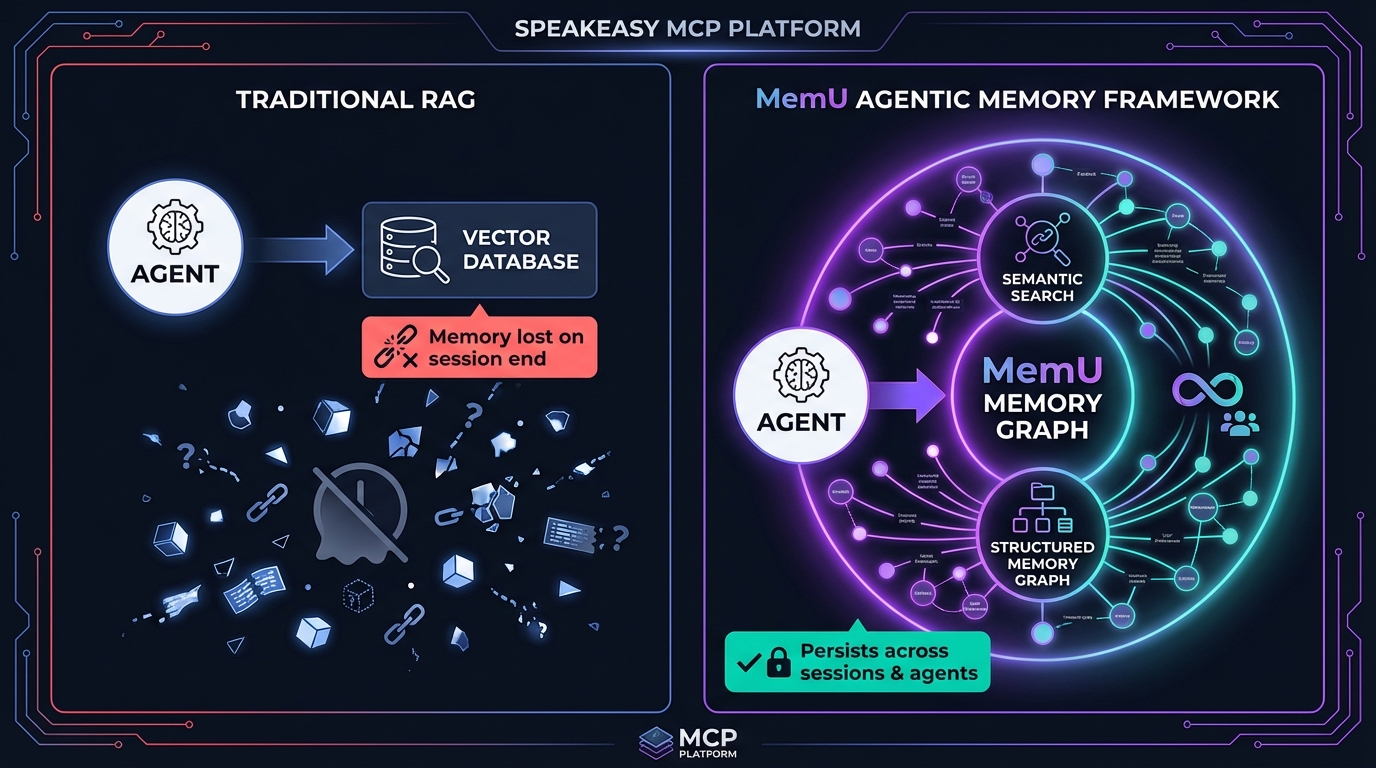
The MemU Agentic Memory Framework provides the persistent tool usage intelligence layer that MCP infrastructure platforms like Speakeasy lack. Where Speakeasy manages tool access and observability, MemU extracts and preserves the knowledge embedded in tool usage patterns.
Managing tool infrastructure ensures agents can access the right capabilities. Remembering how agents use those capabilities — which patterns work, which fail, which compose effectively — is what turns infrastructure into intelligence. Enterprise MCP deployments need both governance and memory.
Consider an enterprise's MCP fleet where agents interact with CRM, ERP, and communication tools. With the MemU Agentic Memory Framework, the system learns that updating a CRM contact record before querying the ERP for that contact's order history produces 40% more accurate results than the reverse order. When a new agent on a different team accesses the same MCP servers, it inherits that usage pattern immediately — no rediscovery required.
The MemU Agentic Memory Framework integrates via REST API alongside any MCP management layer. Key capabilities for enterprise tool infrastructure:
- Tool effectiveness profiling: Beyond call counts and error rates, MemU tracks which tool invocation patterns correlate with successful task outcomes. Agents learn not just that a tool exists but how to use it effectively based on accumulated organizational experience.
- Composition pattern memory: When agents discover effective multi-tool sequences — calling three MCP tools in a specific order with specific parameter transformations between them — those patterns persist as retrievable strategies for any agent with similar task requirements.
- Cross-team intelligence sharing: Tool usage insights discovered by one team's agents automatically benefit other teams' agents through the shared memory graph. The sales team's agent learns from the marketing team's successful CRM integration patterns without explicit knowledge transfer.
Head-to-Head: MemU vs. Speakeasy MCP Platform Alone
Speakeasy MCP Platform alone: Comprehensive enterprise governance for MCP server fleets. Unified authentication, role-based access control, observability, and API-first integration. The platform solves the infrastructure management problem — ensuring agents access the right tools securely and that teams have visibility into tool usage. But observability is not intelligence. The platform records tool interactions without learning from them. Each agent discovers effective usage patterns independently, with no mechanism for preserving or sharing that operational knowledge across the MCP server fleet.
Speakeasy + MemU Agentic Memory Framework: The same enterprise governance, now enriched with persistent tool usage intelligence. Every agent-tool interaction feeds a knowledge graph of effectiveness patterns. Successful tool compositions persist. Cross-team insights compound. MCP infrastructure transforms from managed endpoints into intelligent capabilities that get easier and more effective to use as organizational experience accumulates.
Empowering Speakeasy: Better Together
Combining Speakeasy's governance layer with the MemU Agentic Memory Framework creates an enterprise AI tool infrastructure that neither system delivers independently:
- Intelligent tool routing: When an agent needs a capability, MemU surfaces not just which MCP server provides it but the optimal invocation pattern based on historical effectiveness data. Speakeasy authenticates and authorizes; MemU guides the how.
- Proactive error prevention: The memory graph identifies parameter combinations and tool sequences that historically produce errors. Before an agent invokes a tool with a known problematic pattern, the system can suggest corrections — reducing the 3% error rate that observability merely reports.
- Usage-informed access policies: Speakeasy's role-based access controls can be informed by MemU's usage intelligence. If certain tool combinations create security risks or produce unreliable results, access policies can evolve based on accumulated operational evidence rather than static rules.
- Tool capability evolution: As MemU accumulates knowledge about how agents use MCP tools, patterns emerge that inform tool development. Teams building new MCP servers can reference the memory graph to understand what capabilities agents actually need and which existing tool APIs create friction.
Get Started with MemU
The Speakeasy MCP Platform delivers the enterprise governance layer that AI agent tool infrastructure demands — authentication, authorization, observability at fleet scale. What it doesn't deliver is learning from the tool interactions it manages. The MemU Agentic Memory Framework adds the intelligence layer that transforms MCP server management from infrastructure administration into compounding organizational capability.
Visit memu.pro to explore the Agentic Memory Framework API, or check out the GitHub repository to give your enterprise agent infrastructure the tool usage memory it needs to get smarter with every interaction.
Tags: Speakeasy, MCP Platform, enterprise AI agents, agentic memory, MCP server management, tool usage intelligence, agent memory, MemU AI