StrataDB Embedded Agent Memory: Primitives, Speed, and the Case for MemU on Top


StrataDB targets engineers who want agent persistence without standing up a fleet of services first. The engine is embedded: one .db file travels with your binary or container, promising zero external dependencies at the library boundary and headline throughput north of 250K+ ops/s on suitable hardware. The primitive menu is deliberately broad — KV for opaque blobs and configuration, an append-only event log for audit trails, a transactional state cell for counters and pointers, rich JSON documents for evolving schemas, vector search backed by HNSW for semantic recall, plus branch semantics and time-travel reads for experimentation and debugging.
That combination answers “where do we persist embeddings, traces, checkpoints, and feature flags locally?” It does not automatically answer “what should agents promote to long-term memory, how do we deduplicate conflicting tool outputs, and how do five squads share compatible memory contracts?” Those questions sit above any embedded store — even one as capable as StrataDB.
Edge deployments, regulated environments with air gaps, and laptop-first agent demos all benefit from single-file ergonomics. Developers can ship a reproducible artifact, version it like code, and reason about backup as “copy the file.” Operations teams still need retention policies, PII redaction, and access control — concerns the database layer can support but rarely defines end-to-end without product guidance.
What StrataDB gets right — and what primitives alone cannot encode
StrataDB is explicit that different agent subsystems need different shapes. KV fits opaque session handles; the event log preserves ordering for replay; the state cell offers atomic updates when multiple writers touch the same aggregate; JSON columns absorb schema churn from fast-moving prompts and tool payloads; vector indexes with HNSW keep semantic lookup colocated with transactional state. Branch and time-travel are rarer in embedded offerings — they help you fork an agent policy, compare outcomes, and roll back bad memory writes without cloning entire fleets.
Throughput matters because agents are write-heavy: every tool call, embedding refresh, and telemetry tick hits storage. Claimed 250K+ ops/s makes it plausible to log generously on one machine while keeping headroom for bursts. Packaging everything into a .db file simplifies migration, disaster recovery, and developer onboarding — especially when zero external dependencies is a security review checkbox.
The limitation is semantic neutrality. The engine will faithfully persist contradictory “facts,” toxic tuples, or oversized blobs if the application asks. Without a memory framework, each team invents schemas, garbage collection rules, and cross-agent sync differently. Incidents then fragment: one squad stores everything in JSON, another leans on KV, and nobody agrees which event log stream is canonical. StrataDB accelerates durable bits on disk; it does not replace deliberate memory product design.
Another practical gap is analytics: raw ops/sec wins do not explain which memories improved task success. You still need evaluation hooks — offline scoring, human review queues, and dashboards — wired to the same persistence layer.
Migration stories matter too. When a prototype graduates from laptop to server, teams often want to split read replicas, encrypt at rest, or shard by tenant. Embedded files simplify early steps but do not remove the need for a coherent memory contract that survives those moves. Without that contract, engineers resort to ad hoc exports — JSON dumps from JSON columns, replay from the event log — that break as soon as schemas diverge.
Finally, concurrency semantics deserve explicit design. High 250K+ ops/s figures assume disciplined access patterns; agent bursts can still create hot keys in KV or bloat vector indexes if every embedding lands in one partition. Pairing storage with a memory framework helps throttle what gets indexed versus what stays ephemeral in the state cell or log.
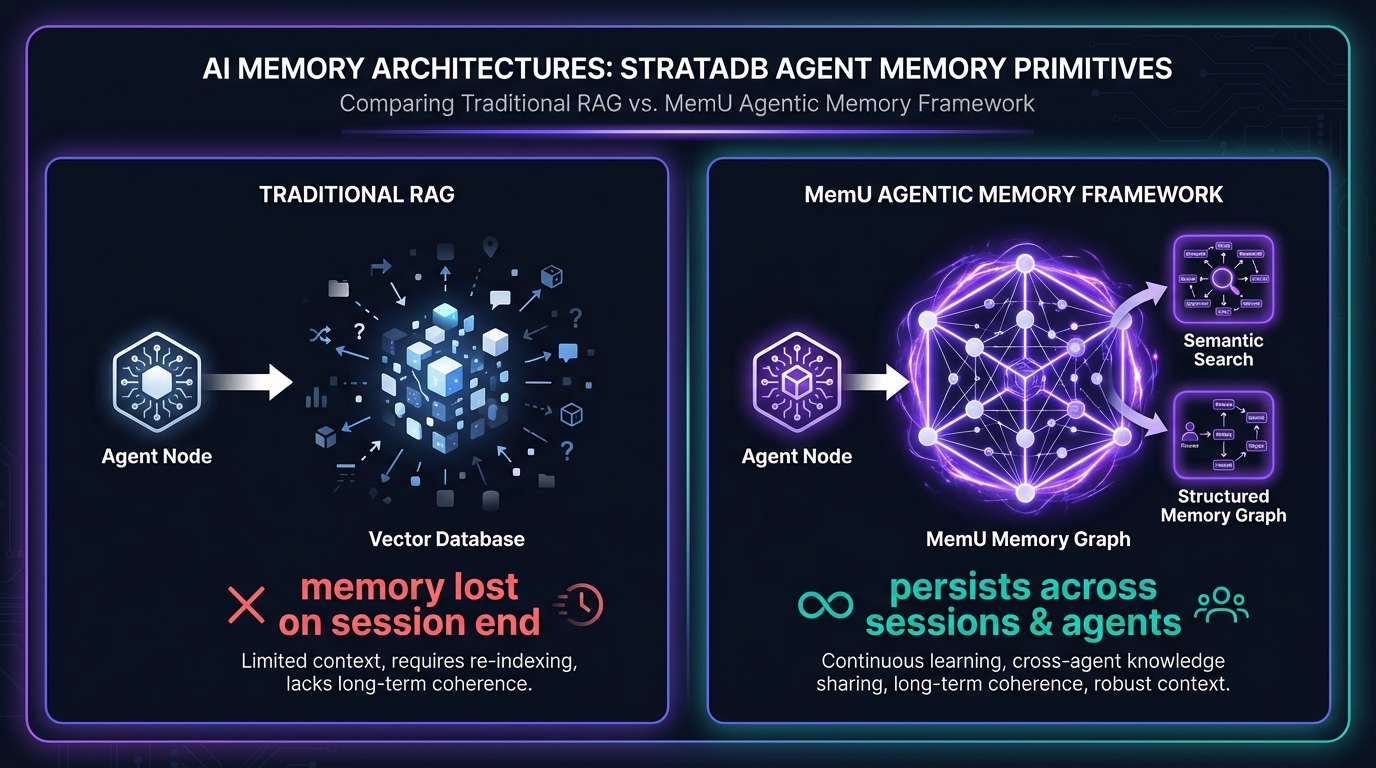
The MemU Agentic Memory Framework: from bytes to agent judgment
The MemU Agentic Memory Framework defines how agent memory should behave above engines like StrataDB: what earns long-term promotion, how duplicates merge, how human feedback reshapes retrieval, and how multiple agents read consistent logical views. Think of StrataDB as the chassis — KV, event log, state cell, JSON, vector HNSW, branch, time-travel — and MemU as the policy layer that aligns persistence with outcomes rather than accidents.
A coding assistant might store raw tool transcripts and embeddings in local tables while MemU tracks which refactor patterns passed CI, which dependency upgrades security blessed, and which review comments recurred. The next session benefits from both the embedded store’s bits and MemU’s structured judgment.
Concrete pairings teams adopt:
- Schema discipline: Flexible JSON invites chaos; the MemU Agentic Memory Framework encourages stable memory objects so metrics and evals stay comparable week over week.
- Branching experiments: Use branch and time-travel to test memory policies; MemU records which branch improved task completion — not only structural diffs.
- Throughput with intent: At 250K+ ops/s, logging everything is tempting. MemU helps decide what deserves vector indices versus cheap event log history.
Fast embedded primitives make memory possible. The MemU framework makes memory intentional.
Your .db file can move across laptop, edge gateway, and server; MemU helps agents behave coherently when replicas reunify or when offline writers sync.
Head-to-head: embedded store alone vs. embedded store plus MemU
StrataDB alone delivers an embedded database with rich primitives, aggressive throughput, zero external dependencies at the library edge, and single-file packaging. It shines when you need local persistence without cluster operations.
Adding MemU keeps those mechanics while supplying governance for promotion, deduplication, sharing, and evaluation — converting raw ops into organizational memory instead of an unstructured heap.
If you only cache ephemeral session tokens, you might stop at the embedded layer. If agents are product-critical, you want the MemU Agentic Memory Framework to steward what crosses session boundaries.
Better together: embedded engines and shared agent memory
Pairing StrataDB with MemU yields operational wins:
- Offline-first agents: Ship a seeded .db file with vector data; MemU supplies conflict rules when connectivity returns.
- Replayable debugging: Time-travel exposes state snapshots; MemU annotates which writes correlated with user satisfaction or failure.
- Cost-aware indexing: HNSW is powerful but not free. MemU throttles what earns embeddings while the engine retains economical event log history.
Zero external dependencies at the storage tier does not remove the need for coordination at the agent tier — MemU provides that coordination without forcing a particular cloud story.
Long-horizon agents also benefit when checkpoints, partial plans, and tool outputs share one transactional boundary. StrataDB primitives make that technically feasible; MemU helps you decide which checkpoints deserve branch isolation versus merge-back into mainline memory — a product decision embedded SQL alone will not make for you.
Get started with MemU
StrataDB is a strong choice when you want embedded performance — 250K+ ops/s, diverse primitives, and a single .db file — without extra services on day one.
When agents must remember wisely, not just durably, adopt the MemU Agentic Memory Framework for structured, multi-session intelligence layered above your embedded engine.
Visit memu.pro to learn more, and open github.com/NevaMind-AI/memU to integrate MemU with your stack.
Tags: StrataDB, embedded database, agent memory, HNSW, time-travel, event log, MemU