Stripe Agent Toolkit Gives AI Agents Payment APIs — But Processing Payments Without Transaction Memory Means Agents Never Learn Customer Billing Patterns


The Stripe Agent Toolkit is transforming how AI agents interact with commerce infrastructure. Rather than requiring developers to manually wire up payment flows, the toolkit provides pre-built integrations that let AI agents create Payment Links, manage subscriptions, handle usage-based billing through the Meter API, and process refunds — all autonomously. With native support for OpenAI Agents SDK, Vercel AI SDK, LangChain, and CrewAI in both Python and TypeScript, it meets agents wherever they're built. Security is handled through restricted API keys (rk_*) that scope exactly what each agent can access. As of March 2026, the toolkit is under active development with benchmarking tools for evaluating how well agents handle real integration scenarios.
But the toolkit gives agents the ability to process payments without the ability to remember payment patterns. An agent that created a subscription for a customer who churned after two billing cycles has no way to recall that outcome when setting up the next similar customer. Payment-processing agents without billing memory repeat failed pricing strategies, miss upsell timing, and cannot build the customer financial intelligence that drives revenue optimization.
Stripe Agent Toolkit: What the Industry Gets Right (And What's Missing)
The design philosophy is well-considered. By providing framework-specific integrations — dedicated packages for OpenAI, Vercel, LangChain, and CrewAI — the toolkit ensures agents interact through idiomatic interfaces rather than raw HTTP calls. The restricted API key system (rk_*) is particularly thoughtful: organizations can issue keys that grant an agent permission to create Payment Links but not issue refunds, or allow subscription management but not direct charges. This granular permission model addresses legitimate security concerns about autonomous agents handling real money.
The framework coverage is also comprehensive. The toolkit supports the full breadth of payment primitives — one-time charges, recurring subscriptions, usage-based metering, invoicing, and Payment Links. For developers building AI-powered customer service agents or billing management systems, it provides turnkey access to payment operations that previously required extensive custom integration.
What the toolkit does not provide is transaction intelligence that persists across sessions. Every time the agent processes a payment, it treats the event as isolated. An agent that discovered quarterly billing reduces churn by 40% for a specific customer segment last month cannot apply that insight to new customer onboarding today. A support agent that processed three refund requests from the same customer for the same reason has no way to flag the underlying product issue. The toolkit processes transactions; it does not build billing intelligence.
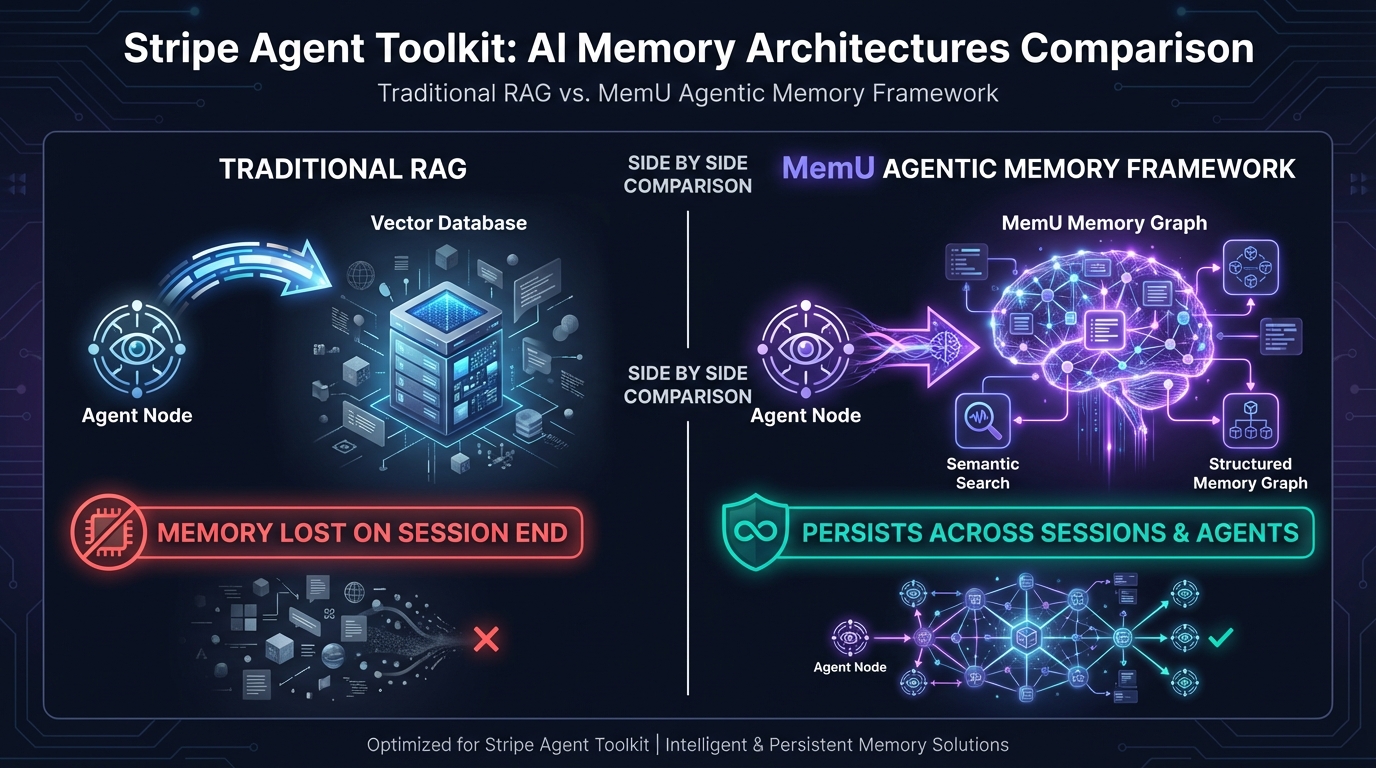
The MemU Agentic Memory Framework: Billing Intelligence for Payment Agents
The MemU Agentic Memory Framework provides the persistent memory layer that payment toolkits do not include natively. Instead of treating each payment operation as an isolated API call, MemU captures billing context — subscription outcomes, customer payment behaviors, pricing strategy results, churn signals — and stores them in a structured memory graph that persists across sessions and organizational billing operations.
Consider an AI sales agent using the toolkit to set up subscriptions. Without persistent memory, the agent applies default pricing and billing frequency to every customer. With the MemU Agentic Memory Framework, the agent recalls billing intelligence: enterprise customers in healthcare consistently prefer annual billing with net-30 invoicing, reducing payment failures by 60%. SaaS startups under 50 employees churn 3x more on monthly plans than quarterly. Customers who receive a prorated first month have 25% higher 6-month retention.
The framework addresses three critical gaps in memoryless payment agents:
- Customer billing pattern memory: Every subscription created, invoice paid or missed, refund processed, and plan upgrade completed is stored with contextual metadata — building a customer financial history that enables personalized billing approaches based on observed patterns.
- Pricing strategy outcome tracking: When agents offer discounts, adjust billing cycles, or create custom Payment Links, persistent memory tracks results. Agents learn which pricing structures drive conversion, which cause confusion, and which billing frequencies minimize involuntary churn.
- Cross-agent billing intelligence: Organizations deploying multiple agents with payment access — sales, support, billing automation — need shared context. The MemU Agentic Memory Framework ensures a support agent processing a refund knows the customer's full billing history without cross-agent synchronization infrastructure.
Giving agents payment APIs without billing memory is like giving a sales team invoicing software but erasing their CRM every night. The MemU Agentic Memory Framework ensures every payment operation contributes to intelligence that makes future transactions smarter.
Integration with payment workflows uses MemU's REST APIs. Before creating a subscription, the agent queries stored billing history for customer-segment insights. After payment events — successful charges, failed payments, cancellations — the context and outcome are stored. The memory layer operates alongside the payment toolkit, adding billing intelligence without modifying the transaction flow.
Head-to-Head: Stateless Payment Agents vs. Memory-Enhanced Billing Intelligence
Stripe Agent Toolkit alone: Comprehensive payment API integration enabling AI agents to process charges, manage subscriptions, handle metered billing, and create Payment Links across major agent frameworks. Restricted API keys provide granular security. But every payment operation is independent — no learning from billing outcomes, no customer pattern recognition, no pricing strategy optimization.
Stripe Agent Toolkit + MemU: The same powerful payment APIs, now backed by persistent billing memory. Subscription setup decisions are informed by historical churn data for similar customer profiles. Refund processing considers the customer's full billing relationship. Pricing strategies are evaluated against accumulated outcome data. Payment agents become billing intelligence systems.
For organizations processing thousands of subscriptions monthly, even modest improvements in churn reduction or payment failure prevention compound into significant revenue improvements when applied across the entire customer base.
Stripe Agent Toolkit + MemU: Better Together
The combination of the toolkit's payment infrastructure and the MemU Agentic Memory Framework's persistent memory creates billing capabilities neither achieves independently:
- Predictive churn intervention: Agents with billing memory recognize pre-churn signals — late payments increasing in frequency, support ticket volume rising, usage declining — and proactively offer retention-optimized pricing before cancellation.
- Revenue-optimized onboarding: New customer subscription setup draws on outcomes from similar customers across the organization's history. Agents recommend billing frequencies and plan structures that historical data shows maximize lifetime value.
- Intelligent dunning and recovery: When payments fail, agents with persistent memory know whether this is a first-time failure from a reliable payer or part of a declining pattern — tailoring recovery strategies from immediate retry to proactive outreach with alternative payment options.
Persistent memory transforms the toolkit from a payment execution layer into a billing intelligence platform — where every charge, subscription, and refund makes every future billing decision more informed.
Get Started with MemU
The Stripe Agent Toolkit represents essential infrastructure for AI-powered commerce — enabling agents to manage billing operations autonomously across major agent frameworks. As businesses deploy AI agents for customer-facing financial operations, robust payment APIs become foundational.
The next step is giving those payment agents billing memory — agents where subscription decisions reflect historical churn patterns, where pricing strategy outcomes are tracked across every interaction, and where financial intelligence compounds with every transaction processed.
The MemU Agentic Memory Framework provides that foundation. Drop-in API integration alongside payment workflows, dual-mode retrieval with semantic search and structured memory graphs, and cross-session persistence that turns payment operations into compounding billing intelligence.
Visit memu.pro to explore the Agentic Memory Framework API, or check out the GitHub repository to start building payment agents that remember.
Tags: Stripe Agent Toolkit, AI agent payments, agentic AI, agent memory, MemU AI, LLM memory, billing intelligence