Supabase for Agents Unifies Backend Infrastructure with MCP, Vectors, and Auth — But Vector Search Alone Is Not Persistent Agent Memory

Supabase has positioned itself as the unified agent backend infrastructure for AI-native applications, consolidating memory storage, vector search, authentication, file management, and API layers into a single Postgres-based platform. The offering includes a native MCP server with full read-write operations, pgvector for semantic similarity search, automatic embedding generation via database triggers and queues, Row Level Security for granular access control, and SOC 2 Type II compliance. Developers get an AI Assistant in the dashboard, Edge Functions powered by Deno for serverless compute, and client libraries across JavaScript, Python, Swift, and Flutter. For teams building agent-powered applications, Supabase eliminates the multi-vendor infrastructure sprawl that typically accompanies agentic deployments — authentication from one provider, vectors from another, storage from a third — by consolidating everything behind a single Postgres connection string.
But infrastructure consolidation and agent memory are fundamentally different capabilities. Agent backend infrastructure that provides vector search does not automatically provide the semantic structure, temporal awareness, and cross-session intelligence that genuine persistent agent memory demands. Similarity search finds what is close in embedding space. Agent memory understands what matters in context.
Agent Backend Infrastructure: What Supabase Gets Right (And What It Misses)
Supabase's approach to the agent backend infrastructure problem is architecturally elegant. By building everything on Postgres, the platform leverages decades of database engineering — ACID transactions, proven replication, battle-tested backups — while adding the AI-specific capabilities modern agent applications require. pgvector turns Postgres into a vector database without requiring a separate Pinecone, Weaviate, or Qdrant deployment. Row Level Security extends Postgres's native permission model to agent data, enforcing multi-tenant data isolation at the database level rather than relying on error-prone application-level access checks.
The automatic embedding pipeline is particularly well-designed. When a new record is inserted, a database trigger places it into a processing queue, a background worker generates the embedding, and the result is written back to the row. Developers get semantic search without building or maintaining an embedding pipeline — the database handles it transparently, eliminating an entire category of operational complexity.
The native MCP server adds another layer of agent-readiness. Agents read from and write to Supabase through the Model Context Protocol, rapidly becoming the standard interface for tool-using agents. Combined with Edge Functions for serverless compute, Supabase provides complete agent backend infrastructure covering data storage, vector retrieval, authentication, file management, and custom logic with SOC 2 Type II compliance.
What Supabase provides is infrastructure. What it does not provide is an intelligence layer. pgvector performs nearest-neighbor search across embedding vectors — finding documents, memories, or records that are semantically similar to a query vector. But similarity is not the same as relevance. A vector search returns items that are close in embedding space regardless of temporal context, causal relationships, or the agent's accumulated understanding of what matters. An agent retrieving memories needs more than cosine similarity — it needs to distinguish current project context from archived data, current best practices from deprecated approaches, and validated outcomes from flagged problems. Agent memory is inherently structured, temporal, and contextual — dimensions vector similarity alone cannot capture.
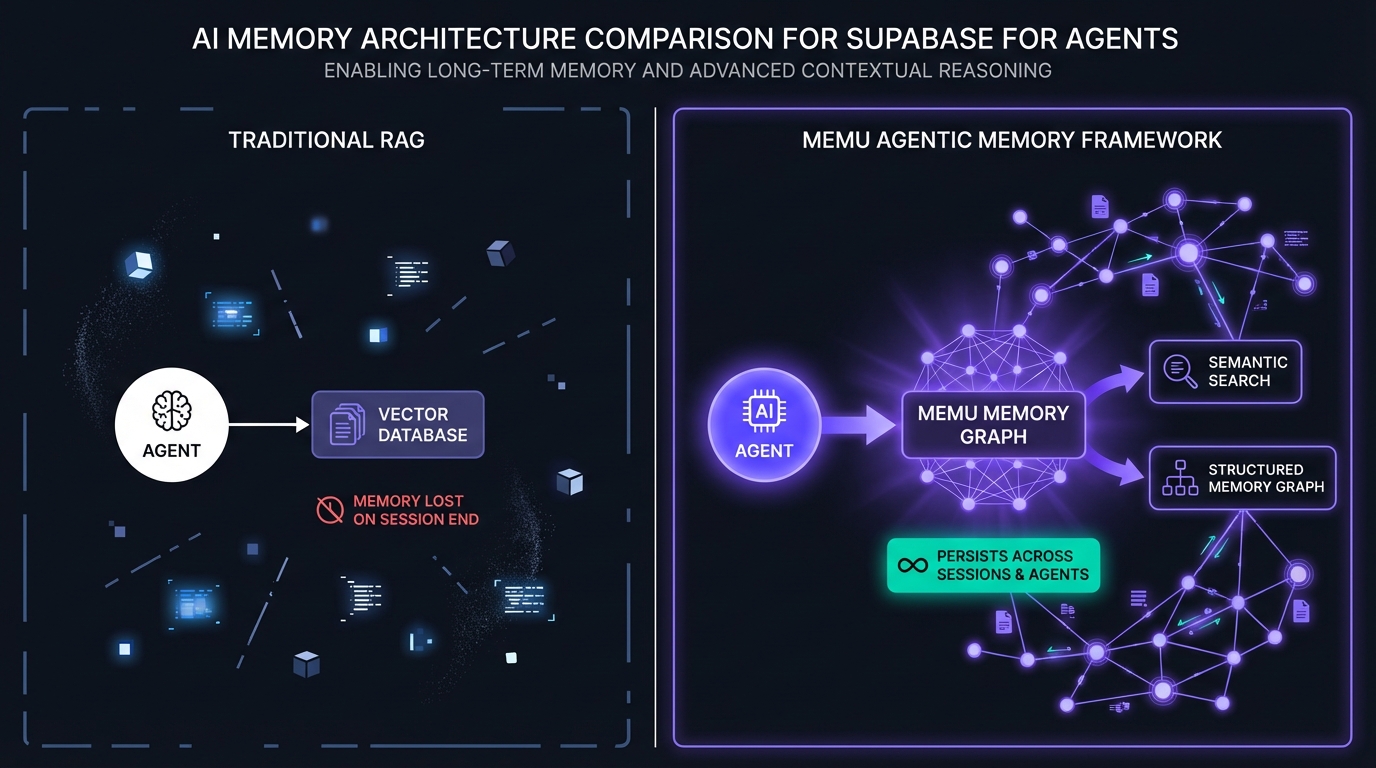
The MemU Agentic Memory Framework: Persistent Agent Memory on Any Backend
The MemU Agentic Memory Framework provides the intelligence layer that transforms agent backend infrastructure into genuine agent memory. Where Supabase delivers the storage, authentication, and retrieval primitives, MemU delivers the semantic structure, temporal awareness, and cross-session persistence that turn stored data into actionable agent intelligence.
Consider a customer support agent backed by Supabase. Using pgvector alone, the agent retrieves past support tickets similar to the current query based on embedding similarity. With MemU, the agent also recalls that this specific customer escalated a similar issue three months ago, that the resolution involved a workaround documented in ticket #4521 that was later superseded by a permanent fix in version 2.3, and that the customer expressed frustration with being asked to repeat information. The vector search finds similar tickets; the memory layer provides the full contextual intelligence that transforms a generic similarity match into a personalized, informed response.
The MemU Agentic Memory Framework adds capabilities that complement Supabase's infrastructure strengths:
- Structured knowledge graphs: Beyond vector similarity, MemU maintains entity relationships, causal chains, and hierarchical knowledge structures that agents query to understand not just what is similar but how things are connected. Customer histories and decision trees are represented as navigable graphs, not flat embedding arrays.
- Temporal memory management: Memories carry temporal metadata — creation time, last access, confidence decay, and validity windows. An agent retrieving context about a software version knows whether that context reflects the current release or an outdated one. Supabase stores timestamps on rows; MemU makes temporal awareness a first-class retrieval dimension that shapes which memories surface and how they are weighted.
- Cross-session persistence with semantic compression: As memory volumes grow, MemU automatically compresses older memories into higher-level abstractions while preserving access to original details when needed. An agent does not need to re-read every past support ticket — it accesses a compressed understanding of common issue patterns, customer preferences, and resolution strategies that represents the distilled intelligence of thousands of interactions.
Vector search finds what is similar. The MemU Agentic Memory Framework finds what matters — building on semantic similarity with the temporal awareness, structural understanding, and cross-session persistence that genuine agent memory requires.
Head-to-Head: Supabase pgvector vs. Dedicated Agent Memory
Supabase pgvector alone: Agents retrieve semantically similar records from the vector store for each query. Every session begins by re-searching the vector index with no awareness of what previous sessions retrieved, what worked, or what the agent learned from prior interactions. The agent backend infrastructure is solid, but the intelligence layer is absent — agents are stateless consumers of a stateful database, unable to accumulate understanding beyond what raw embedding proximity provides.
Supabase + MemU Agentic Memory Framework: Agents access structured, temporally-aware memories enriched with relationship graphs, outcome histories, and confidence scores. pgvector handles base-level similarity retrieval while MemU layers contextual intelligence on top — delivering results that reflect operational relevance, not just semantic proximity. The agent backend infrastructure becomes genuinely intelligent, with each interaction building upon the last.
Compared to other agent backend infrastructure options — Firebase with Vertex AI, PlanetScale with separate vector stores, Neon with pgvector — Supabase offers the most complete consolidated backend. But all these platforms provide storage without agent memory. Adding MemU bridges that gap, creating a stack where backend consolidation and intelligence persistence work together.
Empowering Supabase: Better Together
MemU does not replace Supabase — it elevates every infrastructure primitive Supabase provides:
- Vector search enhancement: pgvector delivers fast nearest-neighbor retrieval; MemU enriches retrieved results with contextual metadata, temporal relevance scores, and relationship data — transforming raw similarity matches into contextually intelligent recall that agents can act on with confidence.
- MCP integration: Supabase's native MCP server provides read-write data access for agents; the MemU Agentic Memory Framework adds a memory-aware MCP layer that lets agents read and write structured memories through the same protocol — unifying data access and memory access under a single interface agents already understand.
- Auth-scoped memory: Row Level Security governs data access at the database level; MemU extends this governance to agent memory — ensuring that multi-tenant agents maintain strict memory isolation per user, per organization, or per security scope, with the same RLS policies that protect transactional data.
Get Started with MemU
Give your Supabase-powered agents the persistent memory they need to transform agent backend infrastructure from capable storage into compounding intelligence. The MemU Agentic Memory Framework works with any backend — Supabase, Firebase, custom Postgres — one API, instant persistence, zero infrastructure migration required. Visit memu.pro to explore the Agentic Memory Framework API, or check out the GitHub repository to start building agents that remember.
Tags: Supabase, agent backend infrastructure, pgvector, MCP server, vector search, Row Level Security, persistent agent memory, agentic memory, MemU AI