Synter Emerges From Stealth With AI Agent Orchestration for Paid Media — But Campaign Agents Without Memory Cannot Compound Cross-Client Intelligence


Synter AI Agent Paid Media: What Campaign Orchestration Gets Right and What It Misses
Synter AI agent paid media orchestration emerged from stealth on March 9, 2026, with early results that demand attention: over $2M in pipeline generated, 11X return on ad spend, administrative time slashed from 60% to 20% of campaign managers’ workdays, and 3X iteration velocity on creative and audience testing. In benchmark testing, the platform delivered 133% CTR improvement, 46% CPA reduction, 81% ROAS improvement, and campaign launch timelines compressed from 14 days to just 2.
The platform transforms paid media campaign management through natural language commands. Media buyers type directives like “Pause campaigns with CPA over $150” or “Shift 20% of budget from underperforming ad sets to top converters” and Synter’s AI agents execute across Google Ads, Meta, LinkedIn, Microsoft Advertising, Reddit, The Trade Desk, and StackAdapt via official APIs. Budget pacing, conversion tracking, audience syncing, and competitive research happen through conversational interfaces rather than platform-by-platform manual operations.
For paid media teams drowning in multi-platform complexity, Synter delivers genuine operational leverage. The agent layer abstracts the mechanical work — bid adjustments, budget reallocation, audience exclusion list management — and lets strategists focus on strategy. Campaign iteration that previously required hours of cross-platform clicks now takes minutes of natural language instruction.
But operational speed is not operational intelligence. And the distinction becomes critical when agencies manage campaigns across dozens of clients in the same verticals.
What Synter Does With Campaign Intelligence Today
The Synter AI agent paid media platform optimizes campaigns in real time. Its agents monitor performance metrics, execute budget adjustments, pause underperformers, and scale winners — all based on current campaign data and the directives media buyers provide. The feedback loop between performance signals and agent actions is tight and responsive.
What the platform does not preserve is the accumulated intelligence from those optimization cycles. When a paid media agent discovers that B2B SaaS campaigns on LinkedIn perform 40% better with job-title targeting than company-size targeting during Q1 budget cycles, that insight lives only in the current session. The next quarter’s campaign starts without it. When the agent learns that Meta campaigns for e-commerce clients see diminishing returns above $500 daily spend on lookalike audiences during holiday seasons, that knowledge evaporates when the campaign concludes.
For a single campaign, this is a minor inefficiency. For an agency running 50 client accounts across six ad platforms, the compounding loss is staggering. Every client onboarding repeats discovery cycles that previous clients already paid for. Every seasonal campaign re-learns patterns that were clear in the previous year’s data. Every new media buyer on the team starts from zero rather than inheriting the collective optimization intelligence of their predecessors.
The competitive landscape — Adept for media buying, Pencil for creative optimization, Smartly.io for creative automation — shares this limitation. Paid media AI agents optimize in the moment without preserving the strategic patterns that emerge over time. They are fast but amnesiac.
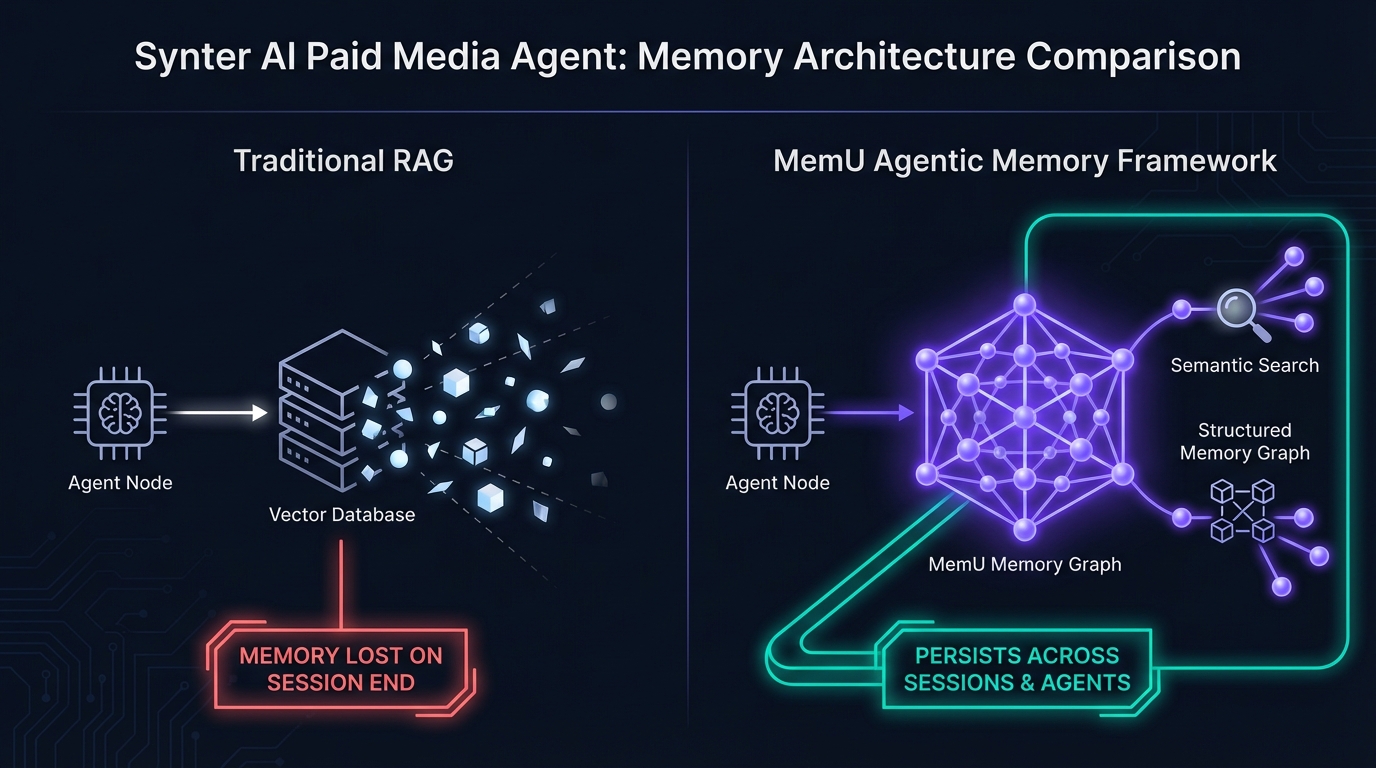
The MemU Agentic Memory Framework: Campaign Intelligence That Compounds
The MemU Agentic Memory Framework provides the persistent campaign intelligence layer that paid media agent platforms like Synter lack. Where Synter executes optimization decisions in real time, MemU captures, structures, and retrieves the strategic patterns embedded in those decisions across clients, platforms, and time periods.
A paid media agent that optimizes 1,000 campaigns but remembers none of them is perpetually a junior buyer. The MemU Agentic Memory Framework gives media agents the accumulated intelligence of every campaign they have ever managed — turning execution speed into strategic depth.
Consider an agency managing SaaS clients across Google Ads and LinkedIn. With the MemU Agentic Memory Framework, when a new SaaS client onboards, the campaign agent immediately retrieves that similar companies achieved optimal CPA by front-loading brand search campaigns in weeks 1-2 before scaling non-brand terms, that LinkedIn InMail ads outperformed sponsored content for director-level targeting in this vertical, and that Meta retargeting windows shorter than 7 days consistently underperformed. The new campaign launches with months of accumulated vertical intelligence from day one.
The MemU Agentic Memory Framework integrates via REST API alongside any campaign management system. Key capabilities for paid media operations:
- Cross-client pattern memory: Optimization patterns discovered across one client’s campaigns inform strategy for similar clients. Vertical-specific intelligence — what works for fintech demand gen versus e-commerce performance marketing — accumulates and compounds through the shared memory graph.
- Seasonal and cyclical memory: Campaign performance patterns tied to fiscal quarters, holidays, industry events, and competitive cycles persist year over year. Agents approach Q4 with the intelligence gathered from every previous Q4, not just current quarter metrics.
- Platform-specific optimization memory: The nuances of each ad platform — Google Ads’ quality score dynamics, Meta’s learning phase requirements, LinkedIn’s audience minimum thresholds — are captured as retrievable operational knowledge. Agents know which platform-specific tactics produce results based on historical evidence.
Head-to-Head: Synter Alone vs. MemU-Backed Campaign Agents
Synter AI agent paid media platform alone: Natural language campaign management across six major ad platforms. Real-time optimization with proven results — 133% CTR improvement, 46% CPA reduction, 81% ROAS improvement. Budget pacing, conversion tracking, audience syncing, and competitive research through conversational interfaces. The platform delivers operational speed that transforms paid media workflow efficiency. But each campaign exists in isolation. The intelligence from optimizing a $500K annual Google Ads account does not inform the next similar account. Seasonal patterns must be rediscovered each year. Cross-platform learnings stay locked in the session that produced them.
Synter + MemU Agentic Memory Framework: The same real-time execution power, now enriched with persistent campaign intelligence. Every optimization decision, budget reallocation, and performance pattern feeds a knowledge graph that spans clients, platforms, and time periods. New campaigns inherit vertical-specific intelligence. Seasonal strategies draw on multi-year pattern data. The MemU Agentic Memory Framework transforms Synter from a fast executor into a strategic advisor that gets sharper with every dollar it manages.
Empowering Synter: Better Together
Combining Synter’s campaign orchestration with the MemU Agentic Memory Framework creates a paid media intelligence system that neither platform delivers independently:
- Intelligent client onboarding: When a new e-commerce client signs with the agency, MemU surfaces that similar brands achieved best results starting with shopping campaigns at 40% budget allocation, scaling to branded search after establishing product feed optimization — a pattern derived from 15 previous e-commerce accounts managed through Synter.
- Cross-platform budget intelligence: The memory graph reveals that for B2B accounts, shifting 15% of LinkedIn budget to Google Ads branded search during conference seasons captures demand generated by event visibility. Synter executes the reallocation; MemU provides the strategic reasoning accumulated across dozens of similar scenarios.
- Creative pattern recognition: MemU retains that video creatives under 15 seconds with problem-solution framing consistently outperform longer formats for SaaS trial campaigns on Meta. When the Synter agent receives a directive to launch a new trial campaign, it references accumulated creative intelligence rather than starting A/B testing from scratch.
- Competitive response memory: When a competitor increases spend on specific keywords, MemU retrieves how previous competitive pressure scenarios were handled — which clients benefited from defensive bidding versus strategic withdrawal. Synter agents respond to competitive dynamics with historical pattern awareness rather than reactive rules.
Get Started with MemU
Synter AI agent paid media orchestration delivers the operational speed that modern media buying demands — and the early benchmark results prove it works. What the platform does not yet deliver is the accumulated campaign intelligence that separates competent execution from strategic mastery. The MemU Agentic Memory Framework adds the memory layer that transforms paid media agents from fast executors into compounding strategic assets.
Visit memu.pro to explore the Agentic Memory Framework API, or check out the GitHub repository to give your paid media AI agents the persistent campaign memory they need to get smarter with every dollar they optimize.
Tags: Synter, AI agent paid media, campaign orchestration, agentic memory, paid media optimization, MemU AI, persistent campaign intelligence, media buying AI