Tabnine Launches Enterprise Context Engine — But Organizational Context Without Persistent Memory Resets Every Session

Tabnine has launched its Enterprise Context Engine, a foundational layer that builds continuously evolving models of organizational software systems, documentation, and engineering practices. Moving beyond simple code completion and basic RAG retrieval, the Tabnine Enterprise Context Engine allows AI agents to reason about system dependencies, architectural constraints, and team conventions at an organizational level. Tabnine positions this as a foundational infrastructure layer for code intelligence — comparable to what databases were for data storage or cloud computing for deployment.
The ambition is significant. Most AI coding tools operate at the file level or, at best, the repository level. The Tabnine Enterprise Context Engine aims to capture the full topology of an organization's software ecosystem — service interdependencies, API contracts, deployment patterns, documentation conventions, and the implicit knowledge that senior engineers carry but rarely document.
But organizational context, no matter how comprehensive, faces a temporal boundary problem. The Tabnine Enterprise Context Engine models what the organization looks like now. It does not remember what individual agents learned during specific sessions, which recommendations were accepted or rejected, or how the organizational context has shifted over weeks of continuous use. Context without persistent memory resets with every session.
Tabnine Enterprise Context Engine: What Everyone's Getting Right (And Missing)
The Tabnine Enterprise Context Engine gets the scope right. By building organizational-level models instead of file-level context windows, Tabnine addresses the fundamental limitation of most code intelligence platforms: they see trees, not forests. An agent that understands the relationship between Service A's API contract, Service B's data model, and the deployment pipeline that connects them can make recommendations that account for system-wide impact — something no single-file autocomplete can achieve.
The move beyond basic RAG is architecturally important. Standard retrieval-augmented generation searches for similar code snippets. The Tabnine Enterprise Context Engine models relationships, constraints, and dependencies — giving agents a structural understanding of how the organization's software fits together. This is organizational AI context in a meaningful sense.
What the architecture does not address is session-level learning persistence. The Tabnine Enterprise Context Engine provides rich organizational context at query time, but it does not accumulate agent-specific knowledge across sessions. When an agent spends 30 minutes helping a developer refactor a payment module, discovering edge cases and resolving dependency conflicts along the way, that session-specific intelligence is lost. The next session starts with the same organizational model but zero memory of what was already tried, what worked, and what did not. The code intelligence platform provides static context; it does not build dynamic experience.
What Tabnine Enterprise Context Engine Does With Memory Today
The Tabnine Enterprise Context Engine maintains a continuously updated model of the organization's codebase. As code is committed, documentation is updated, and dependencies change, the context model evolves to reflect the current state. Agents querying the Tabnine Enterprise Context Engine receive up-to-date organizational context — current service topologies, active API contracts, and recent architectural decisions.
Within a session, the code intelligence platform maintains conversational context. An agent helping a developer can reference earlier turns in the conversation, track which files have been discussed, and maintain coherence throughout a multi-step refactoring session. This intra-session memory is standard for modern AI coding assistants.
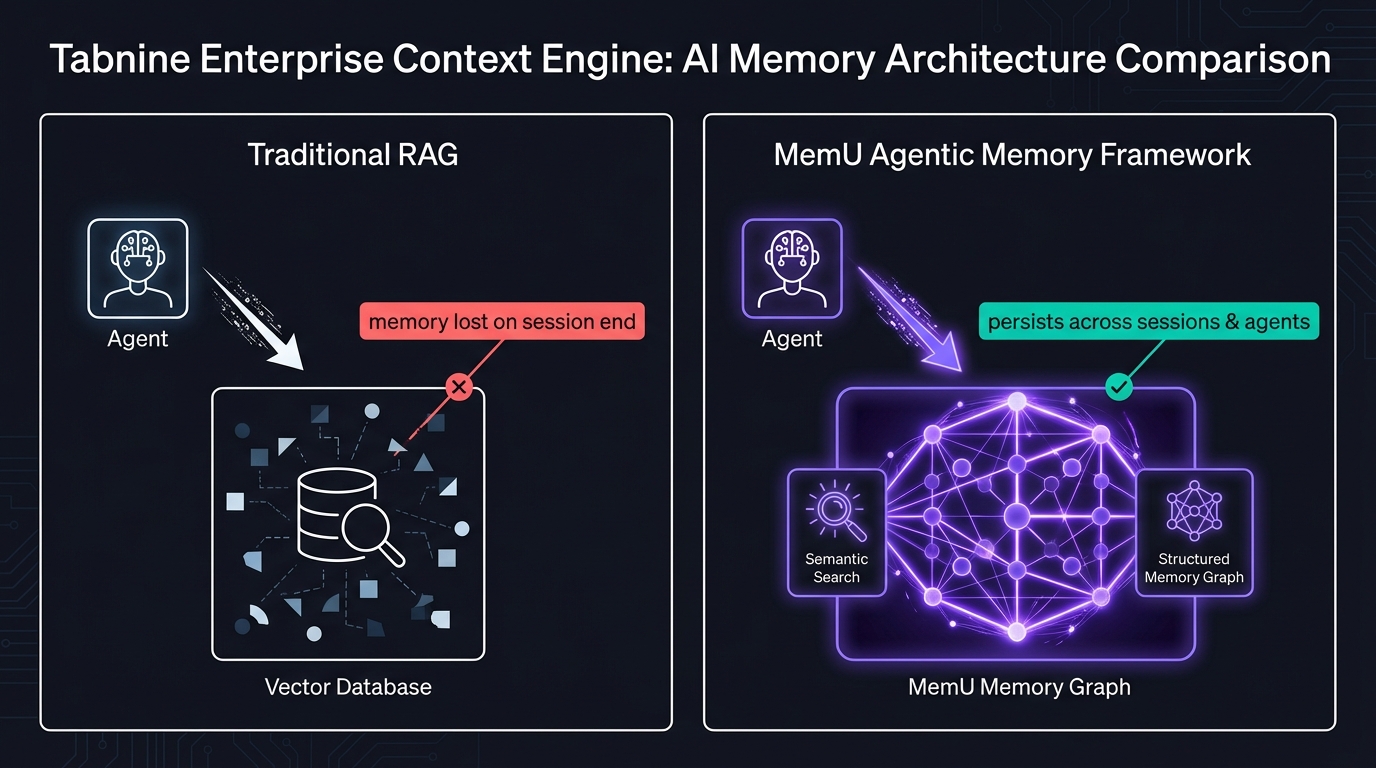
The gap is between sessions. When a developer returns the next day to continue the same refactoring effort, the Tabnine Enterprise Context Engine provides the same organizational context — current codebase structure, dependencies, documentation. But it does not recall yesterday's session: which approaches were explored, which were rejected, which edge cases were discovered, or which decisions were made and why. Organizational AI context without session-persistent memory means every coding session starts with full organizational knowledge but zero experiential knowledge. The Tabnine Enterprise Context Engine knows what the codebase looks like; it does not remember what happened during the last interaction with it.
The MemU Agentic Memory Framework: A Different Architecture
The MemU Agentic Memory Framework provides the persistent experiential memory layer that organizational context engines need to evolve from static knowledge providers into continuously learning systems. Instead of resetting agent experience at session boundaries, MemU builds a structured memory graph that captures session outcomes, developer preferences, discovered edge cases, and validated strategies — making every coding session smarter than the last.
The MemU Agentic Memory Framework operates at a different layer than the Tabnine Enterprise Context Engine, and the two are complementary. Tabnine provides the organizational context: "Service A depends on Service B through API Contract X." MemU provides the experiential context: "Last week, refactoring Service A's payment endpoint caused a cascade failure in Service B because Contract X does not validate null currency fields." The first is structural knowledge; the second is operational knowledge that only exists because an agent experienced it.
Three capabilities distinguish this architecture:
- Session-persistent developer context: The MemU Agentic Memory Framework stores session outcomes, developer decisions, and discovered edge cases as structured memories. When a developer returns to continue a multi-day refactoring effort, the agent recalls exactly where the previous session ended, which approaches were explored, and which decisions were made.
- Cross-developer knowledge sharing: The MemU Agentic Memory Framework enables agents to share experiential knowledge across developer sessions. When Developer A discovers that Module X has an undocumented threading constraint, that discovery becomes available to Developer B's agent when they work on Module X three weeks later — organizational AI context enriched with lived experience.
- Recommendation calibration through feedback: Over hundreds of sessions, the MemU Agentic Memory Framework accumulates data on which suggestions developers accept, modify, or reject. The code intelligence platform can calibrate its recommendations based on actual developer behavior, not just organizational code patterns.
The Tabnine Enterprise Context Engine tells agents what the organization's code looks like. The MemU Agentic Memory Framework remembers what agents have learned from working with it — and structures that knowledge so every future session builds on accumulated coding intelligence, not just current codebase state.
Integration requires no changes to existing development workflows. The MemU Agentic Memory Framework exposes a standard API that any code intelligence platform can call alongside existing context queries — agents store session memories on completion and retrieve relevant experiential context before generating recommendations.
Head-to-Head: MemU vs. Tabnine Enterprise Context Engine
Tabnine Enterprise Context Engine: Builds continuously evolving models of organizational software systems, dependencies, and practices. Moves beyond simple RAG to provide structural understanding of how an organization's code fits together. Agents receive rich organizational AI context at query time. But the context is structural, not experiential — it reflects the current state of the codebase, not the accumulated wisdom of hundreds of coding sessions. Each session starts with organizational knowledge but no session history.
MemU Agentic Memory Framework: Maintains retrieval across 10,000+ memory entries with sub-100ms latency. Session outcomes, developer preferences, discovered edge cases, and validated strategies persist indefinitely. The structured memory graph connects coding decisions to their outcomes, enabling agents to learn which approaches succeeded in specific contexts. Cross-developer memory sharing transforms individual discoveries into organizational intelligence.
The distinction is architectural: the Tabnine Enterprise Context Engine provides the map of the organization's software. MemU provides the field journal of everything agents have learned while navigating that map. One shows where things are; the other remembers what happened there. A complete code intelligence platform needs both.
Empowering Tabnine Enterprise Context Engine: Better Together
The MemU Agentic Memory Framework does not replace organizational context — it makes it experiential. Here is what the combination unlocks for enterprise code intelligence:
- Multi-session project continuity: Enterprise refactoring and migration projects span weeks. With MemU, the Tabnine Enterprise Context Engine provides organizational structure while agents maintain session-persistent memory of the entire project arc — decisions made, alternatives rejected, edge cases encountered — eliminating the daily context reconstruction that slows long-running engineering efforts.
- Emergent documentation: The MemU Agentic Memory Framework captures implicit knowledge that developers share during coding sessions — undocumented constraints, tribal knowledge about legacy systems, and workarounds for known issues. Over time, this experiential data supplements the organizational AI context with operational knowledge that formal documentation never captures.
- Personalized developer experience: Each developer works differently. The MemU Agentic Memory Framework learns individual preferences — coding style, preferred libraries, review standards — and calibrates the Tabnine Enterprise Context Engine's outputs accordingly. The same organizational context produces personalized recommendations, improving adoption and developer satisfaction.
Get Started with MemU
Organizational context engines represent a genuine advancement for enterprise code intelligence. Adding persistent memory transforms static context into compounding intelligence. The MemU Agentic Memory Framework integrates with any code intelligence platform — including the Tabnine Enterprise Context Engine, GitHub Copilot, and custom development pipelines — through a straightforward API that adds cross-session knowledge persistence without disrupting existing developer workflows.
Visit memu.pro to explore the Agentic Memory Framework API and start building coding agents that learn from every session they power.
Tags: Tabnine Enterprise Context Engine, enterprise context engine, organizational AI context, code intelligence platform, Tabnine, MemU AI, agentic memory, persistent memory architecture