Tavily Search API for AI Agents: Real-Time Research, Depth Tiers, and Durable Memory


Agents advertised as “research assistants” need APIs built for machines, not humans clicking ten blue links. The Tavily Search API targets real-time retrieval tuned to LLM pipelines — responsive enough for interactive copilots, structured enough for downstream synthesis. Ecosystem credibility matters: LangChain highlights the integration, and packages such as langchain-tavily reduce glue code in Python chains. A 1k free/month allowance lowers the barrier to prototypes before production metering kicks in. Topic lanes like general, news, and finance steer queries toward plausible source mixes, while basic versus advanced depth toggles help teams trade speed, cost, and thoroughness per turn.
The Tavily Search API answers retrieval. It does not automatically answer “what did we already learn from last week’s searches?” Without memory, each run repeats exploration, revisits noisy domains, and re-learns formatting preferences users already stated — wasting tokens and testing patience.
Platform teams also worry about drift: when every squad wraps Tavily differently, tracing and cost allocation splinter. Shared tool definitions from LangChain help at the code layer; shared memory contracts help at the behavior layer.
What Tavily gets right — and why agents still need memory
The Tavily Search API is opinionated in a productive direction: responses lean LLM-friendly, which reduces bespoke scraper maintenance for many workflows. Emphasis on real-time freshness suits news desks, market monitors, and incident bots where stale caches silently lie. First-class LangChain alignment — including langchain-tavily — helps organizations already on that stack standardize tools, callbacks, and traces.
Pricing psychology supports iteration. 1k free/month calls let builders experiment with agent loops before finance demands forecasts. Domain routing (general, news, finance) trims prompt entropy: the service nudges retrieval toward sensible source classes instead of forcing the model to guess filters every message.
Depth controls — basic versus advanced — mirror human research: skim first, drill when stakes rise. Yet depth remains a per-request knob. Without cross-session recall, agents cannot learn that advanced was wasted on routine FAQs, or that basic routinely missed nuance in finance workflows. Stateless calls do not accumulate that operational knowledge.
Another gap is citation governance: Tavily will return what you ask for; it will not remember which outlets your compliance team demoted last Tuesday. That is why pairing search with the MemU Agentic Memory Framework matters for regulated teams — memory holds the demotion list, not the HTTP response.
Observability is another hidden cost. When dozens of microservices each call Tavily with slightly different parameters, dashboards show aggregate spend but not aggregate learning. Centralizing memory means you can attribute improvements — fewer bad summaries, shorter review queues — to specific policy tweaks rather than guessing which team changed a prompt. That feedback loop is how agent platforms mature from science fair to operations.
Security reviews also ask about data residency and logging. The Tavily Search API handles transport and results; your memory layer decides what fragments of those results become long-lived artifacts inside your perimeter. The MemU Agentic Memory Framework gives you a place to enforce redaction, TTLs, and access control independent of whatever the model saw transiently in context.
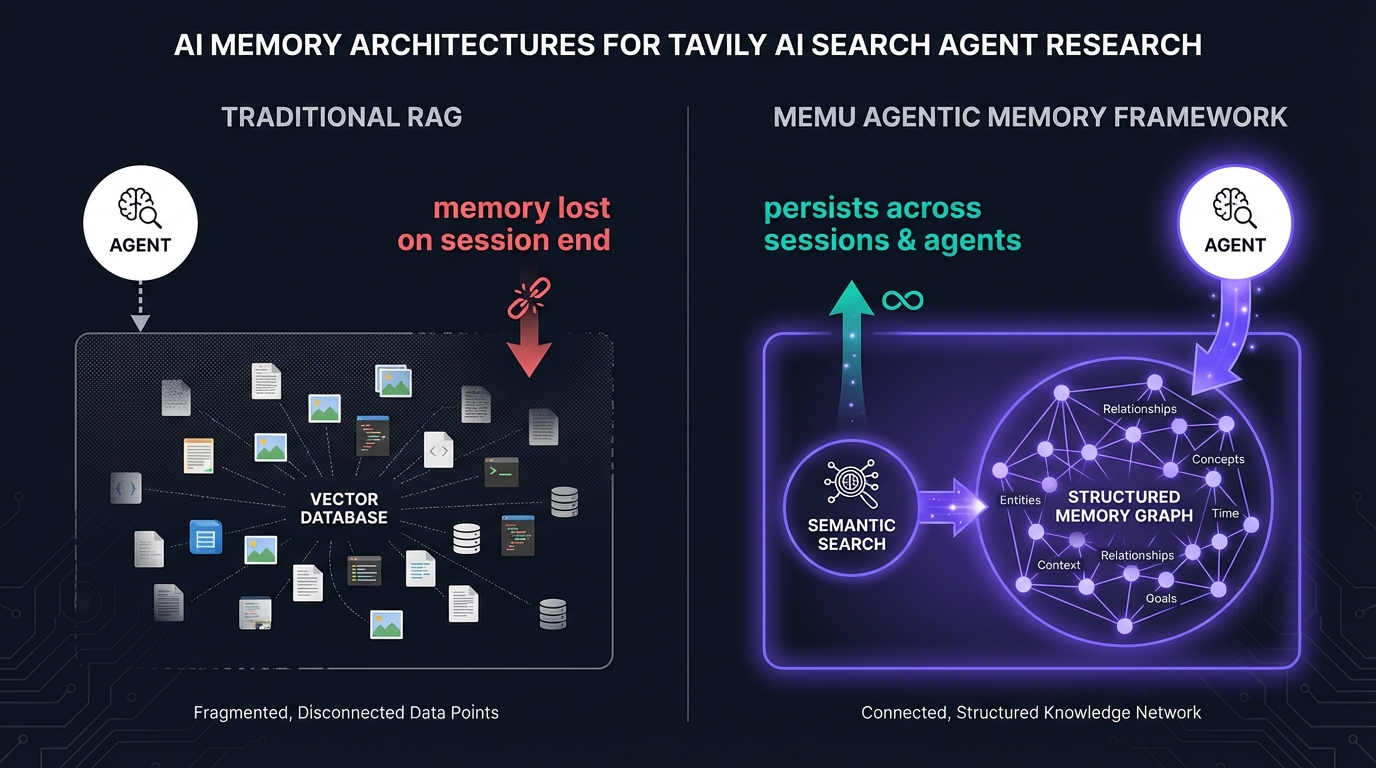
The MemU Agentic Memory Framework: from search results to search judgment
The MemU Agentic Memory Framework records what APIs omit: evolving retrieval policy. After each Tavily Search API call, MemU can log which snippets grounded answers, which domains reviewers overrode, and whether basic or advanced depth correlated with approval — whether the call path used raw REST or langchain-tavily.
A financial copilot might require finance topic plus advanced depth for earnings commentary, while internal wiki questions use general with basic passes. MemU retains those guardrails so new sessions inherit them immediately.
High-value patterns:
- Depth and topic tuning: Bind news, finance, and general routes to remembered outcomes instead of static system prompts.
- LangChain-aware memory: Chains orchestrated via LangChain benefit when MemU supplies one store across tools — live search today, databases tomorrow.
- Spend discipline: Beyond the 1k free/month sandbox, MemU tracks when advanced depth was justified — curbing margin burn as volume grows.
Tavily fetches the present web. The MemU framework remembers how your agents should read it.
Real-time freshness plus durable judgment yields assistants that feel informed without feeling chaotic.
Head-to-head: Tavily alone vs. with MemU
The Tavily Search API alone delivers real-time retrieval, LangChain and langchain-tavily ergonomics, a 1k free/month entry tier, topic modes (general, news, finance), and basic or advanced depth. It excels at fetching up-to-date context on demand.
Adding MemU keeps that fetch surface while persisting source quality, depth policy, and reviewer feedback — shrinking repeated mistakes and token-heavy rediscovery.
Ephemeral search with no cross-session requirements might tolerate the API alone. Production assistants rarely stay that simple.
Better together: LangChain tools and shared agent memory
Combining the Tavily Search API with the MemU Agentic Memory Framework strengthens typical stacks:
- Consistent tool behavior: Whether you wrap Tavily manually or via langchain-tavily, MemU supplies one memory substrate for all chains LangChain orchestrates.
- Domain-aware ranking: Boost or demote sources per function — finance analysts versus general support — using MemU reputation instead of one-off prompts.
- Progressive depth: Start basic, escalate to advanced when MemU flags high-stakes intents, saving latency on long-tail queries.
As usage moves past the 1k free/month tier, disciplined depth choices convert directly to margin — fewer redundant advanced calls, fewer bad citations requiring human rework.
Finally, multilingual and multi-region teams often need the Tavily Search API to behave differently by locale — different trusted outlets, different freshness thresholds, different escalation rules. Encoding those differences only in prompts scales poorly. MemU lets you store locale-specific memory shards so Paris and Singapore agents inherit the right policies without duplicating entire chain graphs in LangChain.
Runbooks should document which topic and depth defaults apply to which use case; the Tavily Search API will not write that documentation for you. When those runbooks live in MemU-backed memory instead of wikis nobody reads, agents and humans stay aligned during incidents — the same lesson applies to on-call bots that must summarize news feeds without amplifying rumor. Treat memory updates as code review: small, reviewed diffs beat silent prompt edits in production.
Get started with MemU
The Tavily Search API is a pragmatic choice for real-time agent research — especially with LangChain, langchain-tavily, and explicit depth and topic controls.
Layer the MemU Agentic Memory Framework so those searches teach your agents what to fetch — and how — on every subsequent run.
Visit memu.pro for product details, and use github.com/NevaMind-AI/memU to add persistent agent memory alongside the Tavily Search API.
Tags: Tavily, LangChain, langchain-tavily, real-time search, AI agents, agent memory, finance news research