Tech Mahindra and Microsoft Launch Ontology-Driven Agentic AI — But Knowledge Graphs Without Persistent Memory Are Static Maps

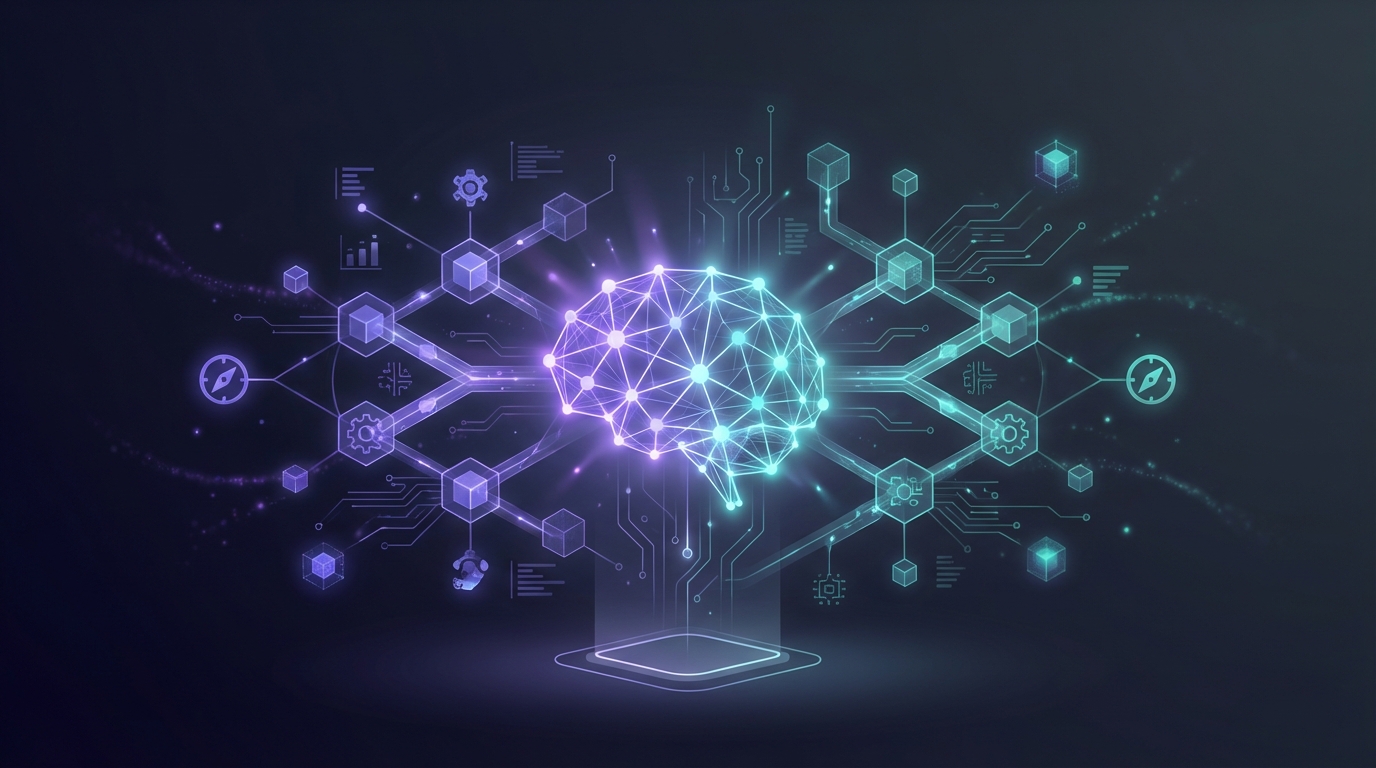
Tech Mahindra and Microsoft have launched an ontology-driven agentic AI platform that puts semantic structure at the center of enterprise intelligence. Built on Microsoft Fabric and Azure AI Foundry, the platform uses knowledge graphs and domain-specific ontologies to give AI agents a structured understanding of telecom and enterprise environments. The explicit goal: reduce hallucinations, improve decision accuracy, and enable agents to reason about network optimization and fraud detection with domain-grounded context.
This is a meaningful architectural choice. Ontology-driven agentic AI moves beyond flat prompt engineering into structured semantic reasoning — agents that understand not just text but the relationships between entities, processes, and constraints within a specific domain. For telecom operators managing millions of network events per hour, this matters enormously.
But ontologies define what an agent can know. They do not define what an agent has learned. A knowledge graph without persistent memory is a static map — accurate at the time of creation, but blind to everything that happened after deployment.
Ontology-Driven Agentic AI: What Everyone's Getting Right (And Missing)
Tech Mahindra's ontology-driven agentic AI approach gets the foundational layer right. By encoding domain knowledge into formal ontologies — entity types, relationships, constraints, and inference rules — the platform gives agents a semantic scaffold for reasoning. Knowledge graph agents can traverse relationships between network nodes, identify anomaly patterns in fraud detection, and ground their outputs in verified domain structure rather than statistical guesses.
The enterprise AI platform leverages Microsoft Fabric for data integration and Azure AI Foundry for model serving, creating an end-to-end pipeline where ontology-driven agentic AI can access structured and unstructured data through a unified semantic layer. This reduces the integration overhead that has blocked many enterprise AI deployments from reaching production.
What the architecture does not address is temporal evolution. Ontologies represent domain knowledge at a point in time. Real enterprise environments change constantly — new network topologies, evolving fraud patterns, shifting regulatory requirements. An ontology-driven agentic AI system that cannot accumulate operational experience between sessions will keep making the same initial discoveries, running the same diagnostic sequences, and missing the same edge cases that only emerge over weeks of continuous operation. The semantic AI infrastructure is solid; the memory layer is absent.
What Ontology-Driven Agentic AI Does With Memory Today
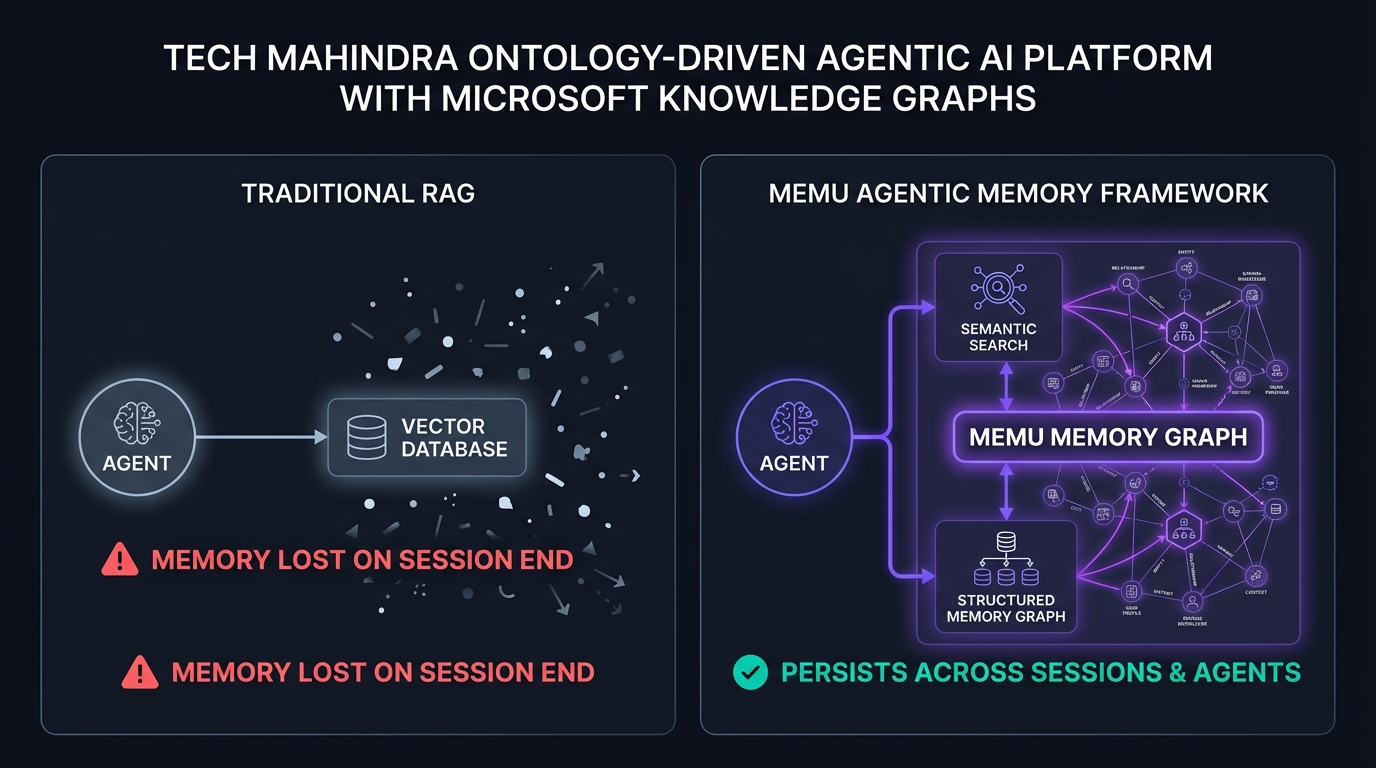
The current ontology-driven agentic AI architecture treats knowledge graphs as read-only reference structures. Agents query the ontology during task execution, traverse entity relationships to inform decisions, and return results — but the graph itself does not evolve based on what agents discover during operation. The knowledge graph agents operate within a semantic frame that was defined at build time.
Within a session, the ontology-driven agentic AI platform maintains execution context. An agent investigating a network anomaly can follow a chain of reasoning — querying topology data, correlating with traffic patterns, checking historical baselines — and retain that chain throughout the investigation. This is effective for single-session diagnostic workflows.
The gap appears at session boundaries and across agent pools. When an ontology-driven agentic AI agent discovers that a specific combination of network signals reliably predicts equipment failure, that discovery exists only in the session's execution trace. The next agent handling a similar pattern starts with the same static ontology, blind to operational insights that were already validated. For enterprise AI platforms running hundreds of agents across distributed telecom networks, this creates a systemic knowledge loss that compounds with every session reset. Knowledge graph agents without persistent memory generate insights but never accumulate institutional intelligence.
The MemU Agentic Memory Framework: A Different Architecture
The MemU Agentic Memory Framework provides the persistent knowledge layer that transforms ontology-driven agentic AI from a static reference system into a continuously learning architecture. Instead of limiting agents to the knowledge graph defined at deployment, MemU builds a dynamic memory graph that captures operational discoveries, validated patterns, and cross-session insights — turning every agent interaction into accumulated intelligence.
The MemU Agentic Memory Framework integrates with existing semantic AI infrastructure without requiring changes to the underlying ontology. Consider a telecom operator running ontology-driven agentic AI for network optimization: the first week, agents diagnose 200 network events, discovering that Topology Pattern X correlates with Failure Mode Y under Load Condition Z. Without persistent memory, week two starts from zero context. With the MemU Agentic Memory Framework, every validated pattern is stored as structured, retrievable knowledge — week two's agents begin with week one's accumulated expertise.
Three architectural capabilities distinguish this approach:
- Semantic-structural dual retrieval: The MemU Agentic Memory Framework combines vector-based semantic search with a structured memory graph. Agent discoveries are stored not as flat logs but as interconnected knowledge nodes — queryable by meaning, by entity relationship, and by outcome correlation.
- Ontology-aware persistence: Memories are tagged with ontological context, so knowledge graph agents can retrieve past discoveries that are relevant to their current position in the domain graph. A fraud detection agent querying the ontology about transaction patterns also retrieves validated fraud signatures discovered by prior agents operating in the same ontological region.
- Cross-agent knowledge propagation: In multi-agent deployments, the MemU Agentic Memory Framework shares operational discoveries across agent pools. What one network optimization agent learns about signal degradation patterns becomes available to every agent in the fleet.
Ontologies define what agents can reason about. The MemU Agentic Memory Framework remembers what agents have learned — and structures that knowledge so every future reasoning step builds on validated experience, not static definitions.
Integration is straightforward. The MemU Agentic Memory Framework exposes a standard API that any enterprise AI platform — including those built on Microsoft Fabric and Azure AI Foundry — can call alongside existing ontology queries. Agents store discoveries on task completion and retrieve relevant memories before reasoning, adding persistent memory without modifying the ontology layer.
Head-to-Head: MemU vs. Ontology-Driven Agentic AI
Tech Mahindra's ontology-driven agentic AI platform: Delivers structured semantic reasoning through formal domain ontologies, knowledge graph traversal, and grounded inference. The enterprise AI platform reduces hallucinations by constraining agent reasoning to verified entity relationships. Agents make better decisions within a single session because they reason over structured domain knowledge rather than raw text. But that structure is frozen at build time — new patterns, evolving baselines, and operational discoveries do not feed back into the knowledge layer.
MemU Agentic Memory Framework: Maintains retrieval across 10,000+ memory entries with sub-100ms latency. Operational discoveries, validated patterns, and cross-session insights persist indefinitely. The structured memory graph connects agent actions to their outcomes, enabling knowledge graph agents to learn which ontological reasoning paths produced accurate results — not just which paths were available. Cross-agent memory sharing eliminates the knowledge silos that form when distributed agents handle related domain events independently.
The distinction is complementary: ontology-driven agentic AI provides the semantic scaffold for reasoning; MemU provides the experiential knowledge that makes reasoning improve over time. One defines what agents know; the other captures what agents learn.
Empowering Ontology-Driven Agentic AI: Better Together
The MemU Agentic Memory Framework does not replace semantic AI infrastructure — it makes it adaptive. Here is what the combination unlocks for knowledge graph agents in enterprise environments:
- Evolving domain knowledge: Ontology-driven agentic AI agents discover operational patterns that are not encoded in the original ontology. With MemU, these discoveries persist and inform future agent sessions, effectively extending the knowledge graph with validated operational intelligence gathered over months of deployment.
- Accelerated incident response: Telecom network agents handling fault diagnosis start each session with the accumulated knowledge of every prior diagnosis. The ontology provides the structural context; MemU provides the experiential context. Resolution times decrease as the memory layer grows.
- Fraud detection that compounds: Fraud patterns evolve faster than ontologies can be manually updated. The MemU Agentic Memory Framework captures emerging fraud signatures as agents encounter them, making the detection system progressively sharper without requiring ontology rebuilds.
Get Started with MemU
Ontology-driven agentic AI represents a strong architectural foundation for enterprise intelligence. Adding persistent memory transforms it from a reference system into a learning system. The MemU Agentic Memory Framework integrates with any semantic AI infrastructure — including platforms built on Microsoft Fabric, Azure AI Foundry, or custom knowledge graph stacks — through a drop-in API that adds cross-session persistence without disrupting existing ontology layers.
Visit memu.pro to explore the Agentic Memory Framework API and start building knowledge graph agents that learn from every operation they perform.
Tags: ontology-driven agentic AI, knowledge graph agents, enterprise AI platform, semantic AI infrastructure, Tech Mahindra, Microsoft Fabric, MemU AI, agentic memory, persistent memory architecture