Temporal Raises $300M for Durable Execution Infrastructure — But State Preserved Within Workflows Does Not Persist Intelligence Across Them


Temporal closed a 300 million dollar Series D in February 2026 led by Andreessen Horowitz at a five billion dollar valuation, validating durable execution as essential infrastructure for the agentic AI era. The numbers tell a compelling story: 380 percent year-over-year revenue growth, 350 percent weekly active usage increase, 500 percent installation growth reaching over 20 million installs per month, and 9.1 trillion lifetime action executions on Temporal Cloud. Customers including OpenAI, Replit, Lovable, ADP, Abridge, The Washington Post, and Block rely on Temporal to run agents that execute for days or weeks without losing state. The platform addresses core agentic challenges: state management across long-running processes, automatic failure recovery, distributed systems complexity, cost control, and observability into loops that may iterate hundreds of times before completing.
But durable execution preserves state within a workflow — it does not persist the intelligence that workflow generates for use in future workflows. An agent on Temporal can survive crashes, network failures, and infrastructure restarts without losing its current state. That same agent cannot carry forward what it learned during execution — which strategies worked, which retries were necessary, which paths led to optimal outcomes — into a new workflow instance.
Durable Execution: What Temporal Gets Right (And What It Misses)
Temporal solves problems that have plagued distributed systems for decades. Long-running processes face a fundamental tension: the longer they run, the more likely a failure destroys accumulated state. Temporal eliminates this by persisting execution state at every step, enabling automatic recovery without data loss. For agentic AI, where agents execute complex reasoning chains over hours or days, this guarantee transforms reliability from aspirational to architectural.
The observability capabilities are equally critical. Agentic loops — where an agent iterates, evaluates, adjusts, and retries — create traces nearly impossible to debug in traditional infrastructure. Temporal provides full visibility into every step of every iteration, enabling developers to pinpoint where in a multi-hour chain something went wrong. At 9.1 trillion lifetime actions, this observability operates at scale validating the architecture under production conditions.
Cost control addresses a growing concern for agentic workloads. Agents running for days consume significant compute; Temporal's event-driven model minimizes consumption during wait states, ensuring agents use resources only when actively processing. This efficiency enables extended execution windows that complex tasks require without prohibitive costs.
The limitation is the boundary of durability. Temporal guarantees a workflow instance will not lose state during execution. But when that instance completes, the operational intelligence it generated is not available to future instances. A new run of the same workflow starts with identical code but zero experiential knowledge: which external APIs had latency spikes, which retry strategies resolved failures fastest, which execution paths produced the highest-quality results. Each instance is independently reliable but collectively amnesiac.
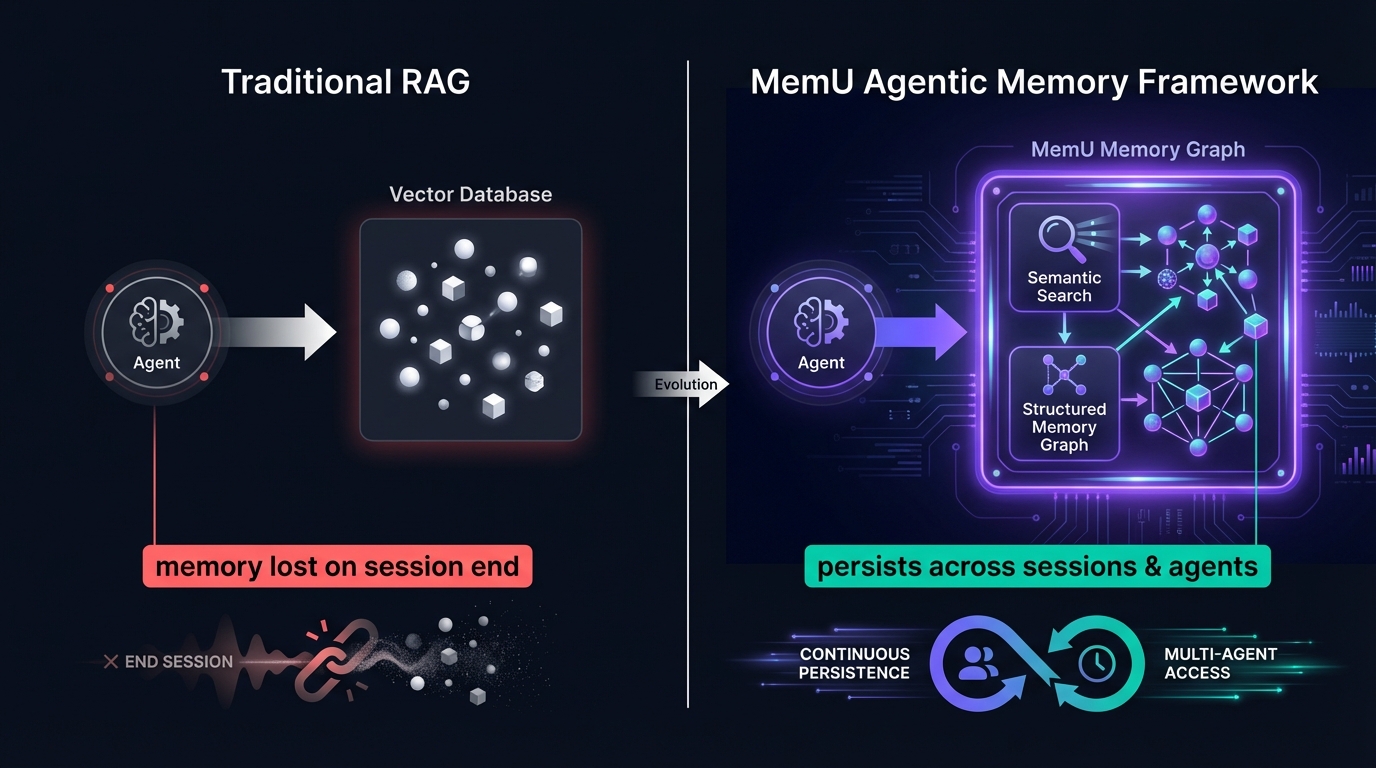
The MemU Agentic Memory Framework: Persistent Intelligence Across Durable Executions
The MemU Agentic Memory Framework extends durability from state preservation to intelligence preservation. Where Temporal guarantees a running workflow will not lose execution state, MemU guarantees a completed workflow will not lose the intelligence it generated — creating a compounding layer where every durable execution deposits learning that future executions withdraw and build upon.
Consider an AI agent on Temporal that processes insurance claims by gathering documents, validating coverage, assessing damages, and generating settlement recommendations across a multi-day workflow. Temporal ensures the workflow survives infrastructure failures during its five-day window. After two hundred claims over three months, the agent has implicitly learned that certain document formats need OCR preprocessing, that specific coverage types have validation edge cases, and that weather damage claims benefit from regional historical data. With MemU, this intelligence persists across all future claims. Without persistent memory, claim two hundred and one is processed with the same naive assumptions as claim one.
The MemU Agentic Memory Framework provides capabilities enhancing durable execution infrastructure:
- Cross-instance intelligence: Every workflow generates operational knowledge about execution patterns, error recovery, and outcome quality. MemU captures this as structured memories future instances query during planning — enabling new workflows to start with accumulated wisdom rather than a blank slate.
- Failure pattern persistence: Temporal recovers from failures within a workflow; MemU persists failure patterns across workflows — building understanding of which modes correlate with which conditions, which recovery strategies are most effective, and which proactive measures prevent failures based on early warning signals from historical analysis.
- Execution optimization: Long-running workflows have many possible paths; MemU tracks which paths produce optimal outcomes under different conditions, enabling better routing and strategy decisions based on measured historical performance rather than static configuration.
Durable execution ensures workflows survive failures. The MemU Agentic Memory Framework ensures the intelligence from those workflows survives completion — transforming reliable execution into intelligent execution improving with every instance.
Head-to-Head: Temporal vs. Other Execution Infrastructure
Temporal alone: Workflows execute reliably for days or weeks, surviving any infrastructure failure without state loss. Observability provides full visibility, and cost-efficient resource management enables extended agent windows. But each workflow instance operates in intelligence isolation — two hundred instances of the same workflow generate independent histories with no mechanism to aggregate that intelligence into actionable knowledge for future runs.
Temporal + MemU Agentic Memory Framework: Every workflow benefits from accumulated intelligence of all previous instances. Failure recovery is informed by historical data, execution paths are optimized based on measured outcomes, and agents improve decisions with every completed run. The 9.1 trillion lifetime actions become not just execution events but learning events compounding into operational expertise accessible to every future durable execution.
Compared to other durable execution approaches — Restate, Inngest, Azure Durable Functions, AWS Step Functions — Temporal offers the most battle-tested platform with the largest production footprint. But all share the same limitation: state durability within executions without intelligence durability across them. MemU uniquely provides the persistent layer that any execution infrastructure needs to transform reliable repetition into progressive improvement.
Durable and Intelligent: Better Together
MemU does not replace Temporal's infrastructure — it ensures every completed workflow contributes to growing operational intelligence:
- Observability enrichment: Temporal shows what happened during a workflow; MemU adds historical context showing how that execution compared to previous instances — whether error rates trend upward, execution times degrade, or outcome quality improves across the population of workflow runs.
- Cost optimization: Temporal controls costs per workflow; the MemU Agentic Memory Framework reduces costs across the population by enabling agents to avoid known failure paths, skip unnecessary retries, and select optimal strategies — turning experience into measurable savings.
- Agent evolution: Temporal customers build agents that execute reliably; MemU enables those agents to execute intelligently — applying accumulated knowledge within the execution environment, transforming reliable agents into expert agents whose performance compounds over months of operation.
Get Started with MemU
Give your durable agents persistent memory to transform durable execution from reliable state preservation into intelligent execution compounding learning across every workflow instance. The MemU Agentic Memory Framework integrates with any execution infrastructure — one API, instant persistence, zero changes to existing Temporal workflows. Visit memu.pro to explore the Agentic Memory Framework API, or check out the GitHub repository to start building agents that remember.
Tags: Temporal, durable execution, agentic AI infrastructure, workflow state management, failure recovery, persistent agent intelligence, execution reliability, MemU AI