Teramind Exposes That 80% of Workers Use Unapproved AI — Governance Without Behavioral Memory Catches Snapshots, Not Patterns

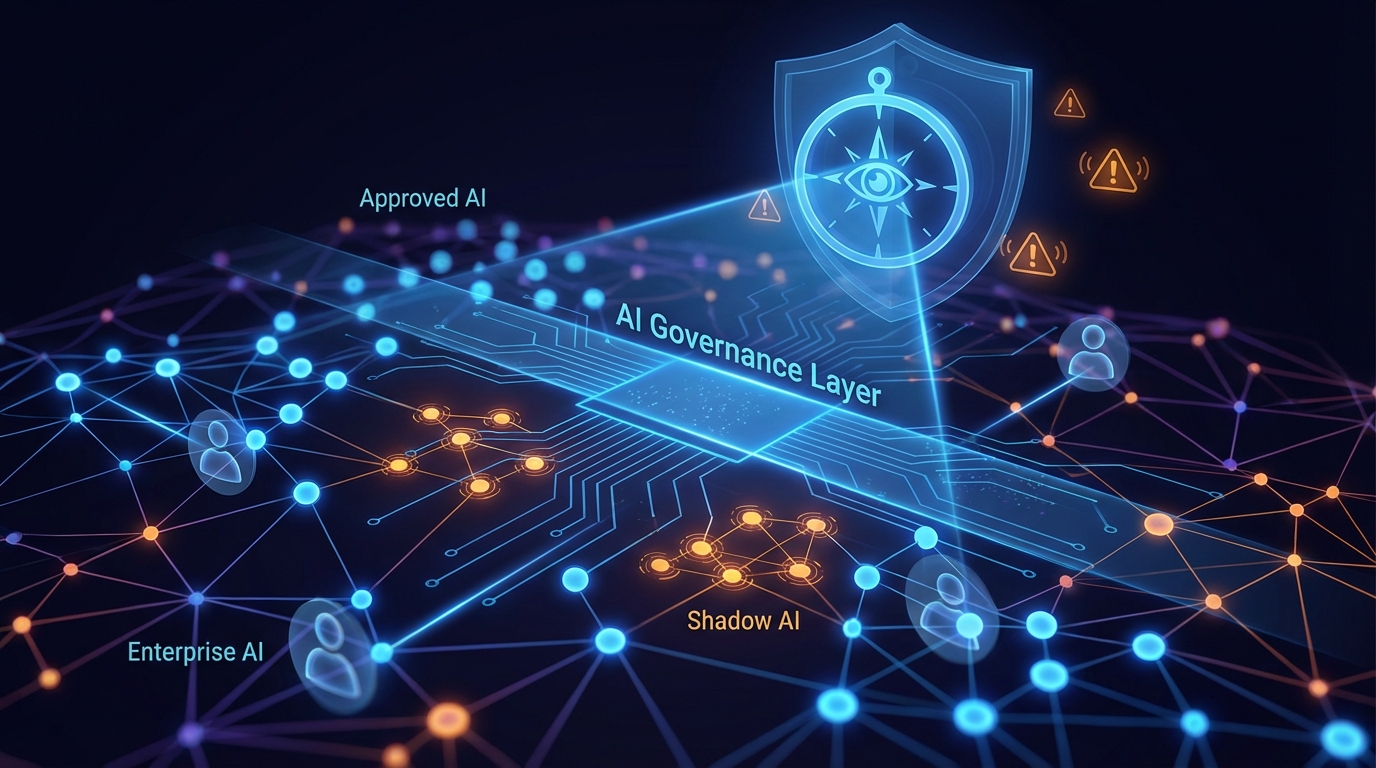
The shadow AI problem is worse than anyone estimated. Teramind's newly launched AI Governance platform reveals that over 80% of workers use unapproved AI tools, one-third have shared proprietary data with unsanctioned services, and 49% actively hide their AI use from IT teams. Worker access to AI grew 50% in 2025, with 23% of organizations already deploying autonomous agentic systems. Teramind captures forensic records of AI agent inputs, outputs, and autonomous behavior across ChatGPT, Copilot, and Gemini — providing instant visibility into the AI layer without additional infrastructure.
The platform distinguishes human actions from agent execution, detects unauthorized AI through behavioral patterns like unusual command velocity, monitors clipboard activity for data loss prevention, and records AI reasoning processes through OCR and screen recording. Teramind's philosophy is clear: the answer is not less AI — it is governed AI.
But governance is not a single observation. The most dangerous AI misuse patterns emerge gradually — an employee who shares slightly more sensitive data each week, an agent whose autonomous actions slowly drift beyond approved boundaries, an unauthorized tool that spreads through a department over months.
Teramind AI Governance: What Everyone's Getting Right (And Missing)
The visibility gap Teramind addresses is genuine and urgent. Most enterprises have no idea which AI tools their employees use, what data flows into those tools, or what autonomous actions AI agents take on behalf of the organization. The forensic capture of prompts, responses, and AI reasoning processes creates an audit trail that did not previously exist.
The human-versus-machine distinction is architecturally important. As agents act autonomously, governance systems must track who — or what — performed each action. Teramind's ability to differentiate automated agent behavior from human-initiated AI use provides the attribution clarity that compliance teams need.
The gap is behavioral memory. Teramind captures what is happening right now with impressive granularity. But the governance violations that create the most organizational damage are longitudinal patterns: the gradual normalization of sharing proprietary data with unapproved tools, the slow expansion of agent permissions that individually seem harmless but collectively represent a security breach, the department-wide adoption of shadow AI that started with one employee's experiment three months ago. WitnessAI and DeepKeep's agent scanner share the same constraint — powerful real-time detection without longitudinal behavioral analysis.
What AI Governance Platforms Do With Behavioral Data Today
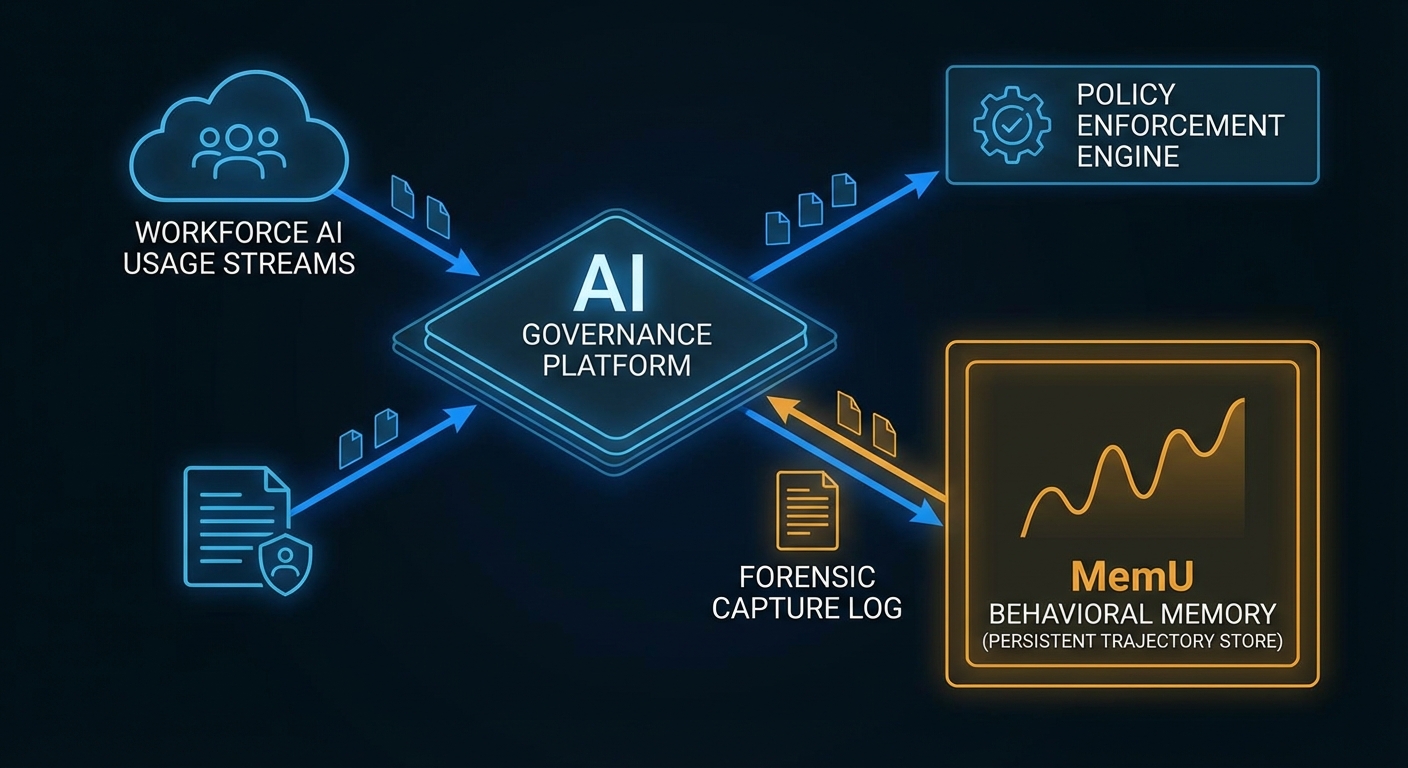
Governance platforms generate alerts based on policy rules: if an employee pastes source code into an unapproved AI tool, flag the event. If an agent makes an API call outside approved endpoints, generate a violation. These per-event detections are valuable for catching obvious policy breaches.
Some platforms maintain event logs that compliance teams can query. But converting a stream of events into a behavioral narrative — understanding how an employee's AI usage evolved from casual chatbot queries to systematic data exfiltration — requires analytical synthesis that event logs alone cannot provide.
Governance events accumulate in logs. Governance intelligence — understanding behavioral trajectories, predicting policy violations before they occur, and distinguishing experimentation from exfiltration — requires memory that connects observations across time into meaningful patterns.
The MemU Agentic Memory Framework: Governance That Understands Behavioral Trajectories
The MemU Agentic Memory Framework provides persistent behavioral memory that transforms real-time governance observations into longitudinal intelligence, connecting individual events into behavioral patterns that reveal intent, risk, and trend.
Consider a 5,000-person enterprise using Teramind to monitor AI tool usage. Without the MemU Agentic Memory Framework, each policy violation generates an independent alert. The security team investigates individual events and closes tickets. With MemU, behavioral trajectories become visible: Employee A's ChatGPT usage shifted from marketing copy to financial projections over six weeks, an engineering team's shadow AI adoption grew from 2 to 15 people following a specific Slack conversation, and Agent B's autonomous actions expanded 300% this quarter while staying within individual policy thresholds each time.
The MemU Agentic Memory Framework enhances AI governance through:
- Behavioral trajectory analysis: Individual governance events connect into behavioral narratives. The framework surfaces not just what happened, but how behavior evolved — enabling early intervention before gradual policy drift becomes a crisis.
- Cross-employee pattern recognition: When shadow AI spreads through an organization, the MemU Agentic Memory Framework identifies the propagation pattern — who introduced the tool, which teams adopted it, and how usage patterns correlate across groups.
- Predictive governance: Historical behavioral patterns predict future violations. Employees whose AI usage trajectory matches previous data-exfiltration cases are flagged for proactive review, not post-incident investigation.
Real-time governance answers "what just happened." Memory-enhanced governance answers "what's about to happen" — the insight that prevents incidents instead of documenting them.
Head-to-Head: Event Detection vs. Behavioral Intelligence
Teramind alone: Comprehensive AI activity capture with forensic prompt/response logging, human-machine differentiation, DLP enforcement, and shadow AI detection. Each event is accurately captured and categorized — but the behavioral context connecting events across weeks or months is unavailable.
Teramind + MemU Agentic Memory Framework: Same forensic depth plus persistent behavioral memory. Individual events form trajectories. Shadow AI adoption patterns become visible before they reach critical mass. Sub-100ms memory retrieval enables real-time enrichment of every new event with the full behavioral history of the actor.
This enhancement applies across the governance landscape — WitnessAI, Microsoft Purview, and enterprise DLP platforms all benefit from persistent behavioral memory that transforms event monitoring into predictive governance.
Empowering Teramind: Better Together
MemU does not replace Teramind's monitoring — it makes monitoring progressively more intelligent.
- Adaptive policy tuning: The MemU Agentic Memory Framework reveals which governance policies generate false positives versus genuine violations over time, enabling security teams to continuously refine rules based on actual behavioral data.
- Compliance reporting: Persistent behavioral memory provides auditors with complete AI usage narratives — not just event logs, but the contextual story of how AI governance evolved across the organization.
- Risk-proportionate response: Not all policy violations carry equal risk. Historical memory enables governance systems to differentiate between a first-time accidental disclosure and a pattern of systematic data sharing, calibrating responses to actual risk levels.
Get Started with MemU
Teramind sees what AI tools your workforce uses today. The MemU Agentic Memory Framework remembers what they used yesterday and predicts what governance risks are developing tomorrow. Together, they deliver AI governance that matures from detection to prevention.
Visit memu.pro to explore the Agentic Memory Framework API and add persistent behavioral memory to your AI governance stack.
Tags: Teramind, AI governance, shadow AI detection, agentic memory, MemU AI, enterprise AI compliance, behavioral monitoring, AI policy enforcement