Tinybird Powers Real-Time Analytics for the Agentic Era — But Query Patterns and Data Insights Do Not Persist Across Agent Sessions


Tinybird Real-Time Analytics: What the Agentic Data Backend Gets Right and What It Misses
Tinybird real-time analytics has positioned itself as the managed ClickHouse platform purpose-built for the agentic era. Where traditional analytics platforms serve human dashboards, Tinybird serves AI agents — providing high-throughput streaming ingestion, sub-second query responses, and API endpoints that agents can call directly to analyze data in real time. For the emerging class of AI agents that need to reason over live data, Tinybird provides the analytical backend that makes data-driven agent decisions possible at scale.
The platform’s infrastructure is genuinely impressive. Event-driven connectors ingest data from Kafka, S3, and Google Cloud Storage with minimal latency. The MCP server integration lets AI agents query Tinybird data sources with zero setup — any agent framework that supports the Model Context Protocol can connect and start running analytical queries immediately. High-throughput ingestion handles the volume of event data that modern applications generate, while ClickHouse’s columnar engine delivers the query performance that real-time agent decision-making demands.
In January 2026, Tinybird launched Agent Skills — open-source packaged instructions designed specifically for AI coding agents like Claude Code, Cursor, and Codex. These skills cover data source creation, pipe building, endpoint configuration, and SQL optimization, effectively teaching coding agents how to build real-time analytics infrastructure using Tinybird. LLM-friendly API descriptions, semantic context through dedicated pipes, and LLM-optimized error messages make the platform natively accessible to AI agents rather than requiring human intermediation.
The Tinybird Code framework extends this further, providing an AI agent framework for complex real-time analytics projects. For teams building agent-powered data applications, Tinybird has invested more heavily than almost any analytics platform in making its infrastructure agent-native.
But agent-native infrastructure is not agent-intelligent infrastructure. And the difference becomes clear when agents query the same data patterns session after session without ever learning from previous analytical discoveries.
What Tinybird Does With Agent Query Intelligence Today
A Tinybird real-time analytics deployment serves an e-commerce monitoring agent. The agent queries clickstream data, identifies a traffic anomaly on the checkout page, correlates it with a recent deployment, and alerts the engineering team. The analytical pipeline works flawlessly — ingestion, query, analysis, action.
The next week, a similar traffic anomaly appears. The agent runs the same diagnostic sequence: query clickstream data, compare against baselines, correlate with deployment logs, check CDN latency, examine database response times. It takes 12 queries and 45 seconds to reach the same conclusion the previous session reached in the same 12 queries and 45 seconds. No learning occurred. The agent did not remember that checkout anomalies in this application correlate with deployment-triggered cache invalidation 73% of the time, and that checking the cache hit rate first would have resolved the diagnosis in 2 queries and 5 seconds.
The Agent Skills framework compounds the issue in a different dimension. When a coding agent uses Tinybird Agent Skills to build a data pipeline, it follows the packaged instructions to create data sources, construct pipes, and configure endpoints. If that coding agent builds a similar pipeline for a different project next week, it does not recall the optimization decisions it made — that denormalizing a specific join improved query latency by 60%, or that a particular materialization strategy reduced storage costs by 40%. The skills teach the agent how to use Tinybird; they do not help the agent remember what it learned while using it.
Real-time analytics platforms like Tinybird, along with competitors such as ClickHouse Cloud, Rockset, and Materialize, provide the infrastructure for agents to analyze data. None of them preserve the analytical intelligence — the query patterns, diagnostic shortcuts, optimization strategies, and data insights — that agents accumulate through repeated interaction with the same datasets.
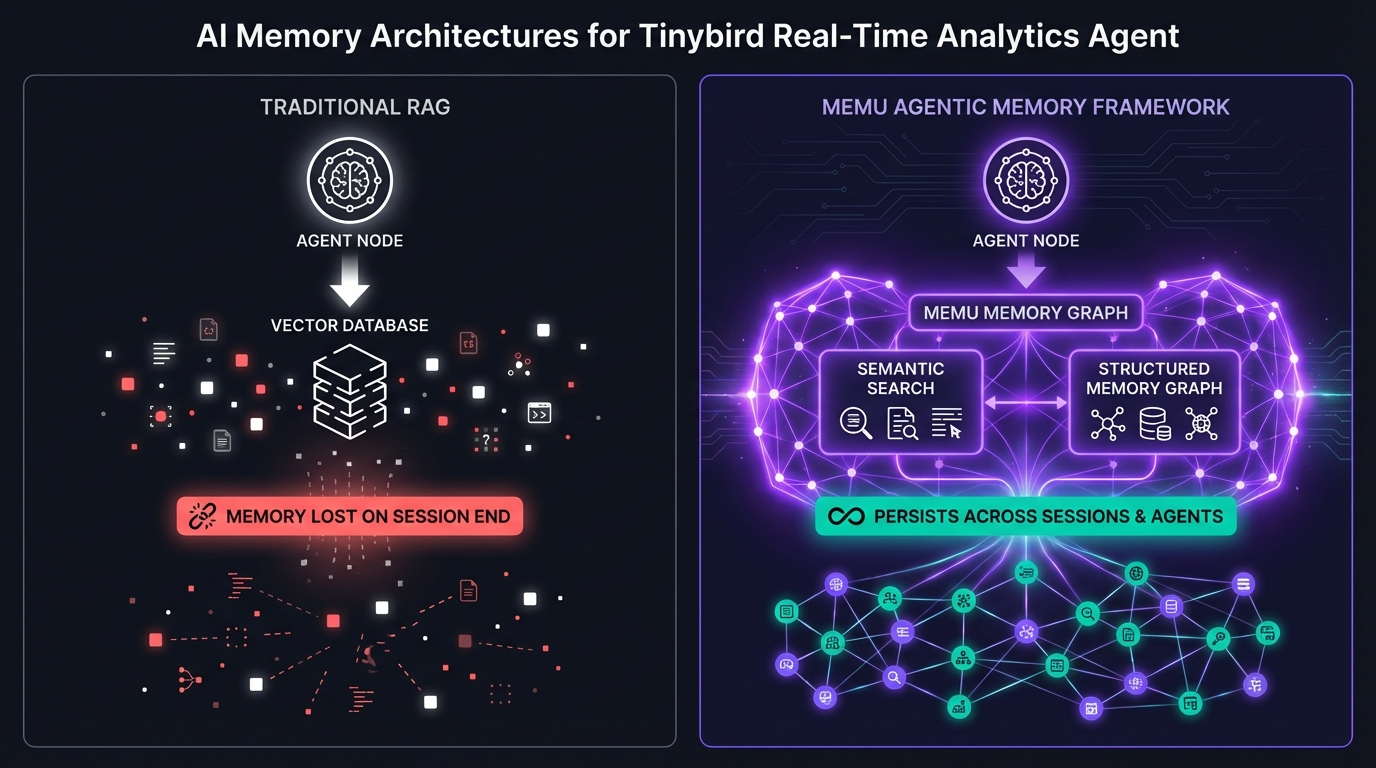
The MemU Agentic Memory Framework: Analytical Intelligence That Persists
The MemU Agentic Memory Framework provides the persistent analytical intelligence layer that real-time analytics backends like Tinybird lack. Where Tinybird delivers the infrastructure for fast data queries, MemU captures and retrieves the knowledge embedded in how agents use that infrastructure over time.
Real-time analytics gives agents the ability to query data instantly. Remembering what those queries revealed — which patterns recur, which diagnostic paths resolve fastest, which optimizations work for specific data shapes — is what transforms agents from data consumers into data experts. Analytics infrastructure needs analytical memory.
Consider a fleet of monitoring agents querying Tinybird for application health data across 50 microservices. With the MemU Agentic Memory Framework, when Service A’s latency spikes, the monitoring agent retrieves that 8 of the last 10 latency spikes in this service originated from a downstream database connection pool exhaustion rather than the service itself. Instead of running the full diagnostic tree, the agent checks the connection pool first — resolving the incident in seconds rather than minutes.
The MemU Agentic Memory Framework integrates via REST API alongside any analytics backend. Key capabilities for agent-driven real-time analytics:
- Query pattern optimization: MemU tracks which query sequences lead to successful outcomes for specific data scenarios. Agents approaching a familiar analytical problem retrieve the optimal query path rather than exploring the full decision tree. Diagnostic efficiency compounds with every resolved incident.
- Data insight persistence: When an agent discovers a meaningful pattern in Tinybird data — seasonal traffic correlations, feature-usage-to-churn predictors, geographic performance variations — that insight persists in the memory graph. Future agents querying the same datasets start with accumulated domain knowledge rather than raw data.
- Schema and optimization memory: For coding agents using Tinybird Agent Skills, MemU preserves pipeline architecture decisions. The agent that discovered an effective materialization strategy for time-series aggregations can retrieve and apply that pattern to new projects without rediscovery.
Head-to-Head: Tinybird Alone vs. MemU-Backed Analytical Agents
Tinybird real-time analytics alone: Managed ClickHouse with high-throughput streaming ingestion, sub-second query latency, MCP server integration, and Agent Skills for coding agents. The platform delivers exceptional analytical infrastructure — fast, agent-native, and well-documented. But agents that query the same datasets repeatedly gain no cumulative advantage. The hundredth diagnostic query runs the same exploratory path as the first. Agent Skills teach tool usage without preserving tool mastery.
Tinybird + MemU Agentic Memory Framework: The same real-time analytical infrastructure, now enriched with persistent query intelligence. Every diagnostic session feeds a knowledge graph of data patterns, query optimizations, and analytical discoveries. Monitoring agents resolve incidents faster because they remember previous resolutions. Coding agents build better pipelines because they recall optimization decisions from previous projects. The MemU Agentic Memory Framework transforms Tinybird from a fast data backend into an intelligent analytical partner that compounds expertise with every query.
Empowering Tinybird: Better Together
Combining Tinybird’s analytics infrastructure with the MemU Agentic Memory Framework creates a real-time analytics system that neither platform delivers independently:
- Accelerated incident resolution: Monitoring agents querying Tinybird retrieve historical diagnostic patterns through MemU. An anomaly in the payment processing pipeline triggers immediate retrieval of the resolution pathway that resolved 12 similar incidents — skipping the 15-minute diagnostic tree and going directly to the root cause in under a minute.
- Intelligent pipeline construction: Coding agents building Tinybird data pipelines reference MemU’s schema optimization memory. The agent knows that for event data with high cardinality dimensions, specific ClickHouse table engines and partition strategies produced 3x better query performance in previous projects — applying that knowledge automatically.
- Cross-dataset insight transfer: When an analytical agent discovers that user engagement metrics correlate strongly with a specific product feature across one Tinybird dataset, MemU makes that insight available to agents analyzing similar datasets for different products. Analytical discoveries in one domain inform hypotheses in related domains.
- Adaptive query optimization: MemU tracks how data characteristics change over time — growing cardinality, shifting distribution patterns, evolving schema — and preserves the query adaptations agents make in response. When data characteristics shift again, agents retrieve the appropriate adaptation strategy rather than experiencing degraded performance until manual intervention.
Get Started with MemU
Tinybird real-time analytics delivers the analytical infrastructure that the agentic era demands — fast ingestion, instant queries, native agent integration. What it does not deliver is the accumulated analytical intelligence that transforms agents from data consumers into data experts. The MemU Agentic Memory Framework adds the persistent memory layer that gives analytical agents the compounding expertise every query session deserves.
Visit memu.pro to explore the Agentic Memory Framework API, or check out the GitHub repository to give your real-time analytics agents the persistent query intelligence they need to get smarter with every data interaction.
Tags: Tinybird, real-time analytics, ClickHouse, agentic memory, AI agent analytics, MCP server, Agent Skills, MemU AI, persistent analytical intelligence