Toolhouse Delivers Backend-as-a-Service for AI Agents with One-Command Deployment — But Deployed Agents Without Persistent Memory Lose Learned Behaviors at Every Shutdown


Toolhouse has built the Backend-as-a-Service platform that AI agent developers have been waiting for. Deploy agents as APIs with a single th deploy command. A globally distributed runtime ensures high availability across regions. The CLI enables local development and testing with the same tooling used in production. Toolhouse auto-connects agents to its MCP Server providing RAG, memory, code execution, and browser use capabilities out of the box, with support for custom MCP servers for specialized integrations. The platform includes evaluation tooling, prompt optimization, and agentic orchestration for complex multi-step workflows. Stateful execution via Run IDs tracks agent sessions. Scheduling and cron support enables autonomous agent operation. Observability with comprehensive logs provides production visibility. With over seven thousand builders, forty-plus integrations, and a sixteen-million-dollar Series A, Toolhouse represents a maturing ecosystem for agent deployment infrastructure.
But production deployment without persistent memory creates a recurring loss. A Toolhouse-deployed agent that processes thousands of requests — learning optimal tool combinations, refining prompt strategies through the optimization pipeline, discovering effective orchestration patterns for specific customer workloads — loses all of that operational intelligence when the deployment restarts or scales down. Agents that deploy in one command but forget everything they learned upon shutdown are agents that never compound operational value.
Toolhouse: What Everyone Is Getting Right (And Missing)
Toolhouse's approach to agent deployment eliminates an enormous category of infrastructure complexity. Instead of building custom hosting, scaling, and monitoring infrastructure, Toolhouse provides a managed platform where deployment is a single CLI command. Auto-connection to the Toolhouse MCP Server means agents immediately access RAG, code execution, and browser automation without integration work.
The developer experience shows thoughtful product design. Local development with the CLI eliminates environment mismatch. Run IDs provide stateful session tracking. Evaluation tooling and prompt optimization help teams improve agent performance systematically. Scheduling and cron support enables autonomous agent operation. Observability with comprehensive logs gives operations teams production visibility.
What Toolhouse does not address is the persistence of operational intelligence across deployment lifecycles. Run IDs maintain state within an active session. But the agent that learned which MCP tool combinations produce the best results for data extraction tasks, or discovered through prompt optimization that a particular instruction structure produces forty percent more accurate outputs, or found that a three-step orchestration pattern outperforms a five-step pattern for customer onboarding — that intelligence exists only during the active deployment. Other agent deployment platforms share this fundamental limitation: they solve the infrastructure problem of running agents while treating the intelligence problem of learning agents as separate.
The MemU Agentic Memory Framework: Persistent Intelligence for Deployed Agents
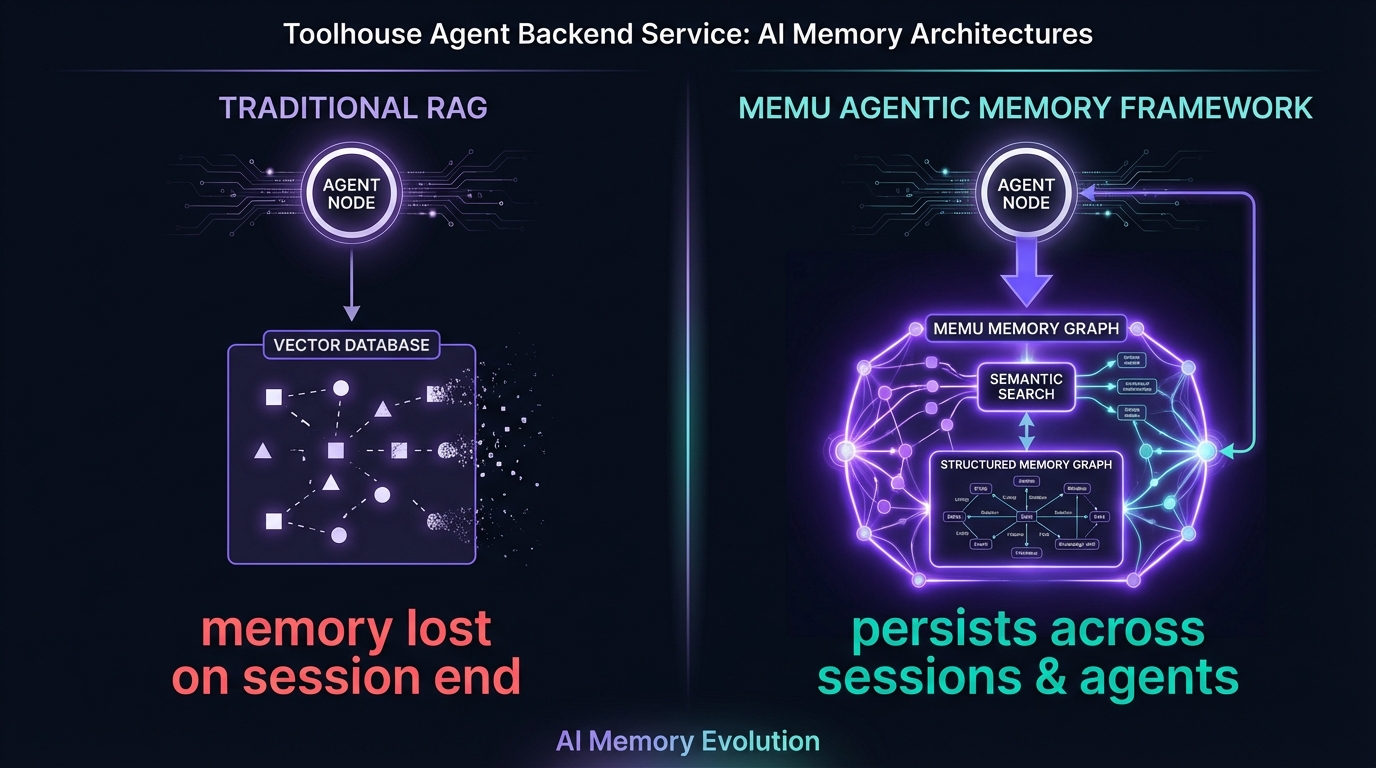
The MemU Agentic Memory Framework provides the persistent intelligence layer that transforms Toolhouse from a deployment platform into a learning deployment platform. Instead of treating each deployment lifecycle as isolated, MemU captures operational intelligence — tool selection effectiveness, prompt optimization results, orchestration pattern performance, and scheduling outcome data — storing it in a structured memory graph that persists across deployment restarts, scaling events, and infrastructure migrations.
Consider a Toolhouse-deployed agent fleet managing e-commerce operations for a retail platform. Without persistent memory, each deployment restart initializes agents with their designed defaults. With the MemU Agentic Memory Framework, the fleet recalls operational history: the RAG component retrieves more accurate product specifications when queries are pre-filtered by category metadata — a pattern discovered after processing fifteen thousand customer queries, the code execution sandbox produces more reliable inventory calculations when initialized with a normalization step learned from three thousand prior executions, and the browser automation tool completes competitor monitoring forty percent faster using navigation sequences optimized across ten thousand prior sessions. That accumulated intelligence loads at deployment startup, making every restart a continuation rather than a reset.
The framework addresses three core limitations of deployment-bounded agent intelligence:
- Tool combination optimization: With the MCP Server providing RAG, code execution, browser use, and forty-plus integrations, the optimal tool combination varies by task. The MemU Agentic Memory Framework captures which tool combinations produced the best results for specific workloads, enabling informed tool selection from the first request after every deployment restart.
- Prompt optimization persistence: Toolhouse includes prompt optimization capabilities, but optimized prompts exist within a deployment. Persistent memory preserves optimization results across deployments, ensuring that improvements compound rather than reset.
- Scheduling intelligence: Cron-scheduled agents discover optimal execution patterns over time. The MemU Agentic Memory Framework preserves learned scheduling insights — which time windows produce the best data quality, which retry strategies handle failures most effectively — enabling autonomous agents that improve their operational patterns.
An agent that deploys in one command but restarts from zero knowledge after every shutdown is efficient infrastructure wrapped around ephemeral intelligence. The MemU Agentic Memory Framework gives Toolhouse-deployed agents persistent memory that compounds operational value across every deployment cycle.
Integration with Toolhouse leverages the framework's REST APIs through custom MCP server configuration. A MemU memory server connects alongside the default Toolhouse MCP Server. At deployment startup, accumulated intelligence loads from the memory graph. During execution, agents query persistent memory for context on similar past tasks. At shutdown, new operational insights are stored. The memory layer operates within Toolhouse's globally distributed runtime, adding persistence without impacting deployment performance or availability.
Head-to-Head: Ephemeral Deployments vs. Memory-Enhanced Agent Infrastructure
Toolhouse alone: A complete Backend-as-a-Service for AI agents — one-command deployment, globally distributed runtime, MCP Server with RAG, code execution, and browser use, prompt optimization, evaluation tooling, stateful Run IDs, scheduling and cron, observability, and forty-plus integrations. Session state persists via Run IDs during active execution. But every deployment restart initializes agents from default configurations.
Toolhouse + MemU: The same deployment simplicity, now backed by persistent operational memory. Agents deploy in one command and immediately access accumulated intelligence about tool combinations, prompt optimizations, and orchestration strategies. The system delivers measurably better performance from the first request of each deployment — not just deployed, but continuously improving across infrastructure lifecycles.
For production agents processing continuous workloads across daily deployment cycles, the compounding effect transforms operational economics. A Toolhouse deployment with months of persistent memory operates with the precision of a deeply optimized system, while a freshly deployed agent requires weeks of active execution to reach equivalent effectiveness.
Empowering Toolhouse: Better Together
The combination of Toolhouse's deployment infrastructure and MemU's persistent memory unlocks capabilities neither achieves independently:
- Self-optimizing deployed agents: Persistent memory enables agents to automatically adjust tool selection and orchestration patterns based on accumulated performance data, turning deployed agents into systems that improve without manual reconfiguration.
- Cross-agent knowledge sharing: When multiple Toolhouse-deployed agents share persistent memory, optimization discoveries from one benefit the fleet. A prompt optimization refined by the customer support agent becomes available to the sales qualification agent.
- Intelligent scheduling evolution: Persistent memory enables cron-scheduled agents to refine their own execution patterns — learning which schedules produce the most valuable results, which retry intervals minimize cost, and which data collection windows deliver the highest quality — creating autonomous agents that optimize their own operational cadence.
Persistent memory transforms Toolhouse from the simplest agent deployment platform into the smartest agent deployment platform — where every execution compounds operational intelligence across the entire fleet.
Get Started with MemU
Toolhouse has built the deployment infrastructure that removes agent operations complexity — one-command deployment, globally distributed runtime, built-in MCP tools, prompt optimization, evaluation, and scheduling that seven thousand builders trust for production agent workloads.
The next step is giving those deployed agents persistent operational memory. The MemU Agentic Memory Framework provides that foundation — API-based integration through custom MCP server configuration, dual-mode retrieval with semantic search and structured memory graphs, and cross-deployment persistence that turns deployed agents into compounding intelligence systems.
Visit memu.pro to explore the Agentic Memory Framework API, or check out the GitHub repository to start building deployed agents that remember.
Tags: Toolhouse, Backend-as-a-Service, agent deployment, AI agents, MCP server, agent memory, MemU AI, LLM memory, agent infrastructure