Trigger.dev Raises $16M for AI Agent Background Jobs — But Agents Without Persistent Memory Restart Learning Every Job


Trigger.dev closed a sixteen million dollar Series A to build the definitive background jobs framework for AI agents. With 14,100 GitHub stars and growing, the open-source TypeScript platform delivers what modern agentic workloads demand: automatic retries, concurrency control, elastic scaling, and zero timeouts. The framework supports core AI agent patterns — tool calling, prompt chaining, routing, parallelization, orchestration, and evaluator-optimizer loops — all running serverless with pay-per-execution pricing. Deployment versioning prevents code changes from affecting already-started tasks, while a real-time monitoring dashboard provides complete visibility into every running job. Human-in-the-loop capabilities with token-based approval, scheduled tasks via cron, and integrations with Prisma, Python, Playwright, and FFmpeg make Trigger.dev a comprehensive execution platform for the agentic era.
But background jobs that execute reliably without persistent memory create a fundamental gap: every job starts from zero knowledge. An agent that processes its thousandth job has no more intelligence than when it processed its first. The execution infrastructure is excellent but the learning infrastructure is absent — reliable job completion is table stakes while intelligent job execution requires memory that survives between runs.
Background Jobs for AI Agents: What Trigger.dev Gets Right (And What It Misses)
Trigger.dev addresses the most critical pain point in agentic AI infrastructure: reliable background execution. AI agents performing complex tasks — multi-step research, data processing, content generation, code analysis — need execution environments that handle failures gracefully, scale elastically, and run without arbitrary timeouts. Traditional job queues and serverless functions were not designed for workloads that might run for minutes or hours while making dozens of external API calls, handling intermittent failures, and maintaining reasoning coherence across extended processing windows.
The framework's approach to AI agent patterns demonstrates deep understanding of agentic workloads. Tool calling enables agents to invoke external services with automatic retry logic. Prompt chaining allows sequential reasoning where each output feeds the next step. Routing directs work to specialized sub-agents based on task classification. Parallelization enables concurrent execution of independent subtasks. Orchestration coordinates multi-agent workflows. And evaluator-optimizer patterns enable iterative refinement loops where agents assess and improve their own outputs. These patterns combined with serverless execution create a powerful foundation for agent jobs running complex agentic logic at production scale.
Deployment versioning solves a subtle but critical production problem: when new code deploys, already-running background jobs continue executing against the version they started with. This prevents mid-execution code changes from disrupting long-running agent tasks — a guarantee essential for production systems where jobs may run for hours. The Realtime API with React hooks bridges background execution and user experience, enabling frontend applications to stream agent progress and reasoning in real time rather than waiting for a black-box process to finish.
The limitation sits at the boundary between individual jobs and collective intelligence. Each job runs in isolation and cannot access what previous runs learned about optimal strategies, common failure modes, or effective tool usage patterns. A thousand completed background jobs generate a thousand independent histories with no mechanism to synthesize that experience into actionable knowledge for the next run. The infrastructure guarantees each job completes reliably — not that the system grows smarter over time.
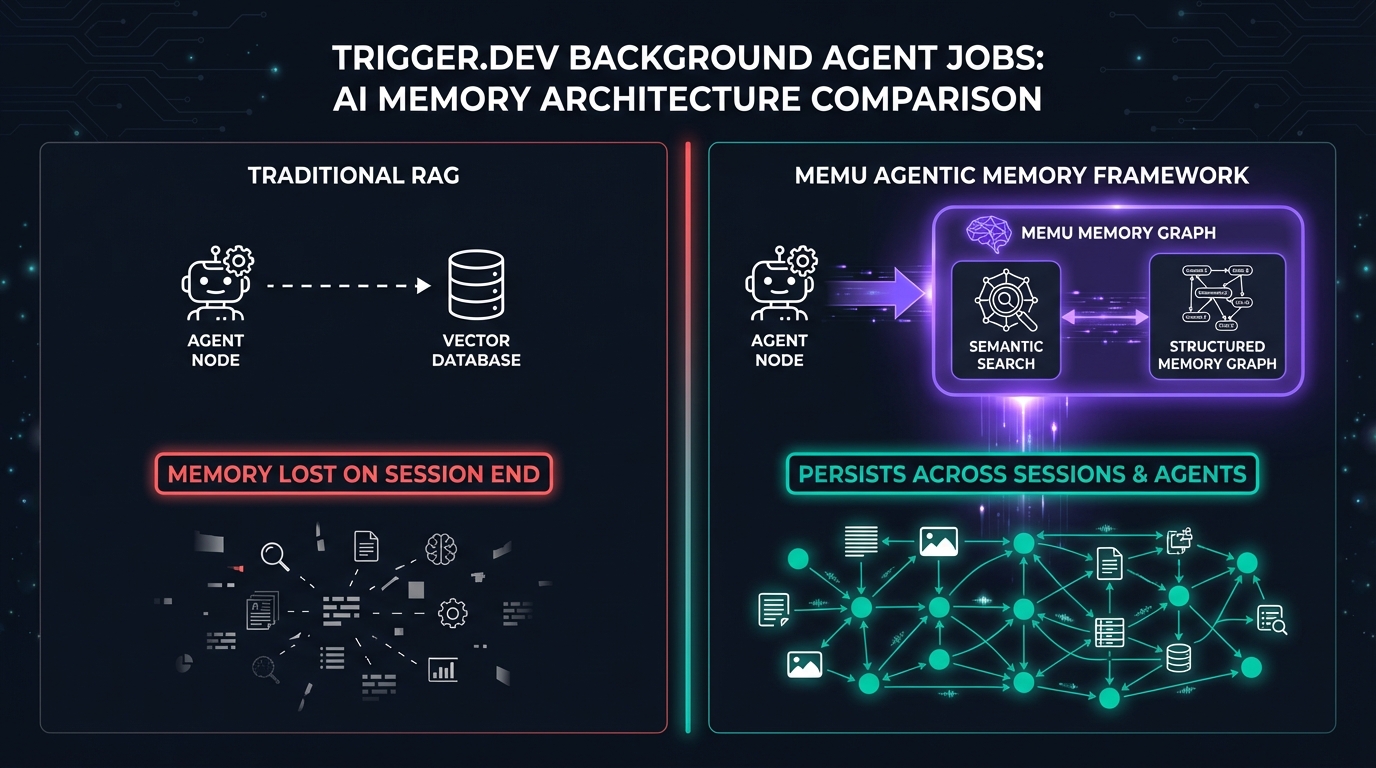
The MemU Agentic Memory Framework: Persistent Intelligence Across Background Jobs
The MemU Agentic Memory Framework extends background jobs from reliable execution to intelligent execution. Where Trigger.dev guarantees each job survives failures and scales elastically, MemU guarantees the intelligence generated by each job persists and compounds — creating a learning layer where every completed job deposits operational knowledge that future jobs withdraw and build upon.
Consider an AI agent running jobs to analyze customer support tickets, categorize issues, suggest resolutions, and route to appropriate teams. Trigger.dev ensures each job completes reliably with automatic retries and real-time monitoring. After processing five thousand tickets over several months, the agent has implicitly learned which categories correlate with urgent escalations, which resolution templates achieve the highest satisfaction scores, and which routing patterns minimize response times. With MemU, this intelligence persists across all future jobs. Without persistent memory, ticket five thousand and one is processed with the same naive assumptions as ticket one — repeating discoveries the agent already made thousands of times before.
The MemU Agentic Memory Framework provides capabilities that enhance agent execution infrastructure:
- Cross-job intelligence: Every job generates operational knowledge about execution patterns, API behaviors, and outcome quality. MemU captures this as structured memories that future jobs query during planning — enabling new runs to start with accumulated wisdom rather than blank assumptions about service reliability and optimal processing strategies.
- Failure pattern persistence: Individual jobs encounter isolated failures; MemU aggregates failure patterns across thousands of executions — identifying correlations between input characteristics and error conditions, building proactive avoidance strategies grounded in historical analysis rather than reactive retry logic that treats every failure as novel.
- Tool usage optimization: Agents using tool calling patterns learn which tools perform best for which scenarios; MemU persists this knowledge so agents select optimal tools based on measured historical effectiveness rather than static configuration or arbitrary defaults.
Reliable execution ensures jobs complete successfully. The MemU Agentic Memory Framework ensures the intelligence from those executions survives completion — transforming reliable jobs into intelligent jobs that improve with every run.
Head-to-Head: Trigger.dev vs. Other Execution Frameworks
Trigger.dev alone: Background jobs execute reliably with automatic retries, elastic scaling, and zero timeouts. Real-time monitoring provides full visibility, deployment versioning prevents mid-execution disruption, and AI agent patterns are first-class citizens of the platform. But each job operates in intelligence isolation — five thousand instances of the same job type generate independent histories with no mechanism to aggregate that operational intelligence into actionable knowledge for future runs.
Trigger.dev + MemU Agentic Memory Framework: Every job benefits from accumulated intelligence of all previous runs. Retry strategies are informed by historical success rates, tool selection is optimized based on measured outcomes, and agents improve their reasoning with every completed execution. The serverless pay-per-execution model becomes not just an infrastructure efficiency but a learning multiplier where each execution event compounds into operational expertise accessible to every future job run.
Compared to other execution approaches — BullMQ, Celery, AWS Lambda, Cloud Functions — Trigger.dev offers the most agentic-native platform with TypeScript-first design and dedicated AI patterns. But all share the same fundamental limitation: execution reliability within individual jobs without intelligence persistence across them. MemU provides the persistent memory layer that any execution infrastructure needs to transform reliable repetition into progressive improvement across the entire population of agent executions.
Reliable and Intelligent: Better Together
MemU does not replace Trigger.dev's infrastructure — it ensures every completed job contributes to growing operational intelligence:
- Monitoring enrichment: Trigger.dev's real-time dashboard shows what happens during a job; MemU adds historical context showing how that execution compared to previous runs — whether error rates trend upward, processing times degrade, or outcome quality improves across the population of job executions.
- Cost optimization: Pay-per-execution controls per-job costs; the MemU Agentic Memory Framework reduces costs across the population by enabling agents to avoid known failure paths, skip unnecessary retries, and select optimal strategies — turning accumulated experience into measurable infrastructure savings.
- Agent evolution: Trigger.dev users build agents that execute reliably; MemU enables those agents to execute intelligently — applying accumulated knowledge within the execution environment, transforming reliable agents into expert agents whose performance compounds over months of continuous operation.
Get Started with MemU
Give your agents persistent memory to transform background jobs from reliable execution into intelligent execution that compounds learning across every run. The MemU Agentic Memory Framework integrates with any execution infrastructure — one API, instant persistence, zero changes to existing Trigger.dev workflows. Visit memu.pro to explore the Agentic Memory Framework API, or check out the GitHub repository to start building agents that remember.
Tags: Trigger.dev, background jobs, agentic AI infrastructure, serverless execution, AI agent patterns, persistent agent intelligence, execution reliability, MemU AI