Ultravox Processes Speech Natively for Real-Time Voice AI — But Voice Agents Without Persistent Memory Cannot Build Rapport Across Conversations


Ultravox by Fixie AI has redefined voice agent architecture by eliminating the speech-to-text bottleneck that plagues conventional voice AI systems. Instead of converting audio to text, processing the text through a language model, and converting the response back to speech, Ultravox processes audio directly — preserving the paralinguistic signals that carry meaning beyond words. Tone, cadence, pitch, hesitation, emphasis — the subtle vocal cues that distinguish a confused customer from a frustrated one — survive the processing pipeline intact. The platform manages its own end-to-end inference stack, achieving minimal latency that makes conversations feel natural. Ultravox-v0.7 delivers response quality comparable to GPT-4o when latency is factored into the evaluation. REST APIs and SDKs for JavaScript, Python, Flutter, Kotlin, and Swift provide cross-platform reach, while built-in telephony integrations connect agents to existing phone infrastructure.
But Ultravox provides voice processing, not voice memory. Each call begins without any knowledge of previous conversations. Voice agents that understand tone and cadence in the moment but forget every interaction afterward cannot build the caller rapport, preference awareness, and conversational continuity that transform transactional calls into trusted relationships.
Ultravox: What Everyone Is Getting Right (And Missing)
The speech-native approach represents a genuine architectural breakthrough. Traditional voice AI pipelines lose information at every conversion step. An ASR system strips vocal inflection from speech, the language model processes sanitized text, and TTS generates a response with synthetic prosody. Ultravox collapses this pipeline into a single model that reasons about audio directly. When a caller says "That's fine" with rising intonation suggesting it is not fine, the model perceives the discrepancy — something impossible when the audio arrives as flat text.
Latency engineering matters profoundly for voice interactions. Human conversation tolerates roughly 300 milliseconds of silence before a pause feels unnatural. Ultravox manages its own inference stack specifically to hit these latency targets, rather than relying on general-purpose API providers whose response times fluctuate with load. The result is conversations that flow at natural human cadence — no awkward pauses, no talking over the caller, no delayed reactions that break the illusion of understanding.
The multi-platform SDK strategy addresses voice AI's deployment reality. SDKs for Swift, Kotlin, JavaScript, Python, and Flutter combined with built-in telephony integrations mean Ultravox covers the complete surface area where voice agents operate. The pricing model — five cents per minute with a free tier — makes experimentation accessible while scaling predictably.
What Ultravox does not address is conversational continuity across interactions. The platform excels at understanding what a caller means right now. But when that call ends, every insight evaporates. A returning caller must re-explain their situation and rebuild rapport from zero. The agent that detected frustration yesterday treats them as a stranger today. Other voice AI platforms share this limitation: sophisticated in-session understanding, zero cross-session memory.
The MemU Agentic Memory Framework: Conversational Memory That Persists Across Calls
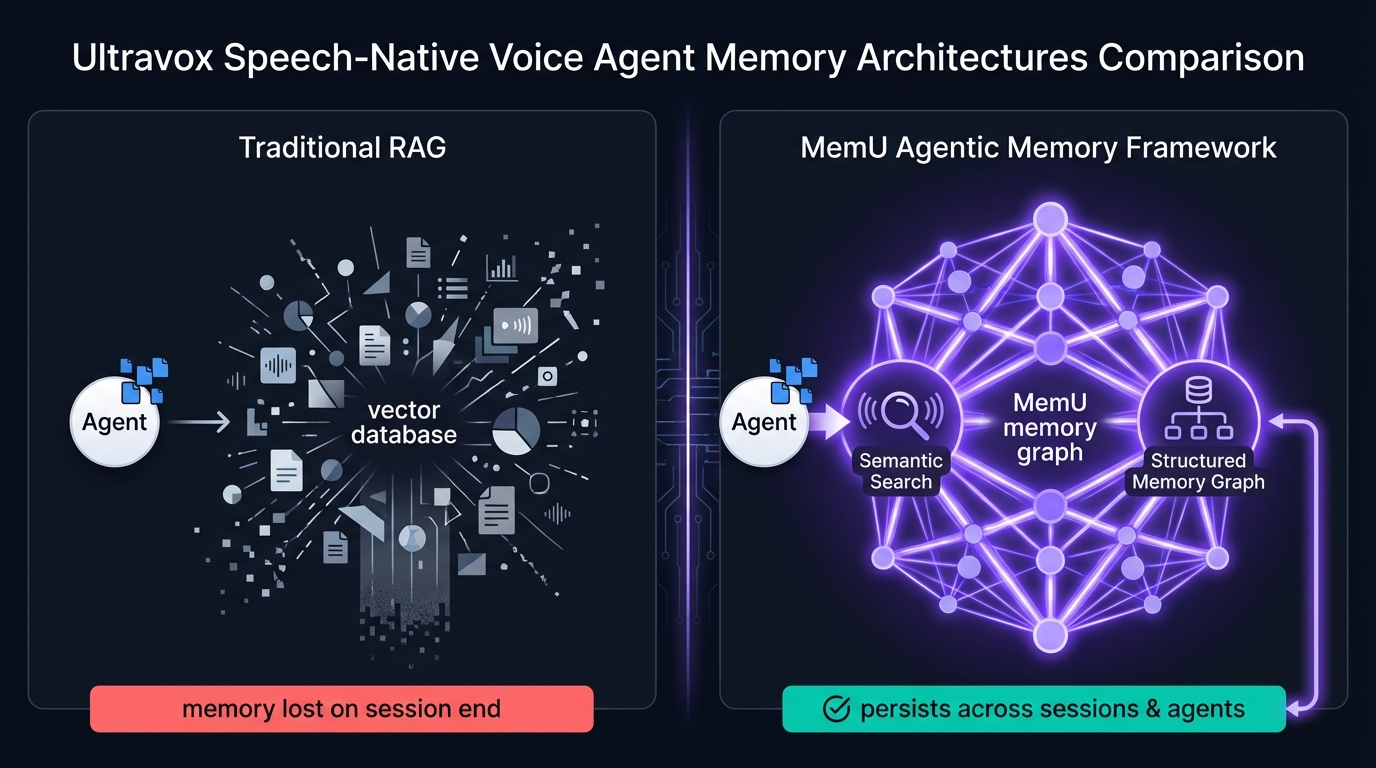
The MemU Agentic Memory Framework provides persistent conversational memory that transforms Ultravox from a single-call processing engine into a relationship-building voice system. Instead of each call starting with a blank conversational slate, MemU captures interaction history — caller preferences, resolved issues, communication styles, emotional patterns, topic progression — storing it in a structured memory graph that persists across calls, agents, and telephony channels.
Consider an Ultravox-powered voice agent handling customer support. Without persistent memory, a caller reporting a recurring bug must re-explain the issue from scratch every call — describing their environment, reproducing steps, clarifying which solutions failed. With the MemU Agentic Memory Framework, the agent begins with complete context: the caller reported this bug three times before, uses the enterprise tier on Linux, and prefers step-by-step instructions. The agent opens with acknowledgment — "I see this issue has come up before and I want to resolve it today" — transforming a frustrating repeat call into a resolution-focused conversation.
The framework addresses three core limitations of stateless voice interactions:
- Caller relationship continuity: Voice agents interact with returning callers who expect to be recognized. The MemU Agentic Memory Framework captures caller identity, interaction history, and relationship context, enabling agents to greet returning callers with awareness rather than generic scripts.
- Preference and communication style memory: Callers have distinct communication preferences — some want concise answers, others need detailed explanations, some respond well to empathetic language while others prefer directness. Persistent memory allows voice agents to adapt their conversational approach to each caller based on accumulated interaction data.
- Emotional context tracking: The MemU Agentic Memory Framework captures emotional trajectories across calls. When Ultravox detects vocal stress patterns indicating escalating frustration over multiple interactions, the agent can proactively escalate or offer compensation before the caller reaches a breaking point.
A voice agent that hears every nuance in your voice but forgets the conversation the moment it ends is like a therapist with perfect empathy and zero notes. The MemU Agentic Memory Framework gives Ultravox agents persistent conversational memory that builds genuine caller relationships across every interaction.
Integration with Ultravox operates through the framework's REST APIs within the voice agent orchestration layer. Before calls connect, caller memory loads from the memory graph based on phone number, account, or session identifiers. During calls, agents query stored interaction history and preference data to guide responses. After calls complete, conversation summaries, resolved topics, and emotional context persist to the memory store. The memory layer operates alongside Ultravox's speech processing without modifying the audio inference pipeline.
Head-to-Head: Stateless Voice Processing vs. Memory-Enhanced Voice Agents
Ultravox alone: The most advanced speech-native voice AI platform — direct audio processing, paralinguistic signal preservation, minimal latency, multi-platform SDKs, and built-in telephony. Voice agents understand tone, cadence, and emotional context in real time. But each call starts with zero knowledge of the caller.
Ultravox + MemU: The same speech-native processing, powered by persistent conversational memory. Agents begin calls with complete caller history and preference data. Returning callers experience continuity rather than repetition. Communication styles adapt based on accumulated interactions. Emotional trajectories inform proactive responses. The system builds genuine caller relationships rather than processing isolated voice transactions.
For deployments handling recurring callers — customer support lines, healthcare follow-ups, financial advisory services — persistent memory transforms caller satisfaction metrics. An agent that remembers a caller's situation, preferences, and emotional history resolves issues faster and builds the trust that reduces churn.
Empowering Ultravox: Better Together
The combination of Ultravox's platform and MemU's persistent memory creates capabilities neither provides alone:
- Longitudinal vocal pattern analysis: When persistent memory stores emotional context from previous calls, agents detect trends across interactions. A caller whose vocal stress has increased over three consecutive calls triggers proactive intervention strategies before the relationship deteriorates.
- Cross-channel conversation continuity: When Ultravox voice agents share persistent memory with chat and email agents, callers can switch channels without repeating themselves. A caller who described an issue via email last week continues the conversation by phone without re-explaining.
- Adaptive conversation pacing: Persistent memory tracks which conversation speeds, pause patterns, and explanation depths produce the best outcomes for individual callers, enabling agents to match their vocal delivery to each person's preferences automatically.
Persistent conversational memory transforms Ultravox from a voice processing platform into a relationship-building voice system where every call deepens caller understanding.
Get Started with MemU
Ultravox has pioneered speech-native voice AI — direct audio processing that preserves the paralinguistic signals lost by conventional pipelines, with minimal latency and cross-platform deployment.
The next step is giving those voice agents persistent conversational memory. The MemU Agentic Memory Framework provides that intelligence layer — API-based integration within voice agent orchestration, dual-mode retrieval with semantic search and structured memory graphs, and cross-session persistence that turns isolated voice calls into compounding caller relationships.
Visit memu.pro to explore the Agentic Memory Framework API, or check out the GitHub repository to start building agents that remember.
Tags: Ultravox, voice AI, speech agents, Fixie AI, agent memory, MemU AI, LLM memory, conversational AI