Understanding MemU: Core Concepts and Terms

What is MemU
MemU is an open-source memory framework for AI applications—high accuracy, fast retrieval, low cost. It acts as an intelligent "memory folder" that adapts to different AI application scenarios.
With MemU, you can build AI applications that truly remember their users. They learn preferences, context, and patterns, growing smarter with every interaction.
Memory as File System
We treat memory as a self-driven file system that operates autonomously in response to user interactions. When users input data, the memory system automatically extracts relevant information, modifies existing documents, generates new files, and organizes the entire structure without manual intervention.
Like humans, this file system places important memories in prominent positions for easier retrieval. The system dynamically adjusts accessibility based on frequency of access, recency, and contextual relevance—ensuring that what matters most to you is always easy to find.
Memorization Architecture Overview
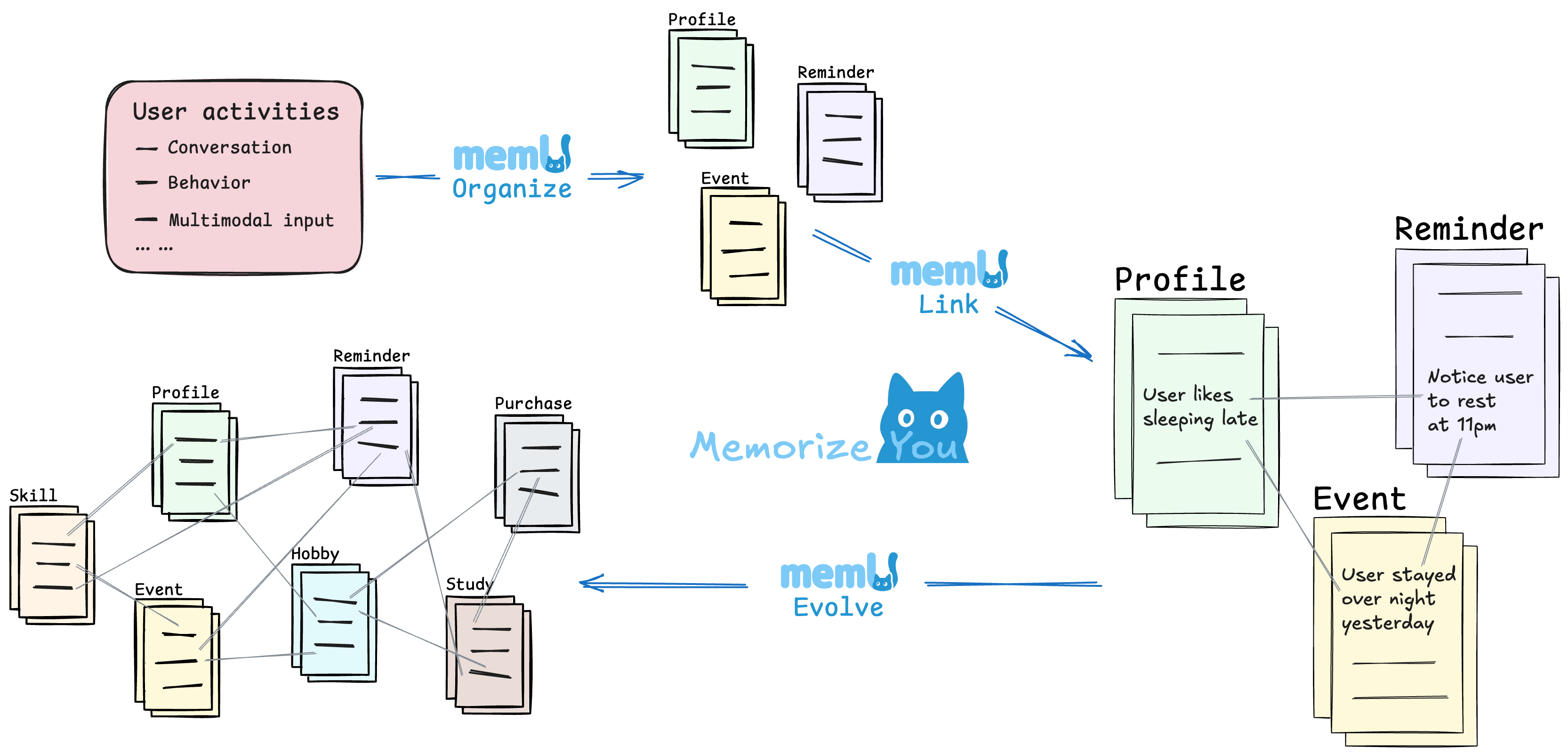
MemU System Architecture Overview
Input Layer
- Conversation: Captures and processes real-time dialogues between users and agents
- User Activity Tracking: Monitors and analyzes user activities to identify behavioral patterns
- Multimodal Processing (Under Development): Processes audio and video content uploaded by users
Memory Organization
- Key Information Extraction: Processes incoming data through advanced summarization algorithms to identify and extract significant memories into documents
- Automatic Classification: Categorizes extracted memories in compliance with predefined taxonomies.
Memory Graph Connection
- Dynamic Linking: Establishes relationships between related memories across multiple categories
- Knowledge Graph Construction: Creates a hyperlinked structure similar to Wikipedia's architecture, facilitating contextual navigation and knowledge discovery
Continuous Learning & Self-evolving
- Background Processing: Autonomous agents analyze memory patterns during system idle time
- Dynamic Category Generation: Creates new categories based on existing memory contents to ensure the memory architecture evolves with user requirements
- Theory-of-mind: Through theory-of-mind, MemU can understand users' deep intentions and generate more fine-grained memory items
- Adaptive Evolution: Maintains system relevance through continuous self-optimization
Core Concepts
Memory Category
Memory categories in memU, indicated in the filenames of the documents, play the role of organizational containers that group related memories and facilitate memory retrievals. MemU supports three typical category types:
- System categories: Pre-defined categories for common use cases such as profile (for personal information) and event (for important events in user's life)
- Custom Categories: User-defined categories tailored to specific needs, allowing users to create specialized categories like purchase for shopping guide agents
- Cluster Categories: Self-reliant categories generated through automatic clustering, self-reflection, and self-evolving. No human involvement is required.
Memory Item
The finest element of memory management in MemU, and the basic unit for memory retrieval. Each memory item carries a piece of self-contained information, typically one or two sentences in length.