UnityAI Handles 300,000 Patient Interactions Monthly With Agentic AI — But Healthcare Agents Without Longitudinal Memory Can't Learn From Patient Journeys


UnityAI secured $8.5 million in Series A funding led by Third Prime, bringing total funding to $15 million. The company deploys healthcare agentic AI across hundreds of care sites, automating patient operations and staffing coordination at a scale that handles more than 300,000 patient interactions every month. From appointment scheduling and care navigation to workforce management and patient follow-up, the UnityAI platform streamlines the administrative complexity that consumes roughly 30% of healthcare spending in the United States. For health systems drowning in operational overhead while clinical staff shortages intensify, agentic automation at this scale addresses an existential operational challenge.
But healthcare interactions are not isolated events — they are chapters in longitudinal patient journeys that span years, conditions, and care teams. An agentic system processing 300,000 monthly interactions without persistent patient operations memory treats every contact as a first encounter, unable to learn from the patterns embedded in patient histories over time.
Healthcare Agentic AI: What Everyone's Getting Right (And Missing)
UnityAI gets operational automation right. Deploying healthcare agentic AI to handle patient intake, appointment scheduling, staffing allocation, and care coordination removes the manual overhead that overwhelms clinical and administrative teams. At 300,000 interactions per month across hundreds of care sites, the throughput alone represents a meaningful advance in healthcare operations efficiency. For administrators managing complex care networks, agentic workflows eliminate the bottleneck of manual scheduling, follow-up tracking, and resource allocation that consume hundreds of staff hours weekly.
What healthcare agentic AI platforms have not fully addressed is longitudinal memory — the accumulated understanding of individual patient journeys, provider preferences, site-specific operational patterns, and care pathway outcomes that develop over months and years. UnityAI automates the immediate interaction with precision and speed; patient operations memory requires persistence that spans the entire care lifecycle, connecting today's encounter with the complete history of the patient relationship and every clinical decision along the way.
Other healthcare AI platforms — Epic's ambient documentation tools, Abridge clinical AI, Hippocratic AI's patient-facing agents — face the same constraint. They optimize the current encounter effectively and efficiently; none of them accumulate institutional knowledge across the full timeline of patient care. The result is healthcare agents that deliver operational efficiency but remain clinically amnesic, unable to build the longitudinal understanding that defines quality care delivery.
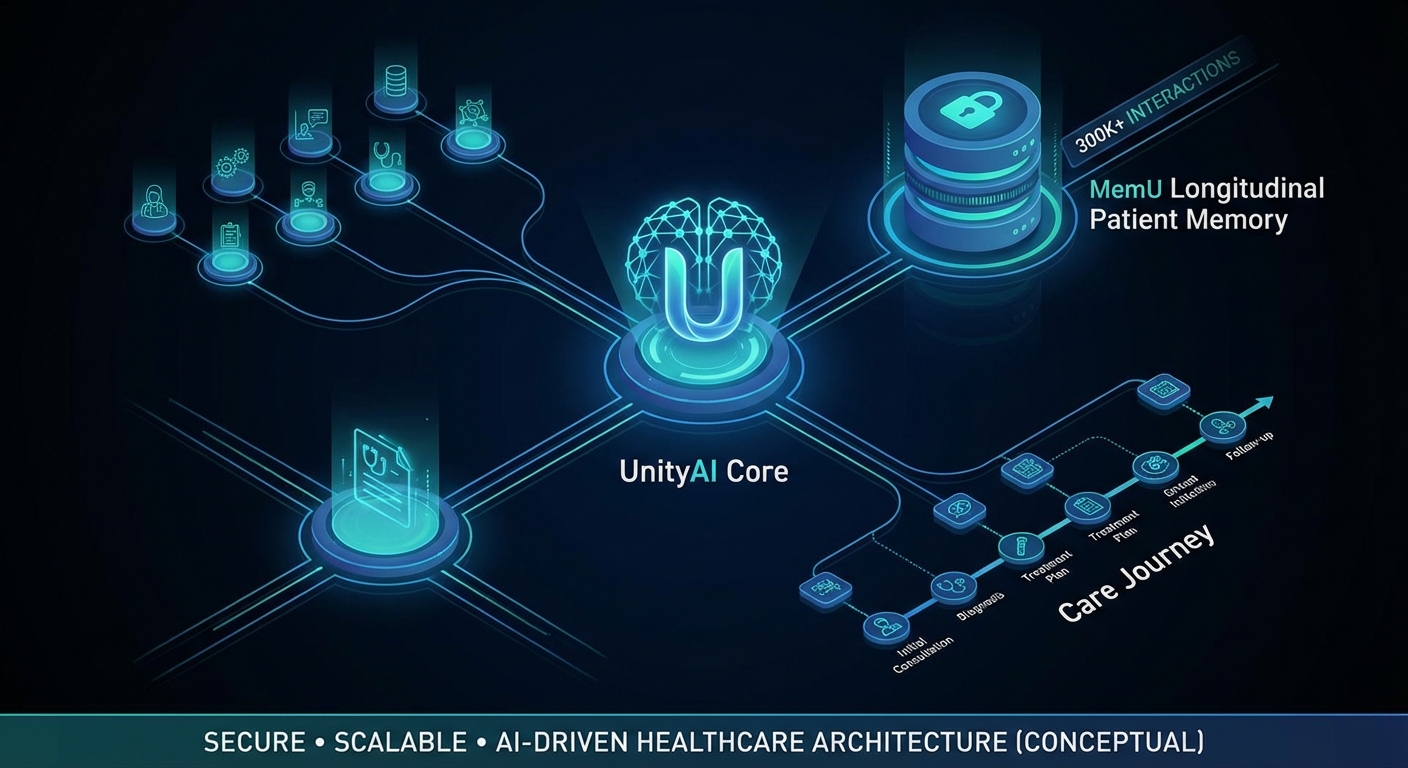
The MemU Agentic Memory Framework: Persistent Memory for Healthcare Operations
The MemU Agentic Memory Framework adds the missing persistence layer. Where UnityAI manages real-time patient operations at scale, MemU manages the longitudinal intelligence those operations generate over weeks, months, and years of continuous patient care.
Consider a patient operations memory scenario: an agent handling a follow-up call for a chronic care patient. With the MemU Agentic Memory Framework integrated, the agent retrieves that this patient missed three consecutive appointments last quarter due to transportation barriers, that a home health referral resolved the access issue, that the patient strongly prefers SMS communication over phone calls, and that medication adherence improved significantly after switching to a 90-day prescription supply. Without persistent memory, the agent processes the follow-up with zero awareness of this journey context — repeating intake questions the patient has already answered and missing interventions that have already been tried and evaluated.
The MemU Agentic Memory Framework provides:
- Longitudinal patient memory: Every interaction, outcome, preference, and care decision persists as structured memory. Agents access the full patient journey context, not just the data available in the current visit or the information stored in a static EHR record.
- Cross-site intelligence: Memory shared across care sites means a patient's operational history follows them seamlessly. When a patient visits a new location in the care network, the agent already understands their care context, communication preferences, and clinical history.
- Operational pattern recognition: Staffing patterns, appointment no-show rates, seasonal demand shifts, and site-specific workflows are stored as operational memory that informs future scheduling, resource allocation, and capacity planning decisions.
Healthcare agentic AI without longitudinal memory is operational throughput without clinical intelligence. The MemU Agentic Memory Framework gives healthcare agents the patient operations memory that transforms transactional automation into genuine care continuity — where every interaction builds on every previous one.
Retrieval operates across thousands of patient operations memory entries with sub-100ms latency, fast enough for real-time scheduling and triage decisions during peak clinic hours when every second of response time directly affects patient experience and operational flow.
Head-to-Head: MemU vs. Healthcare AI Alternatives
UnityAI alone: Agents process patient interactions in real-time, managing scheduling, follow-ups, and staffing with current-session data. Effective for operational throughput at massive scale. But the agent processing its 300,000th interaction this month carries no accumulated understanding from the previous 299,999 — each patient contact starts from whatever data exists in that immediate moment, with no memory of patterns, preferences, or outcomes learned from prior encounters across the care continuum.
UnityAI + MemU Agentic Memory Framework: Each interaction reads from persistent patient operations memory. The scheduling agent recalls that certain providers consistently run behind on specific days due to complex caseloads and adjusts booking windows accordingly. The follow-up agent remembers which outreach strategies succeeded for specific patient segments and adapts its communication approach. The staffing agent understands seasonal demand patterns that repeat annually at particular care sites and pre-allocates resources before shortages develop.
Care continuity intelligence: With MemU, healthcare agentic AI tracks the full arc of patient journeys — not individual encounters in isolation. A patient returning after a six-month gap has their complete care context immediately available, enabling the kind of longitudinal continuity that stateless systems fundamentally cannot provide. The platform processes the interaction efficiently; MemU provides the clinical memory that makes it clinically meaningful and personally relevant.
Empowering Healthcare Operations: Better Together
MemU does not replace UnityAI — it makes healthcare agentic AI dramatically more effective across every operational dimension:
- Patient operations: UnityAI handles scheduling, intake, and coordination at scale; MemU provides historical patient preferences, care patterns, and interaction outcomes that transform each operational decision from generic protocol execution to personalized care delivery tailored to individual patient needs.
- Staffing optimization: The platform manages workforce allocation across hundreds of care sites; MemU remembers demand patterns, provider performance metrics, and site-specific staffing requirements that enable proactive rather than reactive workforce management throughout seasonal cycles.
- Care pathway intelligence: Automated follow-ups and outreach communications reach patients at scale; MemU tracks which care pathways produce the best outcomes for specific patient populations, enabling evidence-informed navigation rather than one-size-fits-all protocols.
- Regulatory compliance: Persistent patient operations memory provides an auditable trail of every interaction, decision, and outcome — supporting the compliance requirements that healthcare organizations must meet under HIPAA, CMS guidelines, and state-level regulations.
Get Started with MemU
Add persistent patient operations memory to your healthcare agentic AI in minutes. The MemU Agentic Memory Framework works alongside any healthcare operations platform — one API, zero vendor lock-in, immediate longitudinal intelligence. Whether you are building on UnityAI's patient operations infrastructure or deploying healthcare agents independently, MemU provides the persistent memory layer that transforms transactional automation into systems that genuinely learn from every patient journey and improve with every interaction.
Visit memu.pro to explore the Agentic Memory Framework API, or check out the GitHub repository to start building agents that remember.