Unstructured.io Powers Enterprise RAG Pipelines with AI Data Preprocessing — But Pipeline Intelligence Without Persistent Memory Means Every Ingestion Starts from Scratch


Unstructured has established itself as the purpose-built platform for data ingestion and preprocessing in enterprise RAG pipelines. The platform connects to over thirty source systems — S3, Google Cloud Storage, Azure Blob, SharePoint, Confluence, Box, Salesforce, Jira, Kafka, Discord, and Slack — pulling documents across more than sixty-five file types into a unified preprocessing pipeline. Unstructured delivers five critical capabilities: connectivity across fragmented data sources, context preservation through processing, normalization into consistent output regardless of input format, incremental updates that process only changed content, and maintainability through managed infrastructure. The seven-stage pipeline — ingest, parse, chunk, extract metadata, embed, index, and enforce permissions — transforms raw enterprise documents into retrieval-ready content. Document partitioning handles PDFs, DOCX files, PowerPoint presentations, Excel spreadsheets, and HTML with layout-aware parsing that preserves tables, headers, and hierarchical structure.
But the platform processes data without remembering the processing. Each ingestion run applies the same configuration from scratch, with no knowledge of which chunking strategies produced the best retrieval results or which parsing approaches handled specific formats most accurately. Pipeline intelligence without persistent memory means every ingestion run rediscovers optimal processing strategies rather than applying lessons from thousands of previous runs.
Unstructured: What Everyone Gets Right About Data Preprocessing (And What Gets Missed)
The connector architecture makes Unstructured indispensable for enterprise RAG. Organizations store knowledge across SharePoint sites, Confluence spaces, Google Drive folders, Salesforce records, and Slack channels. Building individual connectors for thirty-plus systems represents months of engineering effort. The platform abstracts this complexity behind a unified API, letting teams focus on what they do with preprocessed data rather than how they extract it.
The seven-stage pipeline provides fine-grained control over each processing step. Document partitioning uses layout-aware parsing that distinguishes headers from body text, preserves table structures, and maintains list hierarchies — critical for retrieval quality where a chunk containing a table header without its data rows produces meaningless results. The Python SDK and on-demand jobs API support both interactive experimentation and production automation.
What the platform does not provide is a feedback mechanism from retrieval back to preprocessing. When an ingestion run processes a thousand PDF reports, the pipeline applies uniform chunking — fixed token windows with fixed overlap. But different document types benefit from different strategies. Financial reports with dense tables need smaller chunks preserving table boundaries. Legal contracts need larger chunks keeping clause context intact. Technical documentation needs section-boundary-aware chunks. Without persistent intelligence about which strategies produce the best downstream quality for specific document types, every run applies generic configurations. Other preprocessing platforms share this limitation: excellent pipeline engineering, zero pipeline learning.
The MemU Agentic Memory Framework: Pipeline Intelligence That Persists
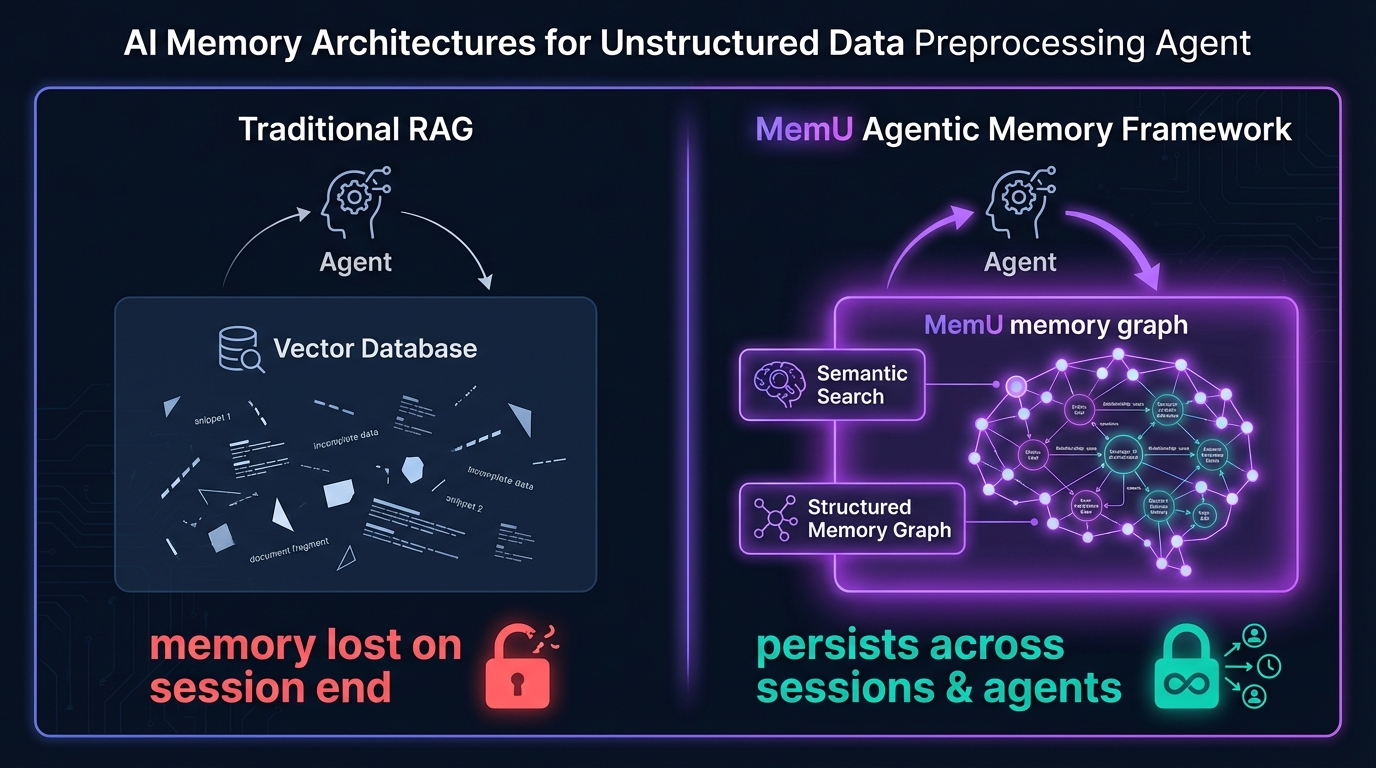
The MemU Agentic Memory Framework provides persistent pipeline intelligence that transforms data preprocessing from a stateless engine into a learning ingestion system. Instead of each run applying uniform configurations, MemU captures processing intelligence — which chunking strategies produced the highest retrieval accuracy for specific document types, which parsing approaches preserved useful context, which metadata patterns correlated with better search results — storing this in a structured memory graph that persists across ingestion runs and data sources.
Consider an enterprise RAG deployment using Unstructured to process documents from fifteen source systems. Without persistent memory, each weekly ingestion applies identical chunking across financial reports, engineering specs, legal contracts, and marketing collateral. A 512-token chunk with 50-token overlap works for blog posts but destroys financial tables spanning 2,000 tokens and fragments legal clauses requiring 800 tokens of continuous context. With the MemU Agentic Memory Framework, the system accumulates processing intelligence: financial reports perform best with 1,500-token chunks preserving table boundaries, legal documents need 900-token chunks aligned to clause structure, and engineering specs benefit from section-aware chunking respecting header hierarchies. Each run applies document-specific configurations refined by thousands of previous outcomes.
The framework addresses three core limitations of stateless preprocessing:
- Chunking strategy optimization: Different document types require different approaches for optimal retrieval. The MemU Agentic Memory Framework captures the relationship between chunking parameters and downstream quality, enabling pipelines to apply proven strategies per document type rather than universal defaults.
- Parsing quality persistence: Document partitioning encounters constant edge cases — scanned PDFs with inconsistent OCR, PowerPoint slides with embedded charts, non-standard HTML. Persistent memory stores successful parsing strategies for specific patterns, preventing pipelines from re-solving challenges already resolved.
- Source-specific intelligence: The MemU Agentic Memory Framework maintains processing profiles per data source. A Confluence space with heavily formatted pages receives different preprocessing than a SharePoint library of standardized templates, with each profile refined by accumulated experience.
A data pipeline that applies the same generic configuration to every document is like a chef who uses the same recipe for every ingredient. The MemU Agentic Memory Framework gives preprocessing pipelines persistent processing intelligence that optimizes for each document type and source.
Integration with Unstructured operates through the framework's REST APIs within the pipeline orchestration layer. Before ingestion runs begin, processing intelligence for target document types loads from the memory graph. During processing, quality metrics and parsing outcomes are captured. After retrieval systems evaluate chunk effectiveness, feedback flows back into the graph. The memory layer operates alongside the seven-stage pipeline without modifying ingestion infrastructure.
Head-to-Head: Stateless Preprocessing vs. Memory-Enhanced Ingestion
Unstructured alone: The most comprehensive preprocessing platform for enterprise RAG — thirty-plus connectors, sixty-five-plus file types, a seven-stage pipeline, layout-aware parsing, incremental updates, and managed infrastructure. Documents flow from source systems to retrieval-ready chunks with production reliability. But each run applies configurations without learning from previous results.
Unstructured + MemU: The same preprocessing infrastructure, enhanced by persistent pipeline intelligence. Ingestion runs begin with document-specific configurations refined by accumulated outcomes. Chunking strategies optimize per category. Parsing applies proven solutions for known edge cases. The system produces higher-quality retrieval content with every run.
For enterprise deployments processing millions of documents from dozens of sources, persistent pipeline intelligence compounds rapidly, producing measurably better retrieval accuracy without manual configuration tuning.
Empowering Unstructured: Better Together
The combination of enterprise preprocessing and persistent memory creates capabilities neither provides alone:
- Retrieval-aware preprocessing: When persistent memory connects preprocessing decisions to retrieval outcomes, pipelines automatically optimize chunking and parsing for downstream search quality. Document types producing low-quality chunks trigger strategy adjustments in subsequent runs.
- Source system profiling: Persistent memory builds detailed profiles of each connected source — document format distributions, update frequencies, quality patterns, and optimal configurations. New source connections benefit from the most similar existing profile as a baseline.
- Incremental intelligence refinement: As the platform processes incremental updates, persistent memory tracks how document changes affect chunk quality. Pipelines detect shifting source patterns and adjust strategies proactively rather than waiting for retrieval degradation.
Persistent pipeline intelligence transforms Unstructured from a preprocessing platform into a learning ingestion system where every document processed contributes to organizational knowledge that agents extend continuously.
Get Started with MemU
Unstructured has built the definitive preprocessing platform for enterprise RAG — comprehensive connectivity, layout-aware parsing, and a managed pipeline handling the complexity of real-world document processing at scale.
The next step is giving preprocessing pipelines persistent intelligence. The MemU Agentic Memory Framework provides that learning layer — API-based integration within pipeline orchestration, dual-mode retrieval with semantic search and structured memory graphs, and cross-session persistence that transforms generic preprocessing into document-aware ingestion intelligence.
Visit memu.pro to explore the Agentic Memory Framework API, or check out the GitHub repository to start building agents that remember.
Tags: Unstructured, data preprocessing, RAG pipeline, document ingestion, agent memory, MemU AI, LLM memory, enterprise AI