Upstash Powers Serverless Agent State With Redis, Kafka, and Vector — But Ephemeral State Management Does Not Encode Persistent Intelligence


Upstash has built the serverless data infrastructure that modern AI agents need for state management. The platform delivers serverless Redis with two-to-fifteen-millisecond latency, serverless Kafka for event streaming, a Vector database using DiskANN and FreshDiskANN algorithms for efficient approximate nearest neighbor search, and QStash for reliable message queuing. The pay-per-request pricing model scales to zero when idle, eliminating the fixed costs that make traditional data infrastructure prohibitive for agent workloads with variable demand. Upstash supports CDC pipelines from PostgreSQL through Kafka to Vector for continuous embedding updates, keeping AI systems current with domain knowledge as source data changes. The free tier provides ten thousand requests per day, with Pro plans at twenty cents per hundred thousand requests. Built-in rate limiting, cosine and euclidean distance metrics, and event streaming for real-time vector ingestion round out a platform designed for the serverless-first AI stack.
But serverless state management and persistent agent intelligence serve fundamentally different purposes. The platform excels at storing and retrieving data with minimal latency and zero operational overhead. What it does not provide is a structured memory system that captures agent reasoning patterns, decision histories, and operational optimizations in a form that agents can query to make better decisions. Ephemeral state keeps agents running — persistent memory makes them intelligent.
Upstash: What Everyone Is Getting Right (And Missing)
The serverless model solves real infrastructure pain for agent developers. Traditional Redis deployments require capacity planning, cluster management, and paying for idle resources during low-traffic periods. Upstash eliminates all of that — agents get sub-fifteen-millisecond key-value access with automatic scaling and per-request billing. For agent state management — caching intermediate results, maintaining conversation context, tracking workflow progress — this is the ideal infrastructure pattern.
The Vector database offering deserves particular attention. DiskANN and FreshDiskANN provide efficient approximate nearest neighbor search at a fraction of the cost of dedicated vector database services. The CDC pipeline architecture — streaming updates from PostgreSQL through Kafka into the Vector store — ensures embeddings stay current without batch reprocessing. This is genuinely innovative for keeping RAG systems synchronized with changing source data. Event streaming through Kafka enables real-time vector ingestion patterns that most vector databases handle through periodic batch updates.
What the platform does not address is the gap between state storage and structured agent intelligence. Redis stores key-value pairs. Kafka streams events. Vector search finds similar embeddings. But none of these primitives encode the kind of structured reasoning that agents need: which decision sequences produced the best outcomes for a given task category, how tool selection patterns evolved as the agent encountered new scenarios, or which retrieval strategies worked best for specific query types. Upstash provides excellent building blocks, but building blocks require an intelligence layer to become agent memory. Other serverless data platforms share this characteristic — they optimize for storage speed without addressing the semantic structure of operational knowledge.
The MemU Agentic Memory Framework: Structured Intelligence on Serverless Infrastructure
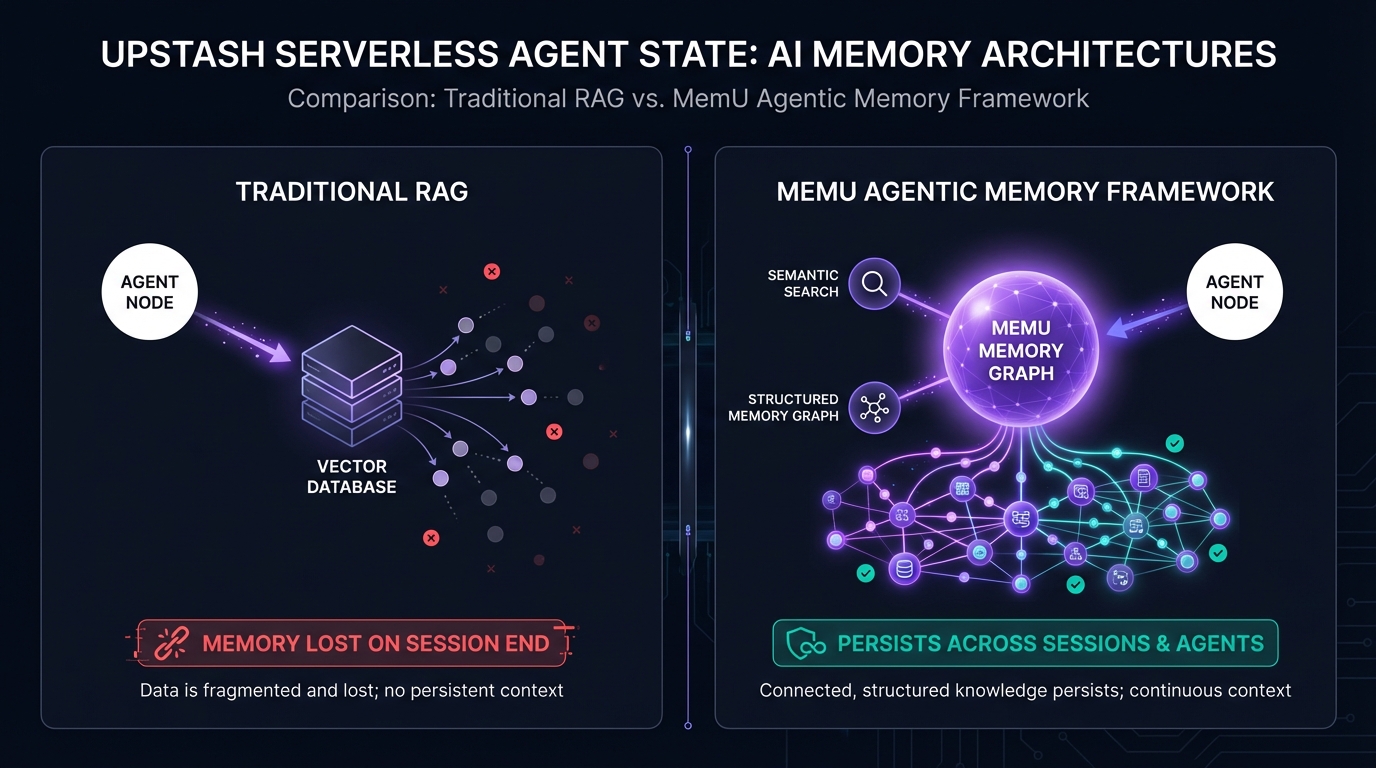
The MemU Agentic Memory Framework transforms serverless data primitives into structured agent intelligence. Instead of storing raw state in Redis keys or unstructured embeddings in vector stores, MemU organizes operational knowledge into episodic, semantic, and procedural memory layers — capturing not just what data an agent accessed, but what reasoning led to successful outcomes, what decision sequences should be repeated, and what patterns should be avoided.
Consider an AI agent managing e-commerce inventory using serverless Redis for caching and Vector for product similarity search. Without structured memory, the agent stores product embeddings and retrieves similar items — functional but generic. With the MemU Agentic Memory Framework, the agent recalls operational intelligence: seasonal demand patterns require inventory adjustments six weeks before peak periods rather than two, product similarity search performs better with a cosine distance threshold of point-eight-five for electronics but point-seven for apparel, and supplier API latency spikes on Monday mornings necessitate pre-cached queries sent Sunday evening. That structured intelligence operates alongside state management, adding decision-quality knowledge that raw key-value and vector storage cannot represent.
The framework addresses three limitations of infrastructure-level state management:
- Decision sequence memory: The MemU Agentic Memory Framework captures which sequences of decisions produced the best outcomes. While Redis caches individual results, it cannot represent the causal relationships between multi-step agent decisions that led to those results.
- Retrieval strategy optimization: Vector search returns similar embeddings, but effective retrieval requires strategy. Persistent memory captures which distance thresholds, result counts, and re-ranking approaches worked best for specific query categories.
- Cross-session reasoning persistence: Serverless functions execute and terminate. The MemU Agentic Memory Framework ensures that reasoning patterns discovered during one execution persist for the next, preventing the cold-start intelligence problem that serverless architectures amplify.
Serverless infrastructure eliminates operational overhead. Persistent memory eliminates intelligence overhead. The MemU Agentic Memory Framework builds structured reasoning on top of data primitives — giving agents knowledge, not just storage.
Integration uses Upstash as the data layer while MemU provides the intelligence layer. Redis handles caching, session state, and rate limiting with sub-fifteen-millisecond performance. Kafka manages event streams and CDC pipelines. Vector stores embeddings for similarity search. The memory framework operates alongside these services through REST APIs, storing and retrieving structured operational memory that gives agents decision-quality context beyond raw data infrastructure.
Head-to-Head: Data State vs. Intelligent Memory
Upstash alone: Serverless Redis with two-to-fifteen-millisecond latency, Kafka for event streaming, Vector with DiskANN for approximate nearest neighbor search, QStash for message queuing, CDC pipelines for continuous embedding updates, pay-per-request pricing that scales to zero, and built-in rate limiting. Exceptional data infrastructure for agent workloads. But data storage is not agent memory.
Upstash + MemU: The same serverless data infrastructure, augmented with structured agent intelligence. Agents do not just cache results — they remember why certain results mattered. Vector search is guided by persistent knowledge of which retrieval strategies work best. Event streams carry operational context that compounds the intelligence of every downstream consumer.
For serverless architectures processing variable workloads with frequent cold starts, the combination is particularly powerful. The platform eliminates infrastructure cold starts with instant-on data access. MemU eliminates intelligence cold starts with persistent operational memory. Together, they deliver agents that scale to zero in cost without scaling to zero in accumulated knowledge.
Empowering Upstash: Better Together
The combination of Upstash serverless infrastructure and MemU persistent memory creates capabilities neither achieves independently:
- Intelligent CDC pipelines: PostgreSQL-to-Kafka-to-Vector pipelines keep embeddings current. Persistent memory adds a decision layer — tracking which embedding updates actually improved agent performance and which introduced noise, enabling selective strategies that maintain retrieval quality.
- Adaptive rate limiting: The platform provides built-in rate limiting for API protection. Persistent memory enables intelligent rate allocation — agents learn which request patterns are high-value and which are low-priority, distributing limits based on operational history rather than static rules.
- Cross-function knowledge sharing: Serverless functions execute in isolation. Persistent memory provides a shared intelligence layer where operational insights discovered by one function become available to all functions processing related workloads, breaking isolation without introducing coupling.
Persistent memory transforms Upstash from best-in-class serverless data infrastructure into the foundation of intelligent serverless agent systems — where pay-per-request efficiency meets pay-once-learn-forever intelligence.
Get Started with MemU
Upstash delivers the serverless data infrastructure that modern agent architectures demand — Redis, Kafka, Vector, and QStash with pay-per-request pricing, scale-to-zero efficiency, and sub-fifteen-millisecond latency that eliminates infrastructure complexity.
The next step is building structured agent intelligence on that infrastructure. The MemU Agentic Memory Framework provides that layer — API-based integration alongside serverless services, structured memory graphs with episodic, semantic, and procedural layers, and persistent operational memory that turns data primitives into compounding agent intelligence.
Visit memu.pro to explore the Agentic Memory Framework API, or check out the GitHub repository to start building agents that remember.
Tags: Upstash, serverless Redis, serverless Kafka, vector database, agent state, agent memory, MemU AI, serverless AI