Vercel v0 Generates Production UI With AI — But Design Systems Without Component Memory Repeat Past Decisions


v0 by Vercel has established itself as the leading AI-powered UI generation tool for React developers. Type a natural language description — or upload a design screenshot — and v0 generates production-ready React components with Tailwind CSS and shadcn/ui, complete with accessibility attributes and responsive layouts. The v0 v2 release added stronger TypeScript support, improved context awareness, and full-stack capabilities including database integrations, authentication, and payment processing. At $20/month for the Pro tier, developers get unlimited generations and commercial usage rights, making it a practical tool for building real product interfaces rather than just prototyping.
But v0 operates within a fundamental constraint: each generation session is independent. The AI that generated a dashboard layout matching your exact design preferences yesterday cannot recall those preferences today. UI generation without component memory means every design session restarts the preference learning process.
v0: What Everyone's Getting Right (And Missing)
v0's technical execution is impressive. The model understands design systems deeply — it generates components that follow shadcn/ui conventions, applies Tailwind utility classes correctly, and handles responsive breakpoints without explicit instruction. The chat-based iteration workflow lets developers refine generated UI through conversation, adjusting spacing, colors, and layout through natural language rather than manual CSS editing. For teams that need to move quickly from wireframe to working component, v0 compresses hours of frontend work into minutes.
The platform also handles the full-stack context well. A prompt requesting "a pricing page with Stripe integration" doesn't just generate UI — it produces the component, the API route, the webhook handler, and the database schema. This depth of generation means developers can go from concept to deployed feature without context-switching between different tools and documentation.
What v0 does not preserve is the design language that emerges across interactions. A developer who has spent twenty sessions establishing their application's visual identity — specific color palettes, spacing scales, animation patterns, component composition approaches — cannot transfer that accumulated design intelligence to session twenty-one. The AI generates excellent UI, but it generates it fresh every time. Other AI UI tools — including Galileo AI, Uizard, and TeleportHQ — share this same limitation. They optimize for single-prompt generation quality; none capture the evolving design system as persistent knowledge.
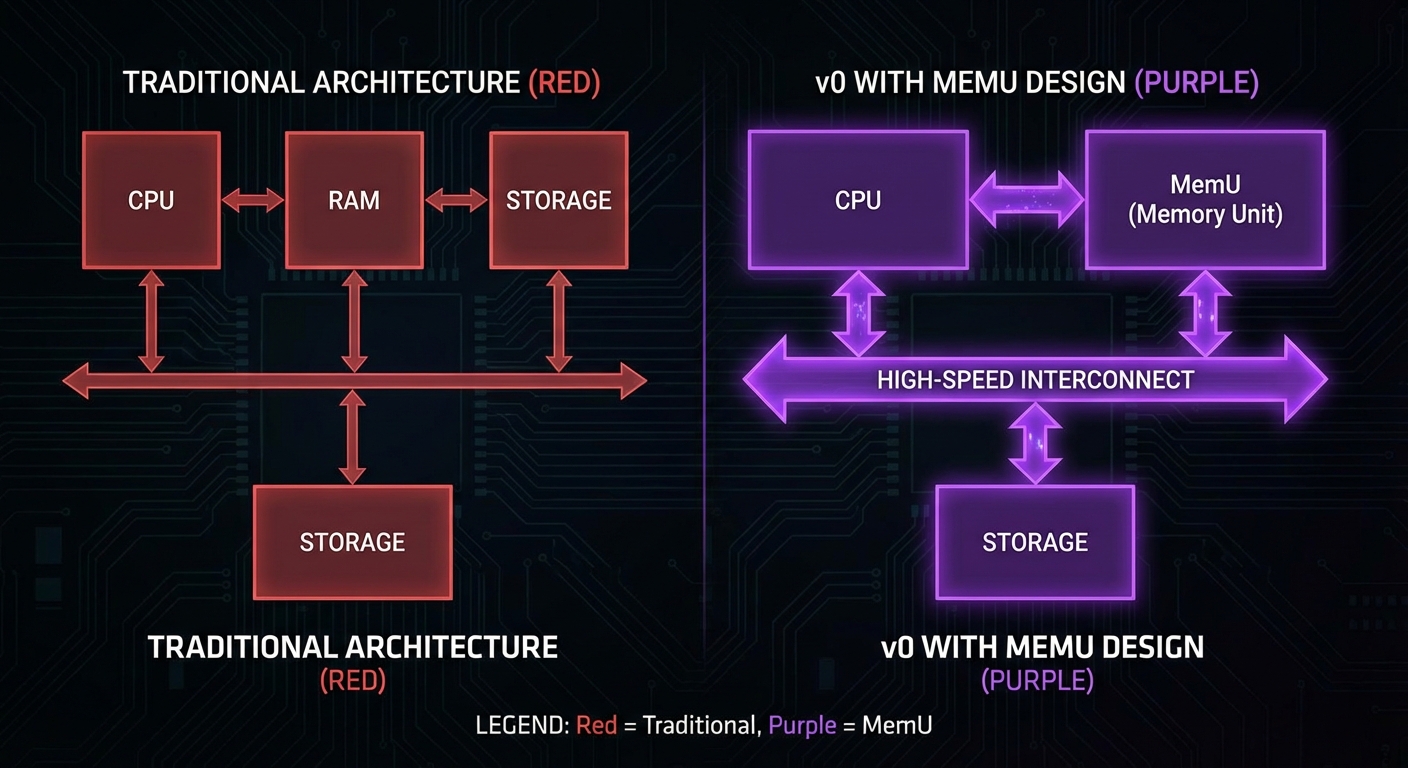
The MemU Agentic Memory Framework: Design Intelligence That Persists
The MemU Agentic Memory Framework provides the persistent memory layer that UI generation tools like v0 do not include natively. Instead of treating each generation request as an isolated design task, MemU captures the visual preferences, component patterns, and design decisions that emerge during interaction and stores them in a structured memory graph that persists across sessions, projects, and teams.
Consider a product team building a SaaS dashboard with v0. Without persistent memory, each component generation starts from v0's default shadcn/ui assumptions. With the MemU Agentic Memory Framework, the AI retrieves the team's established design language: they use 8px spacing increments, prefer outline-style icons from Lucide, apply a specific border-radius scale, and always include skeleton loading states. Every generated component arrives pre-aligned with the existing design system, reducing iteration rounds from five to one.
The framework addresses three core limitations of session-bounded UI generation:
- Design system persistence: Every visual decision — color tokens, spacing values, typography scales, animation durations — is captured and recalled in future sessions. The MemU Agentic Memory Framework builds a living design system from actual usage, not abstract documentation.
- Component pattern learning: When a developer consistently modifies generated card components to include a specific header layout or action button placement, MemU learns that pattern. Future card generations arrive with the preferred structure already in place, eliminating repetitive corrections.
- Cross-project design continuity: Teams building multiple products with shared design language get consistent UI generation across projects. The navigation pattern established in the admin dashboard is automatically applied when generating navigation for the customer portal.
UI generation tools produce excellent components — but without memory, they produce them generically. The MemU Agentic Memory Framework turns every design interaction into persistent intelligence that makes each generated component more aligned with your visual identity.
Integration with v0 workflows requires minimal overhead. The MemU Agentic Memory Framework exposes REST APIs that enrich generation prompts with historical design context before each interaction and store new design decisions after. The memory layer complements the generation engine, providing the design continuity that session-based tools cannot maintain on their own.
Head-to-Head: Stateless UI Generation vs. Memory-Enhanced Design
v0 alone: Best-in-class AI UI generation with deep React, Tailwind, and shadcn/ui understanding. Full-stack generation capabilities and chat-based iteration deliver production-quality components rapidly. But every session starts from default assumptions — the AI has no knowledge of the developer's established design preferences or the project's existing visual language.
v0 + MemU: The same powerful generation, now informed by persistent design memory. Every component arrives pre-aligned with the project's established design system. Color palettes, spacing scales, component compositions, and interaction patterns are recalled from accumulated design decisions across previous sessions. The AI generates UI that looks like it belongs in your application from the first prompt.
The compounding effect is significant for teams with established products. After ten sessions of memory-enhanced generation, the AI understands the product's visual identity deeply enough to generate new pages that are visually indistinguishable from hand-crafted designs — matching the existing application's personality without explicit design system documentation.
Empowering v0: Better Together
The combination of v0's AI generation capabilities and the MemU Agentic Memory Framework's persistent memory unlocks design workflows that neither capability achieves alone:
- Living design system generation: Instead of maintaining a static design system document that drifts from actual implementation, persistent memory captures the real design system as it evolves through usage. Every correction and refinement updates the AI's understanding of the design language, keeping generated output aligned with the team's current standards.
- Responsive pattern intelligence: Agents that remember how previous components adapted across breakpoints generate new components with consistent responsive behavior. The mobile navigation pattern established in earlier sessions is automatically applied to new pages, maintaining a coherent mobile experience without explicit instruction.
- Design review acceleration: When generated components already match the established design system, design reviews focus on layout and content decisions rather than visual consistency. Teams spend less time on pixel-level corrections and more time on user experience design.
Persistent memory transforms v0 from a powerful generation tool into a design partner that understands your product's visual identity and generates components that belong in your application from the first prompt.
Get Started with MemU
v0 has earned its position as the leading AI UI generation tool by combining deep design system understanding with full-stack generation capabilities. The shadcn/ui integration, TypeScript support, and chat-based iteration workflow solve real problems for frontend developers building production interfaces.
The next step is giving that generation engine design memory that persists. Sessions where the AI already knows your color palette, spacing scale, and component preferences. Projects where visual consistency is maintained automatically through accumulated design intelligence rather than manual style guides.
The MemU Agentic Memory Framework provides that foundation. Drop-in API integration, dual-mode retrieval with semantic search and structured memory graphs, and cross-session persistence that turns every design interaction into compounding visual intelligence.
Visit memu.pro to explore the Agentic Memory Framework API, or check out the GitHub repository to start building agents that remember.
Tags: v0, Vercel, AI UI generation, agentic AI, agent memory, MemU AI, LLM memory