Vapi Orchestrates STT, LLM, and TTS for Low-Latency Voice AI — But Telephony-Grade Voice Without Memory Still Resets Every Caller


Vapi markets itself squarely at developers who need production voice stacks without assembling fragile glue code. The platform orchestrates speech-to-text, large language models, and text-to-speech into a cohesive real-time loop tuned for low latency—the difference between sounding attentive versus robotic on a live phone line. Beyond raw audio, assistants gain tools, knowledge bases, workflows, and squads so teams can model handoffs, escalations, and specialist behaviors. Server SDKs across multiple languages make it straightforward to embed voice into backends you already operate. Pricing in the ballpark of five cents per minute keeps experimentation affordable while remaining predictable at scale.
Those capabilities solve connectivity, orchestration, and cost visibility. They do not, by default, give every assistant the same longitudinal understanding of a customer that a seasoned human agent develops over months. Vapi can deliver a crisp answer in the moment; it does not remember that this caller prefers concise confirmations, that last week’s issue was partially resolved, or which troubleshooting path actually worked when the knowledge base article was wrong.
Developer ergonomics are a major reason teams pick Vapi: you focus on assistant logic and business integrations instead of wrestling codecs. Yet ergonomics do not substitute for memory architecture. When product requirements shift from “answer FAQs” to “own the relationship,” latency and voice quality remain necessary but no longer sufficient.
Low-latency voice AI without persistent caller memory repeats questions customers already answered and burns trust on every new session.
Vapi: What Voice Teams Get Right (And What Still Fractures Across Calls)
The architectural bet behind the Vapi stack is correct for modern expectations: callers judge quality by responsiveness and natural turn-taking, not by how many boxes a diagram has. Squads and workflows map well to operational reality—front-line triage, specialist transfer, after-hours coverage—without forcing a single monolithic prompt to do everything. Tool calling unlocks actions (bookings, ticket updates, lookups) that separate demos from products.
Multi-language server SDKs matter because voice touches billing systems, CRMs, and compliance hooks that rarely live in the same repo as the ML experiment. When the platform integrates cleanly with your services, you spend engineering time on business rules rather than RTP trivia.
The persistent gap is continuity. Telephony identifiers, CRM keys, and authenticated user profiles can load context rows from a database, but that is not the same as memory of how this person interacts—what phrasing reduces confusion, which offers they decline, which escalation path ended well. Stateless orchestration plus static profile fields misses the compounding nuance that makes conversations feel personal rather than scripted.
Other voice platforms share the pattern: excellent session engineering, optional long-term recall left to bespoke databases that rarely encode interaction tactics in a form agents can query mid-call.
Cost visibility at roughly five cents per minute helps finance partners model growth, but unit economics improve further when repeat callers resolve faster because the assistant recalls prior outcomes. Memory reduces average handle time and repeat contacts—metrics finance notices even when engineering originally prioritized latency above all else.
The MemU Agentic Memory Framework: Caller Memory That Survives Hangups
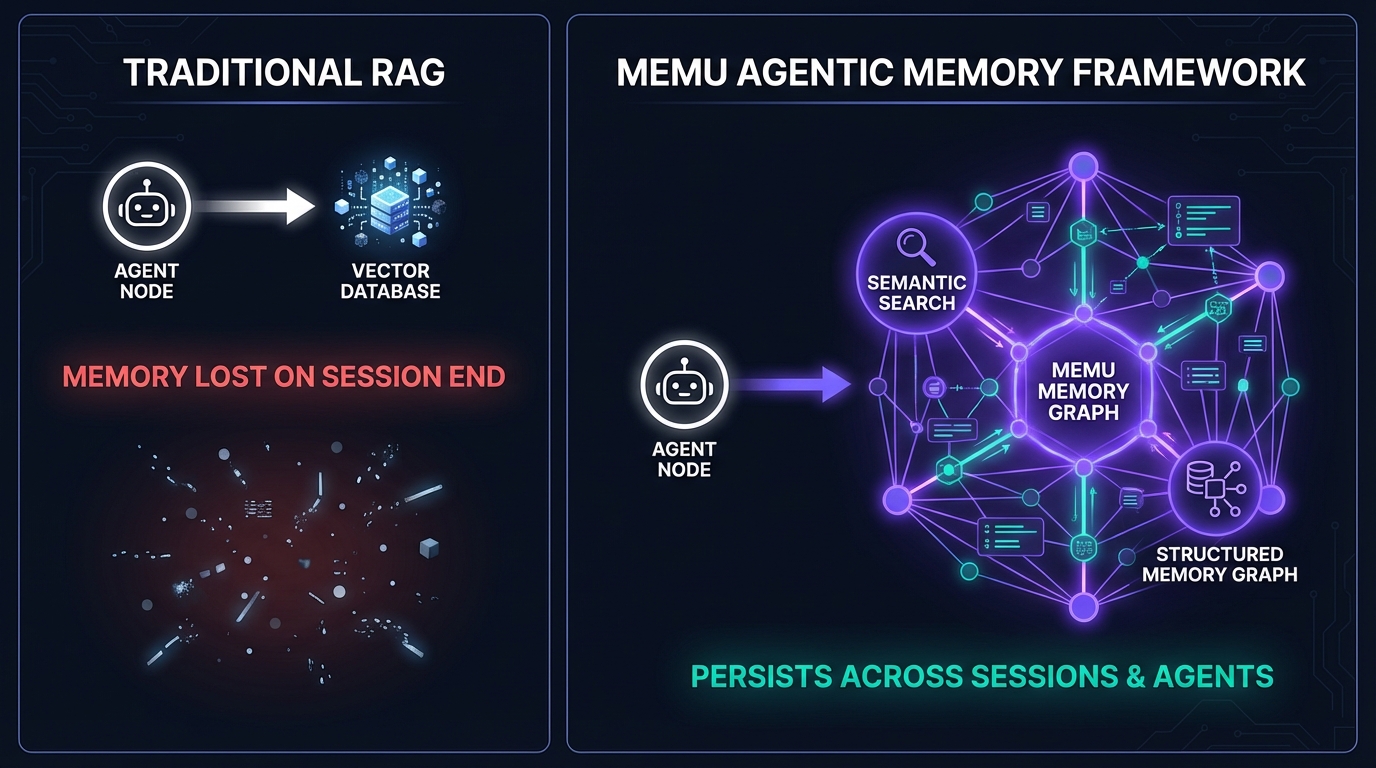
The MemU Agentic Memory Framework gives voice deployments a structured memory graph for preferences, outcomes, and successful dialogue strategies that should persist across calls, channels, and assistant versions. Instead of treating each inbound leg as isolated, assistants retrieve memories before generating the opening line.
A squad might route billing questions to a specialist assistant after intake. Without memory, the specialist re-asks account verification the caller already provided. With MemU, the handoff carries verified facts and tone guidance—“this caller wants short sentences”—learned from prior successful completions.
Operational benefits alongside your production voice stack:
- Preference memory: Pace, verbosity, and confirmation style per caller or account, updated when post-call analytics show satisfaction shifts.
- Issue lineage: Prior resolutions, failed attempts, and promised follow-ups stored as retrievable objects, not buried in call logs only humans read.
- Squad coherence: Shared memory namespaces so intake and specialist agents reference the same evolving picture without fragile session variables alone.
The MemU Agentic Memory Framework turns telephony identifiers into relationships. The voice layer keeps the pipes hot; MemU keeps the story continuous.
Integration typically wraps your webhook or server SDK flow: on call start, fetch relevant memories; on call end, write distilled memories with policy filters for retention and privacy. The MemU Agentic Memory Framework stays model-agnostic, so upgrades to underlying STT, LLM, or TTS providers do not erase organizational recall.
Privacy and retention policies belong in your control plane: classify memories by sensitivity, tie expiration to regulations, and redact on request. The realtime voice layer handles transport; MemU holds the durable narrative with governance hooks you define.
Head-to-Head: Running Vapi With and Without MemU
Voice stack alone: Strong STT+LLM+TTS orchestration, low-latency focus, assistants with tools and knowledge, workflows and squads, multi-language server SDKs, and minute-based pricing suited to telephony workloads when you build on Vapi. Weak when your differentiation is “we actually remember you” beyond static CRM columns.
Vapi plus MemU: Same real-time stack with durable interaction memory. Callers experience fewer redundant questions, smarter handoffs, and assistants that improve as memory accrues—without sacrificing the latency profile the platform optimizes for.
Empowering the Vapi Stack: Better Together
Patterns that pair well:
- Post-call memory writes: Summarize successful resolutions into MemU automatically when QA scores or user feedback pass thresholds.
- Mid-call retrieval: Lightweight queries to the MemU Agentic Memory Framework during tool gaps to avoid blocking audio while still informing the next turn plan.
- Cross-channel continuity: Align voice memories with chat or email agents so switching channels does not erase narrative context.
Squads and workflows shine when specialists inherit context automatically. Without memory, each hop re-negotiates facts the caller already stated; with MemU, the intake assistant’s verified details become the specialist’s opening context. That pattern mirrors how human call centers use CRM screen pops—except the pop is generated from structured memories tuned for LLM consumption, not just raw database rows. The result is fewer dead-air seconds and fewer frustrated repetitions on transfers.
Together, Vapi delivers telephony-ready voice AI infrastructure, and MemU delivers the relationship substrate that makes that infrastructure feel human over time. The combination preserves the roughly five-cents-per-minute economics while improving outcomes that show up in CSAT and retention, not only in milliseconds saved per turn.
Get Started with MemU
If you are shipping on Vapi for low-latency voice, tools, squads, and server SDKs—around five cents a minute—add the MemU Agentic Memory Framework so assistants stop re-learning every caller’s story from zero.
Visit memu.pro to explore the Agentic Memory Framework API, and open the GitHub repository to integrate persistent memory into your voice stack.
Tags: Vapi, voice AI, telephony, STT, LLM, TTS, squads, agent memory, MemU AI