Vercel AI SDK Powers Thousands of AI Applications — But Agents Built With It Lose All Context the Moment a User Session Ends


The Vercel AI SDK has become the default framework for building AI-powered web applications. Its unified API abstracts LLM provider complexity — OpenAI, Anthropic, Google, Mistral, and more — through a clean provider system that lets developers swap models without rewriting application logic. Core primitives include generateText and streamText for conversational interfaces, generateObject and streamObject for structured output with Zod schema validation, and a tool calling system for invoking external functions. For agentic applications, the maxSteps parameter enables multi-step agent loops where the model makes tool calls, processes results, and continues reasoning. AI RSC (React Server Components) brings streaming AI responses directly into React component trees. Thousands of Next.js applications use the Vercel AI SDK in production today.
But the framework builds agents that are powerful within a session and amnesiac across sessions. An agent that spent 15 tool-calling steps researching a user's question retains none of that research when the user returns tomorrow with a follow-up. Great agent frameworks solve the building problem — they don't solve the memory problem. Agents built with the Vercel AI SDK execute sophisticated multi-step workflows that evaporate when the session ends.
Vercel AI SDK: What the Industry Gets Right (And What Disappears Between Sessions)
The design is genuinely elegant. The provider pattern — where each LLM vendor is a pluggable module — means applications aren't locked into a single model provider. Switching from OpenAI to Anthropic is a configuration change, not a refactor. The streaming primitives are particularly well-designed for web applications: streamText sends tokens to the client as they're generated, creating responsive UIs. streamObject progressively builds structured data, enabling forms that populate in real time. For developers building production AI applications on Next.js, these primitives eliminate months of custom streaming infrastructure.
The agentic capabilities are well-architected. The maxSteps parameter creates multi-step agent loops: the model generates a response, makes tool calls, receives results, and continues reasoning until complete. Combined with Zod schema validation, agents perform complex workflows with type-safe tool interactions.
What the framework does not address is state that survives beyond a single execution. The framework provides excellent primitives for what happens during an agent's run but has no built-in mechanism for persisting what the agent learned, discovered, or accomplished. An agent that executed a 20-step research workflow holds all that context in the current execution's message history. When the function returns, that intelligence is gone. The framework builds the agent; it doesn't remember what the agent did.
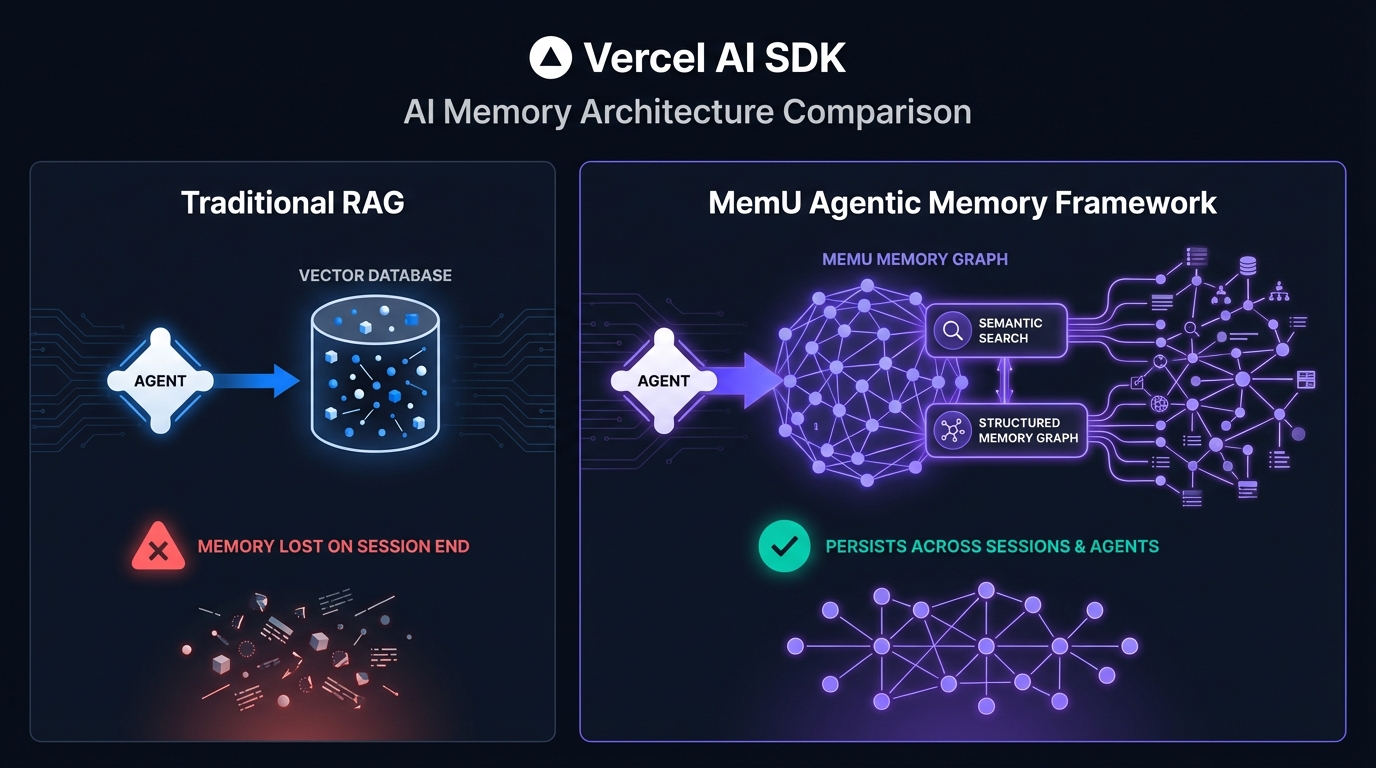
The MemU Agentic Memory Framework: Persistent Intelligence for SDK-Built Agents
The MemU Agentic Memory Framework provides the persistent memory layer that agent-building frameworks do not include natively. Instead of treating each agent execution as an isolated run, MemU captures conversational context, tool call results, user preferences, and task outcomes in a structured memory graph that persists across sessions and application deployments.
Consider a research agent built with the framework that helps analysts investigate market trends. Without persistent memory, each research session starts from zero — the agent re-searches topics explored last week, re-discovers reliable data sources, and has no context about ongoing research interests. With the MemU Agentic Memory Framework, the agent recalls that this analyst tracks three specific competitors, prefers quantitative data over qualitative summaries, previously identified Bloomberg and S&P Capital IQ as most reliable for this sector, and produced a comprehensive analysis last Tuesday that the user wants to build upon rather than repeat.
The framework addresses three fundamental limitations of memoryless agent frameworks:
- User preference persistence: Every interaction reveals preferences — communication style, detail level, preferred sources, recurring topics. The MemU Agentic Memory Framework captures these as persistent memory, enabling agents to personalize from the first message of every session.
- Tool call result caching with context: When agents make expensive tool calls — API queries, database lookups, document parsing — persistent memory stores not just results but the context in which they were useful. Future runs retrieve relevant past results, reducing redundant calls and accelerating multi-step workflows.
- Cross-session workflow continuity: Complex tasks rarely complete in a single session. Persistent memory enables agents to resume multi-session workflows — continuing research where it left off and maintaining project context across days of incremental work.
Building agents without persistent memory is like writing a brilliant research paper and shredding it every evening. The Vercel AI SDK gives agents tools to do incredible work — the MemU Agentic Memory Framework ensures that work compounds over time.
Integration uses MemU's REST APIs. Before starting an agent loop (generateText with maxSteps), the application retrieves relevant memory — user history, previous results, stored preferences — and includes it as system context. After the run completes, key outcomes and updated preferences are stored. The memory layer integrates naturally with the SDK's streaming and tool-calling patterns.
Head-to-Head: Stateless Agent Runs vs. Memory-Enhanced Agent Applications
Vercel AI SDK alone: Powerful framework for building AI applications with streaming, structured output, tool calling, and multi-step agent loops across multiple LLM providers. But every agent run is independent — no user preference retention, no tool call result persistence, no workflow continuity across sessions.
SDK + MemU: The same elegant framework primitives, now backed by persistent agent memory. Agent loops start with relevant context from previous runs. User preferences are known from the first interaction. Complex multi-session workflows maintain continuity. The SDK provides the runtime; persistent memory provides the intelligence.
For applications serving returning users — SaaS products, research tools, productivity applications — the difference is transformative. Users interact with an agent that knows them, remembers their work, and improves based on accumulated experience. Retention and perceived intelligence both increase when agents demonstrate continuity.
Vercel AI SDK + MemU: Better Together
The combination of agent-building primitives and the MemU Agentic Memory Framework's persistent memory creates capabilities neither achieves alone:
- Progressive personalization: Each interaction refines the user's memory profile — communication style, expertise level, commonly requested information. Over sessions, the agent transitions from generic assistant to personalized partner, with the SDK handling runtime and persistent memory providing the user model.
- Intelligent step reduction: Multi-step agent loops (maxSteps) become more efficient over time. An agent that previously researched a topic through 15 tool calls can start subsequent related queries from stored intermediate results, completing in 5 steps what previously required 15.
- Cross-user knowledge building: When appropriately configured, persistent memory enables agents to learn from aggregate interactions. Common questions, effective tool call sequences, and proven solution patterns accumulate into organizational intelligence benefiting every user.
Persistent memory transforms SDK-built applications from single-session tools into intelligent systems that grow more valuable with every interaction — where the framework provides execution and memory provides compounding intelligence.
Get Started with MemU
The Vercel AI SDK provides essential infrastructure for AI-powered applications — clean primitives for streaming, structured output, tool calling, and multi-step agent loops across every major LLM provider.
The next step is giving SDK-built agents persistent memory — applications where returning users are served with accumulated context, where multi-step research builds on previous sessions, and where every interaction makes the agent demonstrably more intelligent.
The MemU Agentic Memory Framework provides that foundation. Drop-in API integration alongside SDK primitives, dual-mode retrieval with semantic search and structured memory graphs, and cross-session persistence that turns stateless agent runs into compounding application intelligence.
Visit memu.pro to explore the Agentic Memory Framework API, or check out the GitHub repository to start building agents that remember every interaction.
Tags: Vercel AI SDK, agent framework, AI agent memory, agentic AI, MemU AI, LLM memory, Next.js AI