VS Code Becomes the Multi-Agent Hub — Claude, Codex, and Copilot in One IDE, Zero Shared Memory

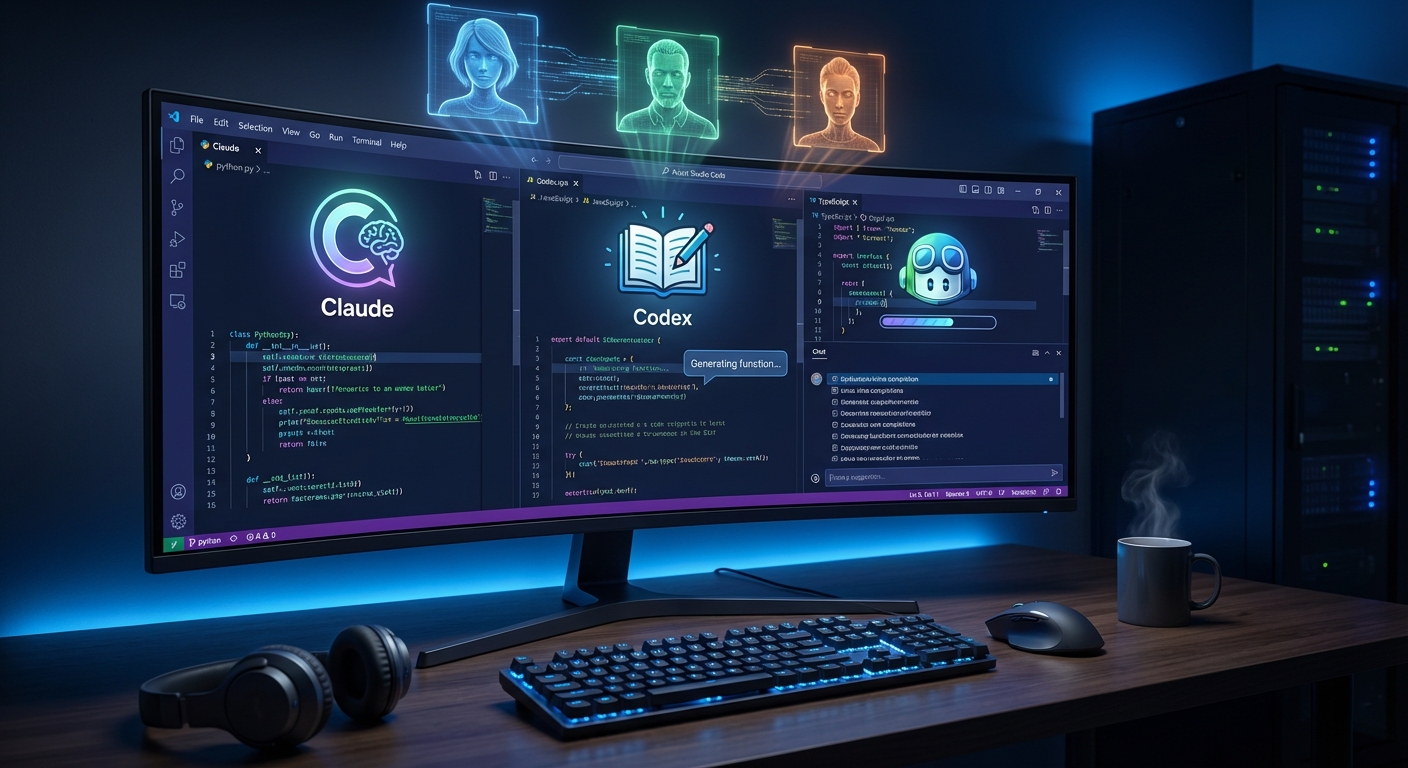
VS Code just became the first IDE to natively support multiple AI agents running simultaneously. The January 2026 release (v1.109) introduced a unified Agent Sessions view where developers can run Claude, Codex, and Copilot agents side by side — local, background, or cloud. GitHub Copilot Pro+ subscribers get immediate access to all three agent types. The multi-agent development era isn't coming; it shipped in a VS Code update.
The architecture supports three deployment models: local agents that run interactively on your machine, background agents that work asynchronously using git worktrees for isolation, and cloud agents that execute autonomously on remote infrastructure. Developers can delegate tasks to different agents, compare outputs, and manage everything from a single sessions panel. It's the most significant IDE upgrade since integrated terminals.
But VS Code solved the orchestration problem while ignoring a critical gap: these agents can't share memory. Claude doesn't know what Codex just discovered. The background agent can't access what the local agent learned. Multi-agent, zero shared context.
What Multi-Agent Development Actually Looks Like
In practice, multi-agent development in VS Code means running Claude Code for complex architectural decisions, Codex for rapid implementation, and Copilot for inline suggestions — all in the same session. A developer might ask Claude to design a new API, hand the implementation to Codex, and use Copilot for test scaffolding. The Agent Sessions view tracks each agent's progress and outputs.
Background agents are particularly powerful: they work in isolated worktrees, making changes without disrupting the developer's current context. A developer can spin up a background Codex agent to refactor a module while continuing to work on features with a local Claude agent. Cloud agents go further — they run on GitHub's infrastructure, producing PRs and issues that the team can review asynchronously.
The productivity gains are real. Three agents working in parallel can accomplish in minutes what a single agent does in an hour. But the effectiveness depends entirely on coordination — and coordination requires shared context that none of these agents currently maintain.
The Shared Memory Gap in Multi-Agent IDEs
Consider a realistic development workflow: Claude analyzes a codebase and identifies that the authentication module uses an outdated pattern. It recommends a migration strategy. The developer then asks Codex to implement the migration. Codex starts from scratch — it has no knowledge of Claude's analysis, the reasoning behind the strategy, or the specific patterns that Claude identified as problematic.
The developer becomes the memory bus, manually copying context from Claude's output into Codex's prompt. This works for simple handoffs but breaks down at scale. When five agents work on interconnected tasks over a multi-day sprint, manually shuttling context between them becomes the bottleneck that multi-agent development was supposed to eliminate.

Background agents compound the problem. They operate asynchronously — the developer isn't present to provide context. A background agent refactoring a module has no way to know about design decisions that a local agent made an hour earlier. Cloud agents are even more isolated: running on remote infrastructure, they have access to the codebase but none of the contextual knowledge that's been generated during the development session.
Why Agent Sessions Aren't Enough
VS Code's Agent Sessions view tracks which agents are running and their outputs. But tracking isn't memory. The sessions view shows that Claude produced an analysis and Codex produced an implementation — it doesn't enable Codex to understand Claude's reasoning or build on Claude's discoveries. It's a process monitor, not a knowledge sharing layer.
The fundamental issue is that each agent operates within its own context window. Claude's context contains the analysis conversation. Codex's context contains the implementation conversation. There's no mechanism for cross-agent knowledge transfer beyond what the developer manually provides. In a multi-agent IDE, each agent is essentially a solo developer who can't read anyone else's notes.
This limitation becomes critical as multi-agent workflows scale. A team using cloud agents for overnight code reviews, background agents for continuous refactoring, and local agents for feature development generates enormous amounts of contextual knowledge. Without shared memory, every piece of that knowledge evaporates when the agent session ends.
What Cross-Agent Memory Enables
Imagine the same workflow with persistent cross-agent memory. Claude analyzes the codebase and writes its findings to shared memory: the authentication module uses patterns X, Y, and Z that should be migrated. When Codex starts the implementation, it retrieves Claude's analysis automatically — not as a raw conversation dump, but as structured knowledge about the codebase.
Background agents become dramatically more effective. They can query shared memory for recent design decisions, ongoing refactoring plans, and known issues before starting their work. Cloud agents generating PRs overnight can incorporate the full context of the day's development decisions, producing PRs that align with the team's direction rather than operating in isolation.
Over time, the shared memory accumulates a comprehensive understanding of the project: architectural decisions, common patterns, known pitfalls, and effective strategies. Every agent — regardless of provider or deployment model — benefits from the collective knowledge, transforming multi-agent development from parallel solo work into genuine collaboration.
How MemU Adds Memory to Multi-Agent IDEs
MemU provides the persistent memory layer that connects agents across VS Code's multi-agent architecture. Each agent writes experiences and discoveries to MemU's memory system. Before starting a task, each agent retrieves relevant memories — regardless of which agent originally created them. Claude's architectural insights are available to Codex. Codex's implementation patterns are available to Copilot. Background agent discoveries persist across sessions.
The integration works across all three deployment models. Local agents write and read from MemU in real-time. Background agents query MemU before starting isolated work in worktrees. Cloud agents access the same memory layer from remote infrastructure. The result is a unified knowledge base that spans agents, sessions, and deployment models.
VS Code built the multi-agent IDE. MemU makes the agents actually collaborate. Together, they deliver the productivity promise that multi-agent development was designed to achieve.
Get Started
Turn your multi-agent IDE into a collaborative system with persistent memory. Explore MemU at memu.pro and on GitHub.