W&B Weave Traces and Evaluates AI Agent Behavior — But Observing Agent Mistakes Without Persistent Memory Means Watching the Same Failures Recur


W&B Weave has built the observability platform that autonomous AI systems need for production reliability. The platform visualizes complex agent rollouts — debugging multi-step tasks, tool calls, and reasoning chains. Weave auto-logs traces for Model Context Protocol interactions with A2A support forthcoming. Pre-built, third-party, and custom scorers measure agent quality systematically. Online evaluations score production traces in real time via LLM judges, while monitors detect quality degradation passively. Real-time guardrails catch hallucinations and prompt injection attacks. Governance features reproduce specific agent versions through versioning. Integrations with CrewAI and OpenAI Agents SDK embed Weave tracing into popular frameworks.
But Weave provides observation, not intervention. The platform shows you what agents did wrong — it does not prevent agents from making the same mistake again. Agent observability without persistent memory creates an endless loop: detect failure, analyze trace, understand root cause, watch the identical failure recur tomorrow because the agent has no memory of what went wrong or how it was resolved.
W&B Weave: What Everyone Is Getting Right (And Missing)
The Weave platform addresses a critical gap in the AI agent stack. As agents become more autonomous — making multi-step decisions, calling external tools, handling branching logic — understanding why an agent produced a specific output becomes exponentially harder. A customer support agent that hallucinated a refund policy did so because of a specific chain of reasoning steps, tool call results, and context window contents that traditional logging cannot capture. Weave traces make this entire decision chain visible, from initial prompt to final output.
The evaluation framework deserves recognition. Most teams assess agent quality through manual spot-checking. Weave's scorer architecture systematizes this into repeatable evaluations — pre-built scorers for accuracy and relevance, custom scorers for domain-specific criteria, and LLM judges at scale. Online evaluations run scorers against production traffic in real time, turning quality assessment from periodic audit into continuous monitoring.
Real-time guardrails address the safety dimension. Hallucination detection catches fabricated claims before they reach users. Prompt injection defenses prevent adversarial inputs from hijacking agent behavior — operating at inference time, not after the fact.
What Weave does not provide is a feedback loop between observation and correction. The platform shows you that an agent failed and which reasoning step caused it. But this intelligence stays in the dashboard — it does not flow back into the agent's knowledge. The traces exist in Weave, the analysis exists in the team's understanding, but the agent itself remains unaware. Other observability platforms share this architecture: they watch agents, they do not teach them.
The MemU Agentic Memory Framework: From Observing Failures to Preventing Them
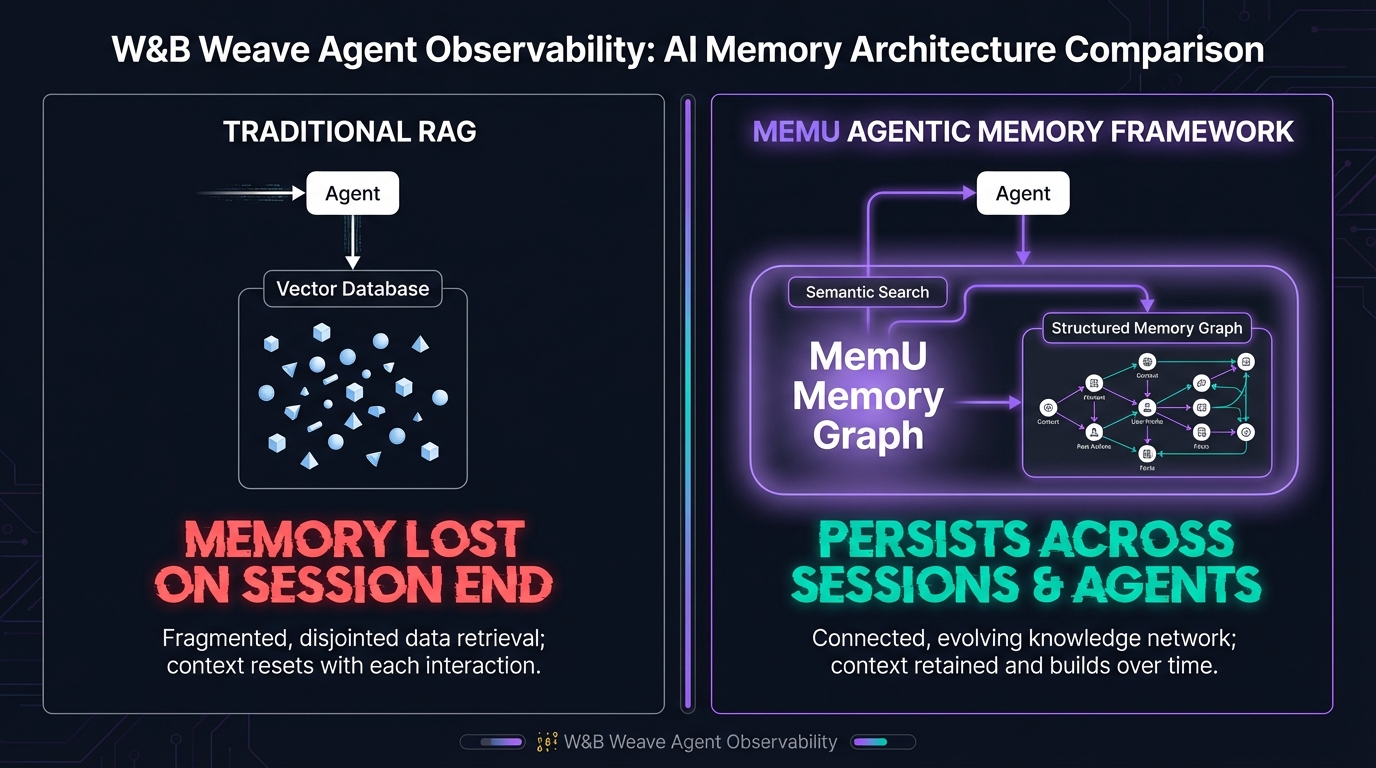
The MemU Agentic Memory Framework provides persistent learning memory that transforms Weave from a passive observation platform into an active improvement system. Instead of traces and evaluations existing solely for human review, MemU captures the operational intelligence derived from observability data — failure patterns, successful resolution strategies, quality scoring trends, guardrail triggers — storing it in a structured memory graph that agents query during execution to avoid previously observed mistakes.
Consider a Weave-monitored customer support agent handling return inquiries. Without persistent memory, traces show the agent repeatedly hallucinating a "30-day return extension" that does not exist — the same failure weekly, flagged by the same LLM judge, never reaching the agent itself. With the MemU Agentic Memory Framework, the first occurrence is captured as persistent knowledge: the policy is strictly 14 days, the "30-day" phrasing is outdated, and the correct response references the updated policy URL. The agent that hallucinated weekly now references accurate policy from memory, and Weave traces confirm the improvement — observability and memory forming a closed loop.
The framework addresses three core limitations of observation without memory:
- Failure pattern persistence: Observability platforms detect recurring failure modes across traces. The MemU Agentic Memory Framework captures these patterns as persistent agent knowledge — transforming dashboard alerts into operational guardrails that agents consult before making decisions, preventing failures rather than just detecting them.
- Evaluation-driven improvement: When scorers identify quality degradation in specific task categories, persistent memory encodes the quality criteria that triggered the degradation. Agents query this knowledge during execution, self-correcting before outputs reach users and scorers.
- Guardrail intelligence accumulation: The MemU Agentic Memory Framework captures guardrail trigger patterns — which input types cause hallucinations, which prompt structures invite injection attacks, which tool call sequences produce unreliable results — enabling agents to proactively avoid triggering scenarios rather than relying on runtime interception.
Observing an agent make the same mistake every day without giving it memory of the correction is like filming a driver hitting the same pothole every morning without telling them about it. The MemU Agentic Memory Framework closes the loop between Weave's observability and agent behavior, turning traces into persistent operational intelligence.
Integration with Weave operates through the framework's REST APIs within the agent orchestration layer. Before execution, operational memory loads from the memory graph — known failure patterns and guardrail intelligence for the task type. During execution, agents validate decisions against previously observed failures. After execution, Weave traces and scores feed back into the memory store. The memory layer operates alongside Weave's tracing without modifying the observability pipeline.
Head-to-Head: Passive Observability vs. Memory-Enhanced Agent Learning
W&B Weave alone: The most comprehensive agent observability platform — trace visualization, MCP auto-logging, scorers, online evaluations, guardrails, and version governance. Teams see exactly what agents do. But agents themselves remain unaware of observed failures.
Weave + MemU: The same observability infrastructure, connected to persistent agent memory. Traces and evaluation scores flow into operational knowledge that agents consult during execution. Failure patterns detected once are prevented going forward. Quality degradation triggers self-correction before outputs reach users. Guardrail triggers become proactive avoidance strategies. The system improves continuously rather than simply observing recurring failures.
For production deployments where agent quality directly impacts business outcomes — customer-facing support, content generation, financial analysis — the closed feedback loop between observability and memory transforms quality metrics. An agent that learns from every traced failure achieves steady quality improvement rather than the flat reliability curve of a stateless system.
Empowering W&B Weave: Better Together
The combination of Weave's platform and MemU's persistent memory creates capabilities neither provides alone:
- Automated root cause resolution: When Weave traces identify a failure pattern and persistent memory stores the resolution, future occurrences are automatically corrected without human intervention. The observability platform detects the pattern, memory provides the fix, and the agent applies it — creating a self-healing loop.
- Cross-agent learning propagation: When multiple agents share persistent memory derived from Weave traces, a failure pattern discovered in one agent's traces becomes preventive knowledge for every agent in the fleet. A hallucination caught in the support agent's traces prevents the same hallucination in the sales agent.
- Predictive quality scoring: Persistent memory tracks which input characteristics correlate with low evaluation scores, enabling agents to flag high-risk queries before processing them — routing complex or ambiguous inputs to human review rather than producing outputs likely to score poorly.
Persistent learning memory transforms W&B Weave from a passive observability platform into an active improvement system where every traced failure strengthens every agent in the deployment.
Get Started with MemU
W&B Weave has built the definitive observability platform for autonomous AI agents — comprehensive tracing, systematic evaluation, real-time guardrails, and production governance.
The next step is closing the loop between observation and behavior. The MemU Agentic Memory Framework provides that intelligence layer — API-based integration within agent orchestration, dual-mode retrieval with semantic search and structured memory graphs, and cross-session persistence that turns observability insights into compounding operational intelligence.
Visit memu.pro to explore the Agentic Memory Framework API, or check out the GitHub repository to start building agents that remember.
Tags: W&B Weave, Weights and Biases, agent observability, AI tracing, agent evaluation, agent memory, MemU AI, LLM memory