Warp Terminal Powers Agentic Development with Oz — But Terminal Agents Without Session Memory Lose Debugging Intelligence

Warp Terminal has redefined what a terminal can be for modern software development. With Oz — its built-in AI agent that ranked #1 on Terminal-Bench and #5 on SWE-bench Verified — Warp Terminal delivers an agentic development environment where AI operates directly within the terminal. Oz has full terminal control: it reads output, executes commands, and uses computer vision to verify that changes actually worked. It handles multi-repo modifications autonomously, supports multiple models from OpenAI, Anthropic, and Google, and lets engineers run multiple agents in parallel with granular permissions. Developers can even deploy Claude Code, Codex, or Gemini CLI from within the Warp Terminal interface. With over 500,000 engineers using it, Warp Terminal has become the terminal of choice for agentic development — building features, fixing bugs, debugging production, and understanding unfamiliar codebases.
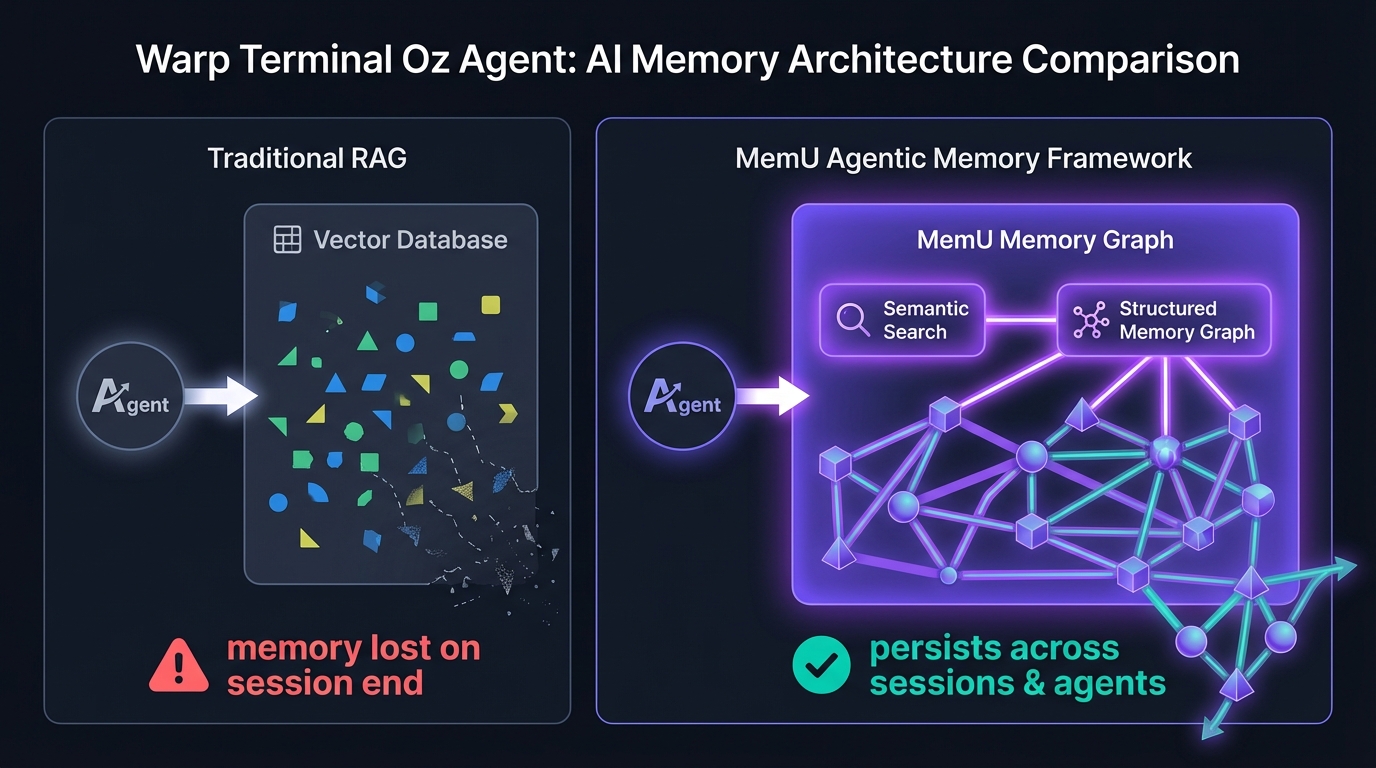
But Warp Terminal's agent intelligence is bounded by terminal sessions. When Oz finishes debugging a complex production issue — identifying the root cause through log analysis, configuration checks, and dependency investigations — that debugging journey disappears. The next time a similar issue surfaces, the agent starts from scratch. Terminal agents without persistent memory of debugging sessions and project context cannot compound the development intelligence that makes engineering teams increasingly effective.
Warp Terminal: What Everyone's Getting Right (And Missing)
Warp Terminal's approach to agentic development reflects deep understanding of how engineers work. Rather than abstracting the terminal behind a chat interface, Oz operates within the terminal — running commands, reading output, and verifying changes through computer vision. This terminal-native approach means the agent works with the same tools developers already use. The #1 Terminal-Bench ranking confirms real execution quality, not just convenience.
The multi-model flexibility is a significant advantage. Engineers route tasks to OpenAI, Anthropic, or Google models depending on the use case. Deploying Claude Code, Codex, and Gemini CLI from within Warp Terminal creates a unified environment where multiple agentic tools coexist. Parallel agent execution with granular permissions means developers run multiple agents simultaneously — one refactoring the API layer while another writes tests — without risking cross-contamination.
What Warp Terminal does not preserve is the institutional development knowledge that emerges from terminal-based workflows. An Oz agent that spent forty minutes debugging a memory leak — tracing through heap dumps, identifying a circular reference, discovering the issue only manifests under specific load conditions — generates invaluable diagnostic intelligence. But that narrative vanishes when the session ends. Other terminal-native development tools — including iTerm2 with AI integrations and terminal-embedded copilots — share this structural limitation. They execute within sessions; none retain the development intelligence that accumulates across hundreds of debugging sessions.
The MemU Agentic Memory Framework: Development Intelligence That Compounds
The MemU Agentic Memory Framework provides the persistent memory layer that terminal-based development environments like Warp Terminal do not include natively. Instead of treating each terminal session as isolated, MemU captures debugging sequences, resolution patterns, and project-specific context, storing them in a structured memory graph that persists across sessions, developers, and project lifecycles.
Consider an engineering team using Warp Terminal across a large microservices codebase. Without persistent memory, each debugging session starts from zero — the agent has no idea which services historically cause cascading failures or which debugging approaches work best for specific error categories. With the MemU Agentic Memory Framework, the agent recalls development history: service X's timeout errors typically stem from connection pool exhaustion, the authentication service requires a specific environment variable sequence after restarts, and API gateway regressions usually trace to unoptimized query patterns from recent migrations. That accumulated intelligence transforms every terminal session from an isolated task into a contextually-informed investigation.
The framework addresses three core limitations of session-bounded terminal agents:
- Debugging pattern persistence: The diagnostic sequences that resolve specific error types are learned through accumulated data. The MemU Agentic Memory Framework captures investigation steps, dead ends, and resolutions, enabling agents to apply proven strategies rather than rediscovering solutions.
- Project context continuity: Understanding codebases requires knowledge that builds over time — architecture decisions, dependency relationships, deployment quirks. Persistent memory gives terminal agents access to accumulated project intelligence that otherwise exists only in developers' heads.
- Cross-developer knowledge sharing: When multiple engineers use Warp Terminal with shared persistent memory, one developer's debugging breakthrough becomes available to the entire team. A resolution discovered at 2 AM during incident response is accessible to every future agent session with similar symptoms.
The best engineering teams build institutional knowledge through years of shared debugging experience. Terminal agents should compound that same knowledge from day one. The MemU Agentic Memory Framework gives Warp Terminal the development memory that turns every session into organizational intelligence.
Integration with Warp Terminal uses the MemU Agentic Memory Framework's REST APIs through custom tool configurations. At session start, relevant project context and historical debugging patterns are loaded. During development, agents query memory for similar past issues. At session end, new debugging insights are stored. The memory layer operates alongside Warp Terminal's existing infrastructure, adding persistence without modifying the terminal experience.
Head-to-Head: Stateless Terminal Sessions vs. Memory-Enhanced Development
Warp Terminal alone: The leading agentic terminal with Oz ranking #1 on Terminal-Bench, multi-model support, parallel execution, and granular permissions. Engineers get a powerful environment where AI operates with full terminal control. But each session starts without knowledge of previous debugging sessions, project-specific patterns, or team development history.
Warp Terminal + MemU: The same agentic terminal experience, now backed by persistent development memory. Agents begin each session with accumulated project context. Debugging approaches are informed by historical resolution data. Project-specific knowledge compounds across the entire engineering team. The terminal gets measurably more intelligent with every session.
For teams working on complex, long-lived codebases — where the same classes of issues recur, where tribal knowledge is critical, and where debugging efficiency impacts incident response times — the improvement is transformative. A terminal agent with six months of accumulated memory approaches problems with the contextual depth of a senior engineer who has been on the team for years.
Empowering Warp Terminal: Better Together
The combination of Warp Terminal's agentic development environment and MemU's persistent memory unlocks capabilities that neither achieves alone:
- Incident response acceleration: Terminal agents with persistent memory immediately correlate current symptoms with historical incidents. The agent recognizes that this 503 pattern matches an issue resolved three months ago and retrieves the specific diagnostic steps, compressing hours of investigation into minutes.
- Onboarding amplification: New engineers using Warp Terminal with persistent memory gain instant access to accumulated project intelligence. The terminal agent explains architecture decisions, highlights pitfalls, and guides setup based on dozens of previous onboarding sessions.
- Development pattern optimization: Persistent memory reveals which workflows and debugging approaches are most effective for specific codebases. Over time, the terminal agent proactively suggests optimal approaches, progressively improving team practices.
Persistent memory transforms Warp Terminal from a powerful agentic terminal into a development intelligence platform where every session compounds the engineering knowledge that makes future development faster and more reliable.
Get Started with MemU
Warp Terminal has built the most capable agentic development environment available — terminal-native AI with full system control, multi-model flexibility, parallel execution, and the trust of over 500,000 engineers.
The next step is giving those terminal agents persistent development memory. Sessions where debugging approaches are informed by historical resolution patterns. Projects where accumulated context compounds across every engineer on the team. Organizations where terminal intelligence grows with every session.
The MemU Agentic Memory Framework provides that foundation. API-based integration that works alongside Warp Terminal's existing architecture, dual-mode retrieval with semantic search and structured memory graphs, and cross-session persistence that turns agentic development into compounding engineering intelligence.
Visit memu.pro to explore the Agentic Memory Framework API, or check out the GitHub repository to start building agents that remember.
Tags: Warp Terminal, Oz agent, agentic development, agent memory, MemU AI, LLM memory, terminal AI