Weaviate Powers 50,000+ Developers with Open-Source Vector Search — But Semantic Similarity Cannot Encode How Agents Learn Over Time

Weaviate has built a thriving ecosystem around open-source vector database agent infrastructure, with more than 15,820 GitHub stars and a community exceeding 50,000 developers. Written in Go under a BSD 3-Clause license, the platform stores data objects alongside their vector embeddings, enabling hybrid search that combines vector similarity with BM25 keyword matching for comprehensive retrieval. RAG integration connects search results directly to language model generation pipelines. Weaviate Agents provide the building blocks for deploying intelligent agents, including a Query Agent that translates natural language into optimized search operations. Over 20 machine learning model integrations ensure flexibility across embedding providers. A Python client plus multiple SDKs make integration straightforward, while Weaviate Academy offers structured learning for the developer community. Deployment options span self-hosted, managed cloud, and Kubernetes VPC — giving teams control over where their vector database agent infrastructure runs and how it scales.
But semantic similarity — the foundation of every vector database agent architecture — maps geometric distances in embedding space, not the temporal and causal relationships that define how agents reason and learn. When an agent retrieves the five nearest vectors to a query, it receives contextually similar information. What it does not receive is knowledge about which of those results led to successful outcomes in previous reasoning chains, which vector combinations proved most effective for specific task types, or how retrieval order influenced multi-step agent decisions. The vector database excels at finding relevant information. It cannot tell agents what to do with it based on accumulated experience.
Vector Database for Agents: What Weaviate Gets Right (And What It Misses)
Weaviate addresses the core retrieval infrastructure challenge for agentic AI systems. Agents need fast, relevant access to knowledge bases — and vector search provides semantic understanding that traditional keyword search cannot match. A customer support agent searching for resolution strategies does not need exact keyword matches; it needs semantically similar approaches that may use entirely different terminology. Weaviate's hybrid search combining vector similarity with BM25 keyword matching delivers both semantic understanding and precise term matching, ensuring agents retrieve comprehensively rather than missing relevant context due to vocabulary mismatch.
The Weaviate Agents framework moves the platform beyond passive storage into active agent infrastructure. The Query Agent translates natural language questions into optimized search operations, eliminating the need for agents to construct complex query syntax. This abstraction layer means agents can focus on reasoning rather than query engineering — asking questions in natural language and receiving structured results without understanding the underlying search mechanics. For vector database agent architectures, this reduces integration complexity and enables more natural agent-database interactions.
The open-source foundation with 50,000 developers creates a robust ecosystem of patterns, extensions, and battle-tested configurations. When teams encounter edge cases in their vector database agent implementations, the community provides proven solutions rather than requiring custom engineering. The BSD 3-Clause license ensures enterprises can deploy without licensing concerns, and the choice between self-hosted, managed cloud, and Kubernetes VPC gives organizations control over data residency and infrastructure costs.
The limitation emerges when agents need intelligence beyond retrieval relevance. Vector similarity tells an agent what information is semantically close to its query — not what information is strategically valuable given its current task context and historical reasoning patterns. Two vectors may be equidistant from a query embedding, but one may consistently lead to correct conclusions while the other leads to reasoning dead ends. This strategic quality cannot be encoded in embedding space because it depends on downstream agent behavior that occurs after retrieval — behavior that the vector database agent infrastructure never observes, captures, or learns from.
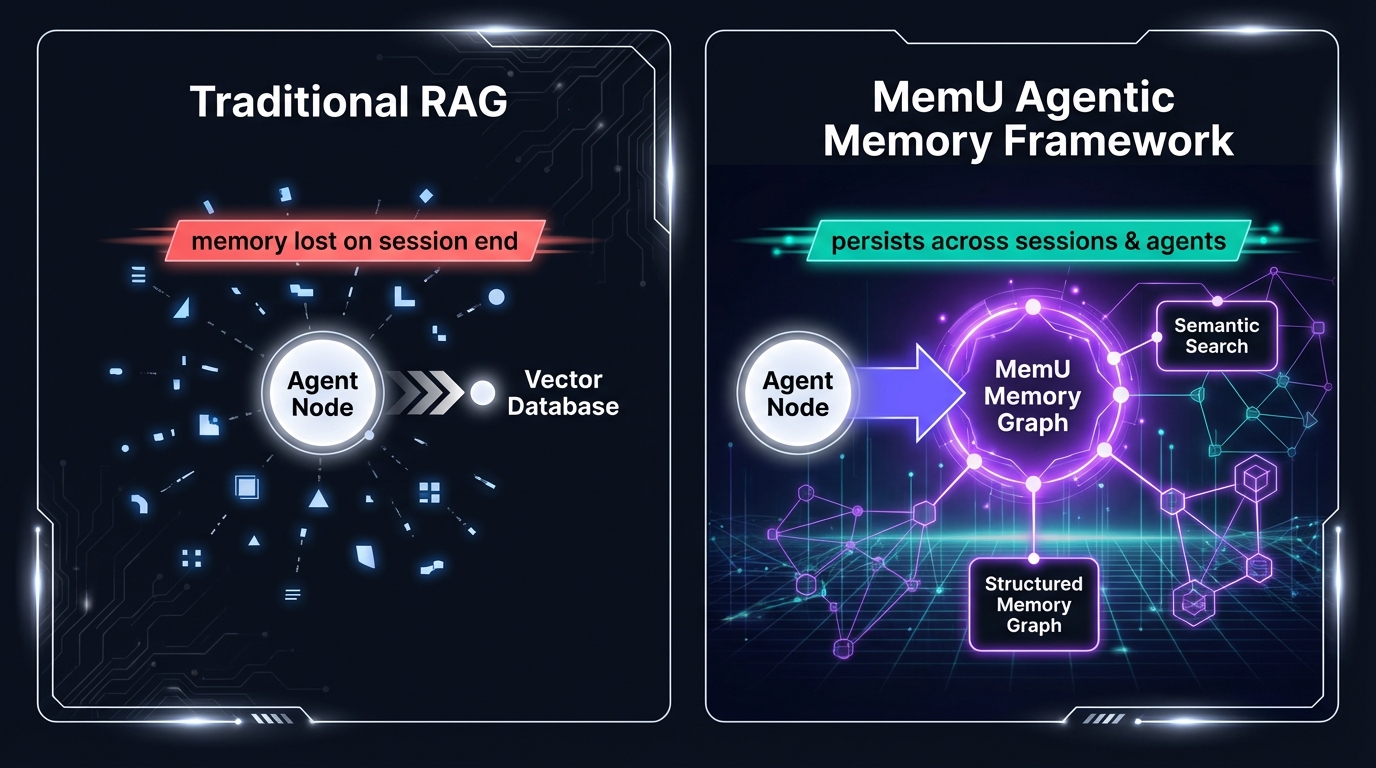
The MemU Agentic Memory Framework: Persistent Intelligence Beyond Semantic Search
The MemU Agentic Memory Framework adds the experiential layer that vector database agent architectures are missing. Where Weaviate provides semantically relevant retrieval based on embedding geometry, MemU captures the outcome-driven intelligence that agents develop through experience — creating persistent knowledge about not just what information exists, but which information drives successful reasoning under which circumstances.
Consider a legal research firm using Weaviate to power agents that analyze case law, contracts, and regulatory documents. After processing 30,000 legal research queries over a year, the agents have accumulated implicit expertise: certain case law combinations consistently support stronger arguments, specific document retrieval sequences uncover relevant precedents more efficiently, and particular reasoning patterns across contract clauses identify risks that individual clause analysis misses. With MemU, these legal reasoning patterns persist as structured intelligence. Without persistent memory, query 30,001 searches Weaviate with the same generic strategy as query one — retrieving semantically similar documents without applying a year of accumulated legal research methodology.
The MemU Agentic Memory Framework provides capabilities that enhance vector database agent infrastructure:
- Retrieval effectiveness memory: Every vector search produces a result set that an agent uses for downstream reasoning. MemU tracks which retrieval patterns correlate with successful task completion — learning that for contract analysis queries, retrieving regulatory context alongside contract clauses produces better risk assessments than contract-only retrieval, enabling agents to construct more effective search strategies based on outcome evidence.
- Decision history persistence: Agents make sequences of decisions informed by retrieved context. MemU captures these decision chains, enabling agents to recognize familiar decision patterns and apply proven reasoning approaches — transforming retrieval from an isolated operation into a step within an accumulated decision intelligence framework.
- Query evolution learning: Agents refine their queries iteratively — initial broad searches narrow based on intermediate findings. MemU captures effective query evolution patterns, enabling agents to start with refined strategies for familiar problem types rather than repeating the full exploratory sequence from broad to specific with every new task.
A vector database agent architecture retrieves semantically relevant information. The MemU Agentic Memory Framework ensures the intelligence from retrieval-driven reasoning persists across sessions — transforming similarity search into experienced retrieval that improves agent decision quality with every interaction.
Head-to-Head: Weaviate vs. Other Vector Database Platforms
Weaviate alone: The open-source vector database agent platform delivers hybrid search with vector similarity and BM25 keyword matching, 20 or more ML model integrations, Weaviate Agents with natural language query translation, and flexible deployment across self-hosted, cloud, and Kubernetes environments. The 50,000-developer community ensures robust ecosystem support. But retrieval intelligence operates on static embedding geometry — 30,000 queries produce 30,000 independent search operations with no mechanism to learn which retrieval patterns produce the best agent reasoning outcomes over time.
Weaviate + MemU Agentic Memory Framework: Every retrieval-driven reasoning chain contributes to accumulated search intelligence. Agents apply learned query strategies, decision patterns reflect proven approaches from historical data, and retrieval quality improves based on downstream outcome tracking. The vector database agent architecture evolves from a similarity retrieval system into a reasoning intelligence platform where search effectiveness improves with every agent interaction.
Compared to other vector database approaches — Pinecone, Qdrant, Milvus, ChromaDB, and LanceDB — Weaviate offers the strongest open-source foundation with native agent infrastructure via Weaviate Agents and a proven community-driven ecosystem. But all share the same fundamental limitation: ranking retrieval results by embedding proximity without considering which results historically led to the best agent reasoning outcomes. MemU provides the persistent memory layer that transforms any vector database from a retrieval engine into a reasoning intelligence system.
Semantic Search and Agent Memory: Better Together
MemU does not replace Weaviate's search infrastructure — it ensures every search-driven reasoning chain contributes to growing agent intelligence:
- Query Agent enhancement: Weaviate's Query Agent translates natural language to optimized searches; MemU enriches that translation with historical context — learning which query formulations produce the most useful results for specific question types, enabling the Query Agent to leverage accumulated effectiveness data rather than relying solely on current query interpretation.
- Hybrid search tuning: Weaviate combines vector and keyword search; the MemU Agentic Memory Framework learns optimal blend configurations — which balance of semantic and keyword matching produces the best results for different domains and query types, enabling search tuning that reflects accumulated evidence rather than manual parameter experimentation.
- RAG pipeline optimization: Weaviate integrates with RAG pipelines for retrieval-augmented generation; MemU captures which retrieval-to-generation patterns produce the highest-quality outputs — learning optimal chunk sizes, retrieval counts, and context assembly strategies for specific use cases, enabling RAG configurations that improve through operational experience.
Get Started with MemU
Give your agents persistent memory to transform vector database agent retrieval from static similarity matching into learned intelligence that compounds effectiveness across every query. The MemU Agentic Memory Framework integrates with any vector search infrastructure — one API, instant persistence, zero changes to existing Weaviate configurations. Visit memu.pro to explore the Agentic Memory Framework API, or check out the GitHub repository to start building agents that remember.
Tags: Weaviate, vector database agent, open-source vector search, hybrid search, agent retrieval, persistent agent intelligence, RAG pipeline memory, MemU AI