Windsurf Cascade Reads Your Code Before You Ask — But Can't Remember What It Learned Yesterday


Windsurf is betting that the best AI coding agent is the one that acts before you ask. Cascade, Windsurf's core AI agent, proactively reads relevant files, understands intent from context, runs terminal commands, and makes coordinated multi-file changes — all while keeping the developer in control for approval. At $15/month for unlimited AI assistance, Windsurf offers the most aggressive price-to-capability ratio in the AI coding space.
The proactive approach differentiates Windsurf from reactive alternatives. Where other AI coding tools wait for explicit instructions, Cascade anticipates needs. Start editing an API endpoint, and Cascade proactively examines the test file, the client that calls it, and the documentation that references it — suggesting coordinated changes across all affected files.
With Claude Opus 4.6, Sonnet 4.6, Gemini 3.1 Pro, and other models now available, Windsurf users can choose the intelligence that powers Cascade's proactive behavior. But regardless of which model runs underneath, Cascade's proactive intelligence resets every session.
Windsurf Cascade: What Proactive AI Coding Delivers
Cascade's proactive behavior is genuinely different from autocomplete or reactive assistance. The system indexes your entire project, understands inter-file relationships, and maintains awareness of your current editing context. This enables coordinated suggestions that account for the full scope of a change rather than just the file you're currently editing.
The Memories and Rules feature lets developers set persistent preferences — coding style, preferred patterns, project conventions. Named Checkpoints allow reverting Cascade's changes if they don't work out. Voice input enables natural language interaction without switching to a chat interface.
MCP integration connects Cascade to external tools and services, extending its proactive reach beyond the codebase into deployment, monitoring, and documentation systems.
The limitation: proactive intelligence is session-scoped. Cascade learns your codebase during each session — understanding architecture, patterns, and relationships. But this learned understanding doesn't carry over. Tomorrow's session re-indexes, re-analyzes, and re-discovers what today's session already knew. Static rules capture explicit preferences; they don't capture the adaptive understanding that Cascade develops through working with your code.
How Windsurf Cascade Handles Project Understanding
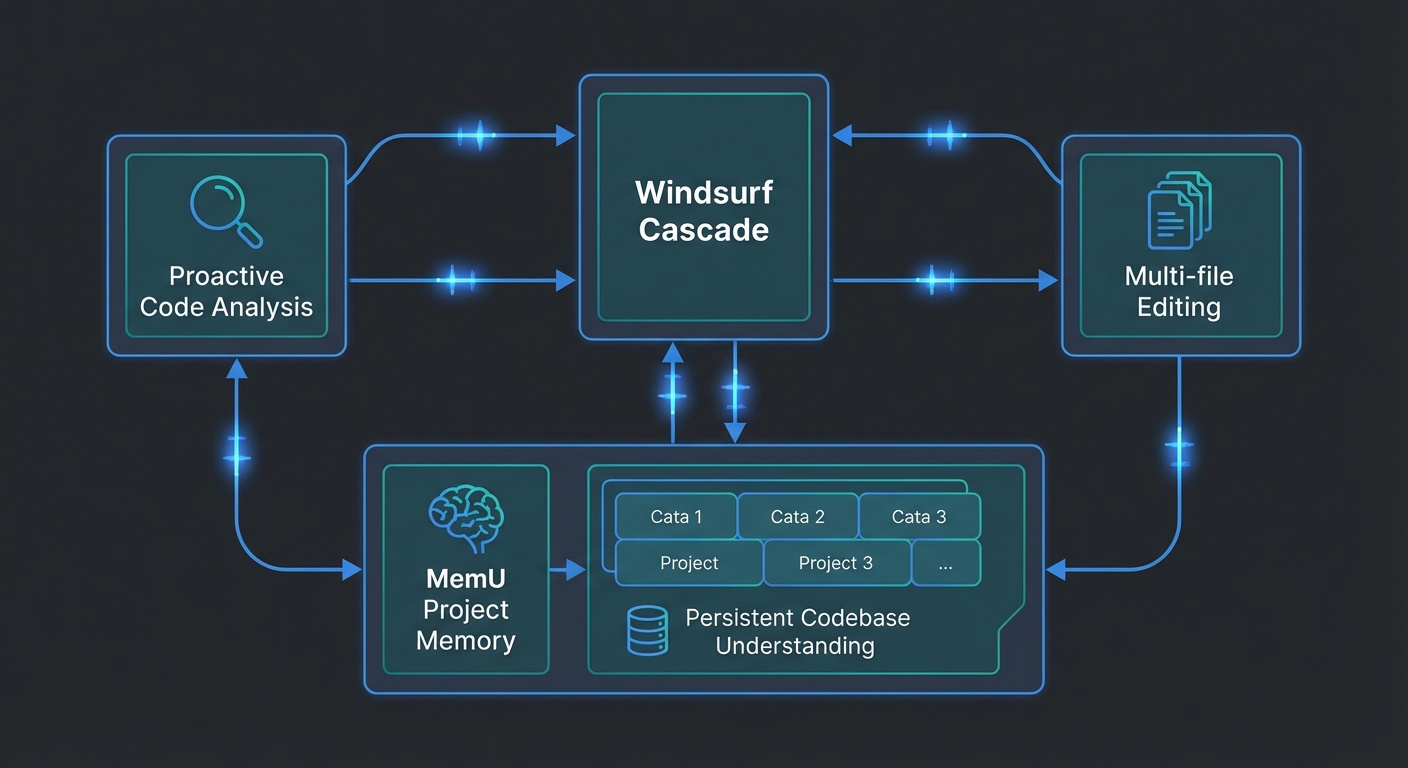
Cascade builds project understanding through three mechanisms: codebase indexing for semantic search, context-aware file reading during active editing, and user-configured Memories and Rules for persistent preferences.
The indexing provides structural awareness — what files exist, how they relate, what symbols are defined where. The active context reading provides dynamic understanding — what the developer is working on right now and what's relevant. Memories and Rules provide static configuration — preferences and conventions that should always apply.
Adaptive understanding falls through the gap. The architectural insight Cascade developed about your service layer's dependency injection pattern — too subtle for a rule, too important to lose. The testing approach that proved effective for your specific data access layer. The deployment quirk that caused issues last week. These are learned through working with the code, not from indexing or rules.
The MemU Agentic Memory Framework: Proactive Agents With Persistent Understanding
The MemU Agentic Memory Framework provides the persistent project understanding that makes Cascade's proactive behavior progressively more accurate.
Consider a developer using Windsurf daily on a complex e-commerce platform. Over weeks, Cascade encounters patterns: payment processing changes always require corresponding webhook updates, inventory service modifications need cache invalidation, and the legacy authentication module has specific constraints. With the MemU Agentic Memory Framework, these patterns persist — Cascade proactively suggests the webhook update before the developer remembers it's needed, because it learned this pattern from previous sessions.
The architecture enhances Cascade through three capabilities:
- Proactive pattern memory: The patterns Cascade discovers about inter-file relationships persist. Proactive suggestions become more accurate as the system learns which coordinated changes matter for your specific codebase.
- Developer workflow learning: Beyond code patterns, MemU captures how you work — which changes you approve, which you modify, which you reject. Cascade's proactive behavior aligns progressively with your actual preferences.
- Project evolution tracking: As codebases evolve, previous architectural decisions inform current understanding. MemU captures not just the current state but the trajectory of architectural evolution.
MemU makes Cascade's proactive intelligence cumulative — every session teaches it something new about your codebase and your preferences.
Head-to-Head: Session Proactivity vs. Learned Proactivity
Windsurf Cascade alone: Proactive multi-file editing, context-aware suggestions, MCP integration. Impressive within sessions. But proactive intelligence resets — no learned patterns, no developer preference evolution, no accumulated project understanding.
Cascade + MemU: Same proactive behavior plus persistent learning. Suggestions improve over time. Developer preferences emerge from behavior. Sub-100ms memory retrieval means proactive suggestions remain instant.
Get Started with MemU
Windsurf Cascade represents a genuinely different approach to AI-assisted coding. Proactive behavior that anticipates developer needs creates a workflow that feels collaborative rather than transactional.
The MemU Agentic Memory Framework makes that collaboration deepen over time. Proactive suggestions grounded in accumulated project understanding. Developer preferences that emerge naturally from working patterns.
Visit memu.pro to explore the Agentic Memory Framework API, or check out the open-source repository on GitHub to start building persistent memory into your AI coding workflows today.