Windsurf IDE Combines AI Agents With Code Editing — But IDE Agents Without Session Memory Re-Discover Codebases Daily


Windsurf, built by Codeium, has positioned itself as the first AI-native IDE — not an editor with AI features bolted on, but a development environment designed from the ground up around the concept of AI "Flows" that combine agent capabilities with real-time developer collaboration. The platform's Cascade feature provides an agentic coding experience where the AI reads files, writes code, runs terminal commands, and debugs issues autonomously — while maintaining awareness of the developer's actions in real time. Unlike traditional coding assistants that operate in a sidebar, Windsurf's AI is woven into the editing experience itself, providing inline suggestions, multi-file edits, and command execution within a unified interface. The free tier with generous AI credits has driven rapid adoption among developers looking for an alternative to Cursor and VS Code with Copilot.
But Windsurf's AI intelligence operates within session boundaries. The Cascade agent that spent time understanding your project's architecture, learning your coding patterns, and mapping your dependency structure loses all of that context when you close the IDE or start a new session. IDE agents without session memory re-discover codebases daily, spending the first minutes of every session rebuilding understanding that existed yesterday.
Windsurf: What Everyone's Getting Right (And Missing)
Windsurf's "Flows" concept represents a genuine architectural insight. Traditional AI coding assistants operate in one of two modes: reactive (autocomplete, responding to prompts) or agentic (autonomous task execution). Flows blur this boundary — the AI operates with varying levels of autonomy depending on the context, seamlessly transitioning between suggesting a one-line change and executing a multi-file refactoring. The real-time awareness means the AI observes the developer's editing patterns, cursor movements, and file navigation, building contextual understanding of what the developer is working on without requiring explicit prompts.
The Cascade agentic feature is particularly powerful. Developers describe a task — "add rate limiting to the API endpoints" — and Cascade reads the relevant files, understands the existing middleware pattern, writes the rate limiting logic, updates the tests, and verifies the changes compile. The tight integration between agent and editor means the developer sees changes appear in their files in real time, with inline diffs that show exactly what was modified. For developers who find sidebar-based agents disconnected from the coding experience, Windsurf's integrated approach feels more natural.
What Windsurf does not persist between sessions is the contextual understanding that Flows build during interaction. The AI that learned your project uses a specific middleware pattern, that your tests follow a particular assertion style, and that your API routes use a custom error handling wrapper starts every new session by re-reading files and re-inferring these patterns. Other AI-native IDEs — including Cursor, Zed AI, and JetBrains AI Assistant — face the same fundamental constraint. They provide intelligent assistance within sessions; none preserve the project-specific knowledge that agents build during coding.
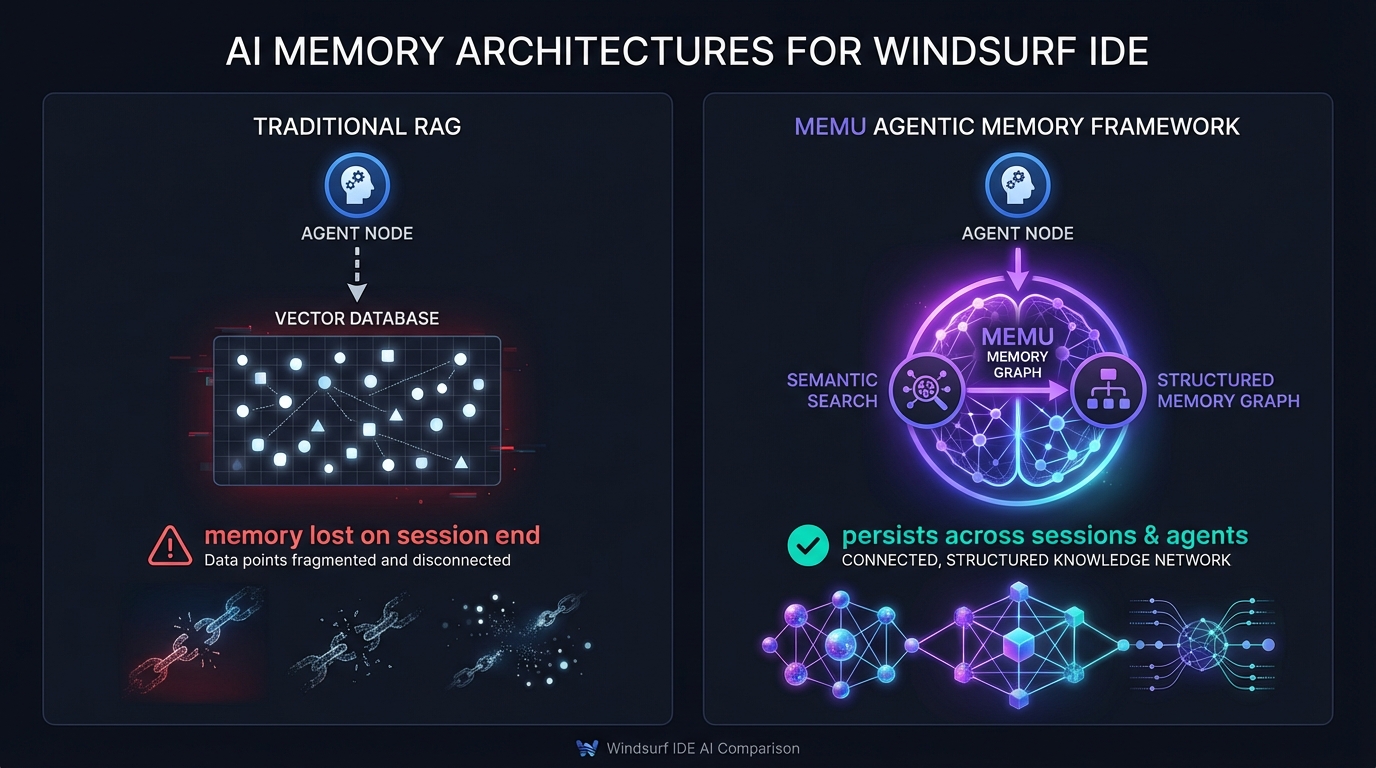
The MemU Agentic Memory Framework: Coding Intelligence That Persists Across Sessions
The MemU Agentic Memory Framework provides the persistent memory layer that AI-native IDEs like Windsurf do not include natively. Instead of treating each coding session as an independent interaction, MemU captures the project understanding, coding patterns, and developer preferences that Flows build during editing and stores them in a structured memory graph that persists across sessions, projects, and developer contexts.
Consider a developer using Windsurf's Cascade to work on a microservices application daily. Without persistent memory, every morning session begins with the AI re-reading project files, re-discovering service boundaries, and re-learning coding conventions. With the MemU Agentic Memory Framework, the AI immediately accesses accumulated project intelligence: the gateway service routes through a custom auth middleware that requires specific header handling, the inventory service has a known race condition on concurrent stock updates that was partially fixed last Tuesday, the team deploys through GitHub Actions with a specific staging-to-production promotion flow, and the developer prefers explicit error types over generic Error classes. That persistent context means the first interaction of every session is productive rather than exploratory.
The framework addresses three core limitations of session-bounded IDE intelligence:
- Project context persistence: Architecture maps, service relationships, deployment configurations, and coding conventions are stored after each session. The MemU Agentic Memory Framework eliminates the daily re-discovery process that wastes the first productive minutes of every coding session.
- Flow pattern learning: As developers work with Windsurf's Flows, their interaction patterns reveal preferences — when they prefer autonomous execution versus guided suggestions, which types of changes they review carefully versus accept quickly, and what level of explanation they want with modifications. Persistent memory captures these preferences and applies them in future sessions.
- Cross-session debugging continuity: Debugging often spans multiple sessions. Persistent memory tracks what was investigated, what was ruled out, and what hypotheses remain untested. A developer who spent the last hour of yesterday's session narrowing down a performance issue can resume tomorrow with the investigation context intact rather than starting diagnosis from scratch.
AI-native IDEs promise a future where AI understands your code as deeply as you do. But understanding that resets every session is a promise that expires daily. The MemU Agentic Memory Framework makes IDE intelligence persistent, turning every coding session into compounding project understanding.
Integration with Windsurf can use the MemU Agentic Memory Framework's REST APIs or MCP server integration. Project context is loaded at session start and new insights are stored at session end. The memory layer complements Windsurf's Flows architecture, providing the cross-session persistence that makes Flow-based intelligence cumulative rather than ephemeral.
Head-to-Head: Session-Bounded IDE AI vs. Memory-Enhanced Coding
Windsurf alone: The most integrated AI coding experience, with Flows that blend suggestion and agency, real-time developer awareness, and Cascade for autonomous task execution. The AI-native design feels more natural than sidebar-based alternatives. But every session starts without project context — the AI re-reads, re-infers, and re-learns the codebase for each new session.
Windsurf + MemU: The same integrated AI experience, now backed by persistent coding memory. Sessions begin with accumulated project understanding — architecture, conventions, debugging history, and developer preferences. Flows operate with deeper context from the first interaction. Cascade executions benefit from historical knowledge about which approaches worked in previous sessions.
For developers who code daily on the same projects, the session-start improvement alone justifies persistent memory. Instead of 5-10 minutes of context-building at the start of each session, the AI is immediately productive — applying accumulated project knowledge from the first keystroke.
Empowering Windsurf: Better Together
The combination of Windsurf's AI-native IDE and the MemU Agentic Memory Framework's persistent memory unlocks coding experiences that neither capability achieves alone:
- Progressive Flow intelligence: Flows that accumulate understanding across sessions become increasingly attuned to the developer's working style. The AI learns when to suggest and when to execute, what level of change requires review, and which patterns the developer consistently prefers — creating a coding experience that adapts to the individual rather than applying generic defaults.
- Repository knowledge base: Persistent memory across many sessions creates a rich knowledge base about the project that benefits the entire team. New developers working in the same repository with Windsurf access the accumulated understanding of every previous session, dramatically accelerating their ramp-up.
- Predictive assistance: With enough session history, the AI can anticipate what the developer is likely to work on next — based on recent code changes, open issues, and discussion patterns — and pre-load relevant context before the developer even starts their session.
Persistent memory transforms Windsurf from a powerful session-based IDE into an AI development environment that genuinely understands your project, your preferences, and your workflow — and that understanding deepens with every session.
Get Started with MemU
Windsurf has pioneered the AI-native IDE concept — demonstrating that AI assistance works best when it's woven into the editing experience rather than confined to a sidebar. The Flows architecture and Cascade agent represent the future of how developers interact with AI during coding.
The next step is making that AI-native intelligence persistent. Sessions where the AI starts with deep project understanding. Codebases where Flows become more effective over time. Teams where project knowledge compounds across every developer's sessions.
The MemU Agentic Memory Framework provides that foundation. MCP-compatible integration, dual-mode retrieval with semantic search and structured memory graphs, and cross-session persistence that turns every coding session into compounding project intelligence.
Visit memu.pro to explore the Agentic Memory Framework API, or check out the GitHub repository to start building agents that remember.
Tags: Windsurf, Codeium, AI IDE, agentic AI, agent memory, MemU AI, LLM memory, AI coding