WitnessAI Extends Security to AI Agents — Governance Without Memory Is Governance Without Context


WitnessAI just extended its enterprise AI security platform to govern autonomous AI agents. The new Agentic Security layer monitors which agents are active across the organization, tracks which MCP servers and tools they access, and protects against adversarial manipulation through unified human-agent attribution and tool discovery. After raising $58M led by Sound Ventures, WitnessAI is building the security infrastructure for the age of AI agents — observe, control, and protect every AI interaction.
The platform operates at the network level via proxy integration, requiring no agent installation on individual machines. It detects shadow AI usage, enforces governance policies in real-time, redacts sensitive data before it reaches AI models, and provides audit trails for regulatory compliance. Automated red-teaming proactively discovers vulnerabilities before deployment. For enterprises deploying AI agents at scale, WitnessAI provides the security control plane.
But security governance has a fundamental dependency that WitnessAI's architecture highlights: effective governance requires understanding agent behavior over time, and understanding behavior over time requires memory.
Why Agent Governance Is Different
Governing traditional AI interactions is relatively straightforward: monitor prompts, filter responses, redact sensitive data. The interaction is stateless — each prompt-response pair can be evaluated independently. But AI agents introduce temporal complexity that changes the governance challenge fundamentally.
An AI agent executing a multi-step task makes dozens of decisions across minutes or hours. It calls tools, accesses MCP servers, reads documents, and takes actions. A single tool call might be harmless in isolation but dangerous in the context of previous actions. An agent that reads a customer database, then accesses an email API, then makes an external HTTP request is potentially exfiltrating data — but only if you connect the dots across the full action sequence.
WitnessAI's Agentic Security monitors these sequences in real-time, which is essential for catching threats as they unfold. But detecting patterns across sessions — recognizing that an agent exhibits the same suspicious behavior every Thursday evening, or that a particular MCP server integration is consistently used in policy-violating ways — requires memory that spans beyond the current monitoring window.
The Observe-Control-Protect Framework
WitnessAI's three-pillar approach addresses the full lifecycle of AI governance. Observe catalogs all AI applications and agents, monitors real-time interactions, and detects unauthorized AI usage. Control enforces acceptable use policies, routes prompts to appropriate models based on risk and cost, and generates audit trails. Protect provides AI firewall capabilities, stops jailbreaks and prompt injection attacks, and filters harmful outputs.
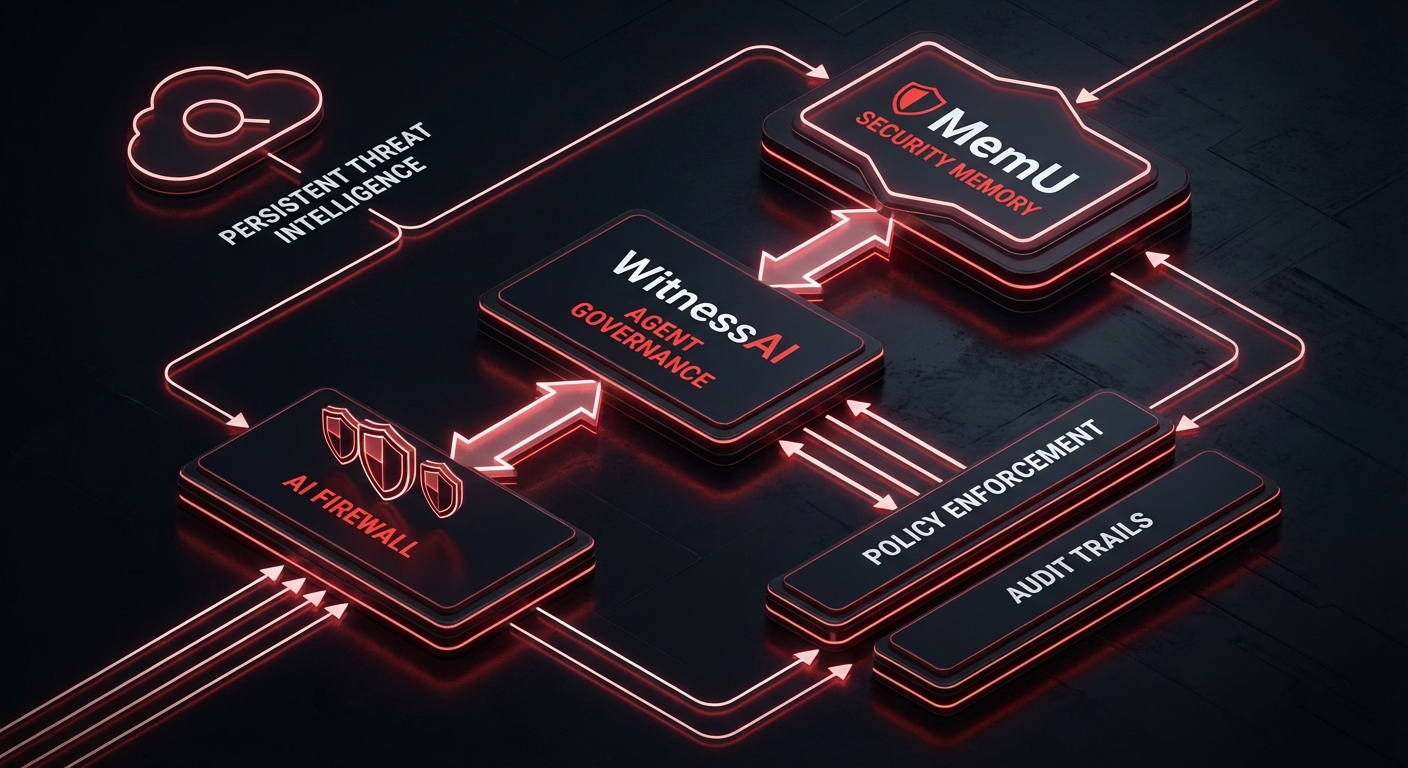
This framework is comprehensive for individual interactions. But agent governance requires a fourth dimension: remember. Security policies need context. Was this agent's current behavior consistent with its past behavior? Has this tool access pattern appeared before? Is this data access request unusual for this agent's typical workflow?
Without behavioral memory, governance systems evaluate each action in isolation. This misses the gradual escalation patterns that sophisticated attacks use — small, individually-acceptable actions that only become threatening when viewed in aggregate over time. The most dangerous agent behaviors aren't single-action violations; they're patterns that emerge across sessions.
Security Memory for Enterprise AI
Enterprise AI security teams need three types of persistent memory to govern agents effectively. Behavioral baselines capture what normal agent behavior looks like for each agent type and role, enabling anomaly detection that adapts to the specific context of each deployment. Incident memory records previous security events, their root causes, and resolutions, enabling faster response to similar incidents. Policy evolution memory tracks how governance rules change over time and why, ensuring that policy updates reflect accumulated understanding rather than reactive patching.
These memory requirements align directly with MemU's architecture. MemU persists agent experiences as structured memories that can be queried by security systems, governance tools, and compliance auditing platforms. When WitnessAI monitors an agent's current behavior, MemU can provide the historical context that turns observation into understanding.
From Monitoring to Intelligence
The evolution from security monitoring to security intelligence parallels the evolution from search to memory in other domains. Monitoring tells you what happened. Intelligence tells you what it means. Monitoring detects a policy violation. Intelligence recognizes that this violation is part of a pattern that has been escalating for weeks.
For enterprises running thousands of AI agents, the difference is critical. Manual review of every flagged interaction doesn't scale. Security teams need intelligent systems that prioritize alerts based on historical context, recognize known-benign patterns, and escalate genuinely novel threats. All of this requires memory — the persistent record of what has been observed, what it meant, and what was done about it.
How MemU Enables Contextual Governance
MemU provides the memory layer that transforms agent governance from stateless monitoring to contextual intelligence. Agent behavioral patterns are persisted across sessions, creating baselines that evolve as agents are updated and organizational policies change. Security events are recorded with full context, building an institutional knowledge base of threats and responses.
The integration with platforms like WitnessAI is architectural: WitnessAI provides real-time governance and protection, MemU provides the historical context that makes governance intelligent. Together, they enable enterprises to deploy AI agents at scale with confidence — knowing that current behavior is monitored and historical patterns are understood.
AI agent security isn't a point-in-time problem. It's a continuous intelligence problem. And continuous intelligence requires memory.
Get Started
Add persistent security memory to your AI governance stack. Explore MemU at memu.pro and on GitHub.