World Labs Marble Creates Explorable 3D Worlds — But Forgets Your Style


Fei-Fei Li's World Labs just solved a problem that's haunted 3D generation: consistency. Marble, their commercial platform released in early 2026, generates explorable 3D worlds from text prompts, single images, videos, or panoramas — and those worlds remain physically stable as you navigate them. No hallucination. No warping. Persistent environments that hold together.
The technology is genuinely impressive. Marble creates high-fidelity 3D environments that export as Gaussian Splats, meshes, or videos. The Chisel Editor decouples spatial structure from visual style. VR compatibility spans Vision Pro and Quest 3. World Labs raised $230 million to build this, and the product delivers on the promise of spatial intelligence.
But Marble shares a limitation with every generative AI system: it doesn't remember what you like. Each generation starts fresh — no accumulated understanding of your aesthetic preferences, project styles, or past creative decisions.
World Labs Marble: What Spatial Intelligence Achieves (And Misses)
Marble represents a breakthrough in AI's ability to understand and reason about 3D space. Fei-Fei Li has argued for years that spatial intelligence is essential for the next decade of AI development. With Marble, World Labs demonstrates what that looks like in practice.
The multimodal input flexibility is remarkable. Feed Marble a text description, and it builds a world. Provide a photograph, and it extrapolates a navigable 3D environment. Upload a video or panorama, and Marble constructs explorable space from the visual information. The Chisel Editor then lets you modify geometry while AI handles aesthetics, materials, and lighting.
For game developers, filmmakers, architects, and VR creators, this accelerates workflows dramatically. Concept art becomes explorable prototypes. Location photos become virtual sets. Design sketches become navigable spaces.
The gap is personalization over time. A filmmaker using Marble for multiple projects starts each one from scratch. The visual language developed for last month's scene doesn't inform this month's. Style preferences must be re-specified every generation. Past creative decisions don't accumulate into an understanding of what the creator wants.
How Marble Handles Generation Context
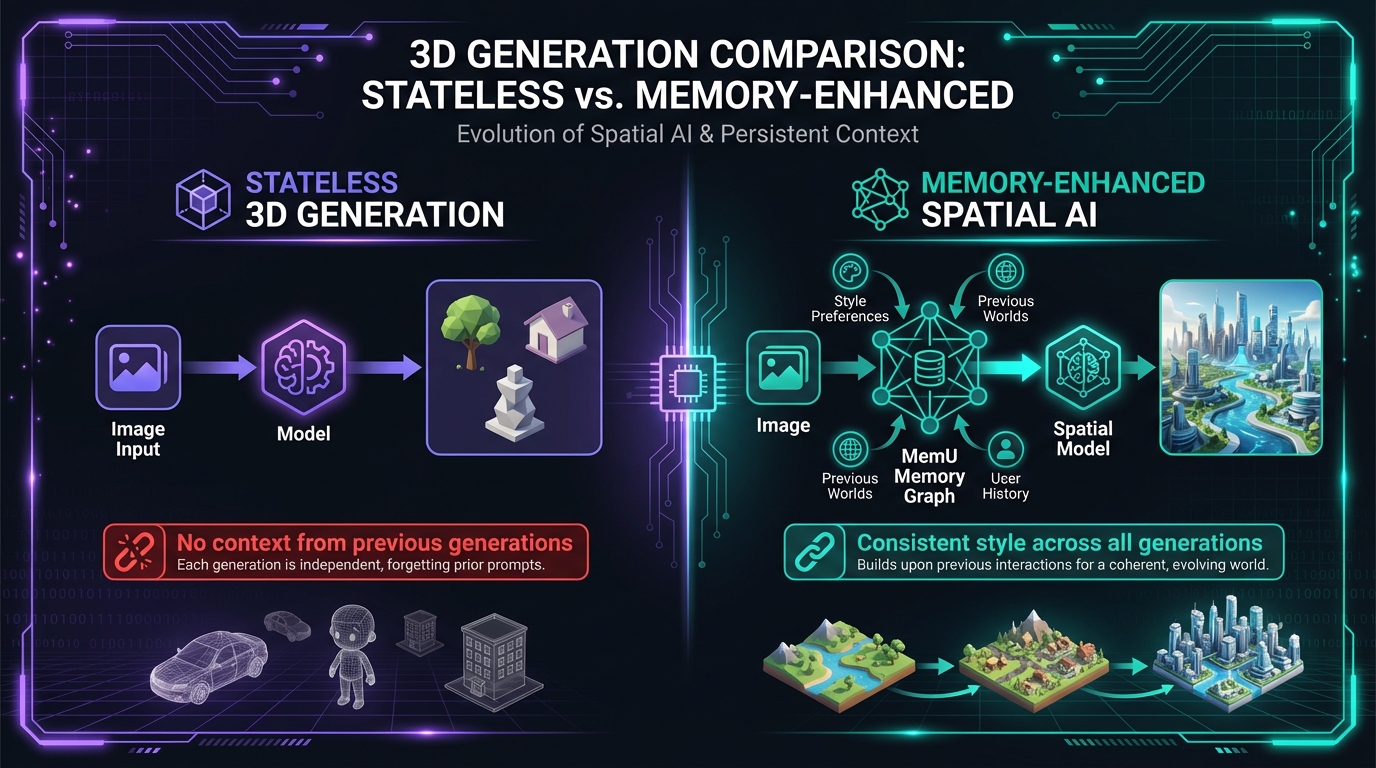
Marble's generation pipeline focuses on spatial consistency within each world. The model ensures that as you explore a generated environment, objects maintain their relationships, perspectives remain coherent, and physics behave predictably. This is the core innovation — stable, explorable 3D rather than warping hallucinations.
Within a session, users can edit, expand, and combine worlds. The Chisel Editor enables fine-grained control. Export options support multiple workflows. The tooling is comprehensive for individual generation tasks.
Cross-session context doesn't persist. The style preferences you specified for Project A aren't available when starting Project B. The lighting approach that worked for one scene requires re-articulation for the next. Material choices don't accumulate into a library of "styles this creator prefers."
This is standard for generative AI tools — DALL-E, Midjourney, Stable Diffusion all work the same way. But for professional workflows involving dozens or hundreds of generations over months, the absence of accumulated preference understanding creates significant friction.
The MemU Agentic Memory Framework: Spatial AI That Learns Your Style
The MemU Agentic Memory Framework provides the preference persistence that spatial AI tools like Marble currently lack. Rather than starting each generation fresh, MemU captures style decisions, aesthetic preferences, and creative patterns into memory that informs future generations.
Consider a game studio using Marble for environment design. They've developed a specific visual language — particular lighting moods, material textures, color palettes, spatial proportions. With Marble alone, each new environment requires re-specifying these preferences. With the MemU Agentic Memory Framework, past style decisions become retrievable context. "Generate in our established style" becomes a meaningful instruction.
The architecture enables this through three mechanisms:
- Style memory: The MemU Agentic Memory Framework captures aesthetic decisions — lighting preferences, material choices, color relationships, spatial proportions — as structured memory that persists across sessions.
- Project continuity: Creative decisions from previous generations inform new ones. The visual language developed over time becomes accumulated understanding rather than session-bounded context.
- Team consistency: Multiple creators working on the same project can share style memory. New team members inherit the accumulated aesthetic preferences without manual style guides.
MemU transforms spatial AI from stateless generation into systems that understand and remember what you're trying to create.
Integration works alongside existing Marble workflows: the MemU Agentic Memory Framework provides APIs that capture generation context and retrieve relevant style memory for new requests.
Head-to-Head: Stateless vs. Memory-Enhanced Generation
Marble alone: Groundbreaking spatial AI that generates consistent, explorable 3D worlds. But each generation is independent — no accumulated understanding of style preferences, project context, or creative patterns. Professional workflows require re-specifying preferences repeatedly.
Marble + MemU: Same spatial AI capabilities plus persistent style memory. Previous generations inform future ones. Creative preferences accumulate into project-specific understanding. Retrieval works across thousands of past generations with sub-100ms latency. Style consistency becomes automatic rather than manual.
World Labs Marble solves spatial consistency within worlds. The MemU Agentic Memory Framework provides style consistency across projects.
Empowering Creative Workflows: Better Together
The MemU Agentic Memory Framework isn't a replacement for Marble — it's the memory layer that makes spatial AI dramatically more useful for professional workflows.
- Production efficiency: Teams using Marble for film, games, or architecture maintain consistent visual language without manual style re-specification. Past decisions inform current generations automatically.
- Creative evolution: Style preferences can evolve intentionally rather than drifting accidentally. Memory tracks what worked and what didn't, enabling deliberate aesthetic development.
- Collaborative consistency: Multiple artists using Marble for the same project share style memory. The visual language stays coherent across contributors and time.
Adding style memory takes a single integration. The MemU Agentic Memory Framework handles preference capture, storage, and retrieval — your Marble workflows just become more consistent.
Get Started with MemU
World Labs Marble represents a genuine breakthrough in spatial intelligence. The ability to generate stable, explorable 3D worlds from minimal input opens creative possibilities that weren't practical before. Fei-Fei Li's vision of AI that understands space is becoming real.
The next step is AI that understands you — your style preferences, your creative patterns, your aesthetic decisions accumulated over time. Generation that builds on what you've already established rather than starting fresh every time.
The MemU Agentic Memory Framework provides that foundation. Drop-in integration with spatial AI workflows means you can add style memory without changing your creative process. Structured preference graphs capture the relationships that make styles coherent. And retrieval scales to support years of accumulated creative decisions.
Visit memu.pro to explore the Agentic Memory Framework API, or check out the open-source repository on GitHub to start building persistent memory into your spatial AI workflows today.