X Enforces 'Made with AI' Labels With 90-Day Suspensions — Content Provenance Without Platform Memory Is Disclosure Without Detection


X just drew a line on AI-generated content in conflict zones. Creators in X's revenue-sharing program who post AI-generated videos depicting armed conflicts without proper disclosure now face 90-day suspensions for first violations and permanent bans for repeats. The policy comes as AI-generated videos of the U.S.-Israeli military operation with Iran flood the platform, blending synthetic footage with authentic reporting. X's head of product Nikita Bier stated bluntly: "During times of war, it is critical that people have access to authentic information on the ground."
The platform is also testing a broader "Made with AI" post-level toggle that lets any creator voluntarily disclose AI-generated content. X already watermarks content generated by its Grok chatbot, but the new system extends labeling responsibility to all creators. The combination of automated detection, community notes, and creator self-disclosure creates a multi-layered approach to AI content provenance.
But labeling individual posts is not the same as understanding content patterns. A creator who posts 50 pieces of AI-generated content and labels only the ones that attract scrutiny is gaming the system. Detecting this behavior requires memory that tracks disclosure patterns across posts, across time, and across creators — not just per-post label checks.
X's AI Labeling: What Everyone's Getting Right (And Missing)
Mandatory disclosure for conflict-zone AI content addresses a genuinely dangerous category of misinformation. AI-generated footage of armed conflicts can manipulate public opinion, justify military actions, or undermine legitimate journalism. The penalty structure — 90-day suspension escalating to permanent ban — provides meaningful deterrence for revenue-motivated creators.
The multi-layered detection approach combines three methods: generative AI detection tools that analyze content characteristics, Community Notes crowdsourced fact-checking that leverages collective human judgment, and creator self-disclosure that encourages voluntary transparency. Each layer catches what the others miss, creating defense in depth.
The gap is platform-level content memory. X evaluates each post against its labeling requirements independently. But the most sophisticated AI disinformation operates across multiple posts, building false narratives incrementally. A series of partially synthetic posts — each individually plausible — can construct a misleading narrative that no single-post analysis would detect. Meta, YouTube, and TikTok face the same structural challenge with their AI labeling policies.
What Platforms Do With AI Content Detection Today
Social platforms deploy AI classifiers that analyze individual pieces of content for synthetic characteristics — artifacts in image generation, inconsistencies in video, or statistical patterns in text. These classifiers produce per-content confidence scores that inform moderation decisions.
Some platforms maintain content moderation histories for individual users, flagging repeat offenders for escalated review. But the correlation between content patterns across users — coordinated inauthentic behavior where multiple accounts post complementary AI-generated content to construct a false narrative — requires cross-account, cross-temporal analysis that per-content classification cannot perform.
Content classifiers detect synthetic media. Narrative manipulation — the coordinated use of AI content to shape perception across posts, accounts, and time — requires platform memory that connects individual detections into behavioral intelligence.
The MemU Agentic Memory Framework: Platform Intelligence That Sees Patterns
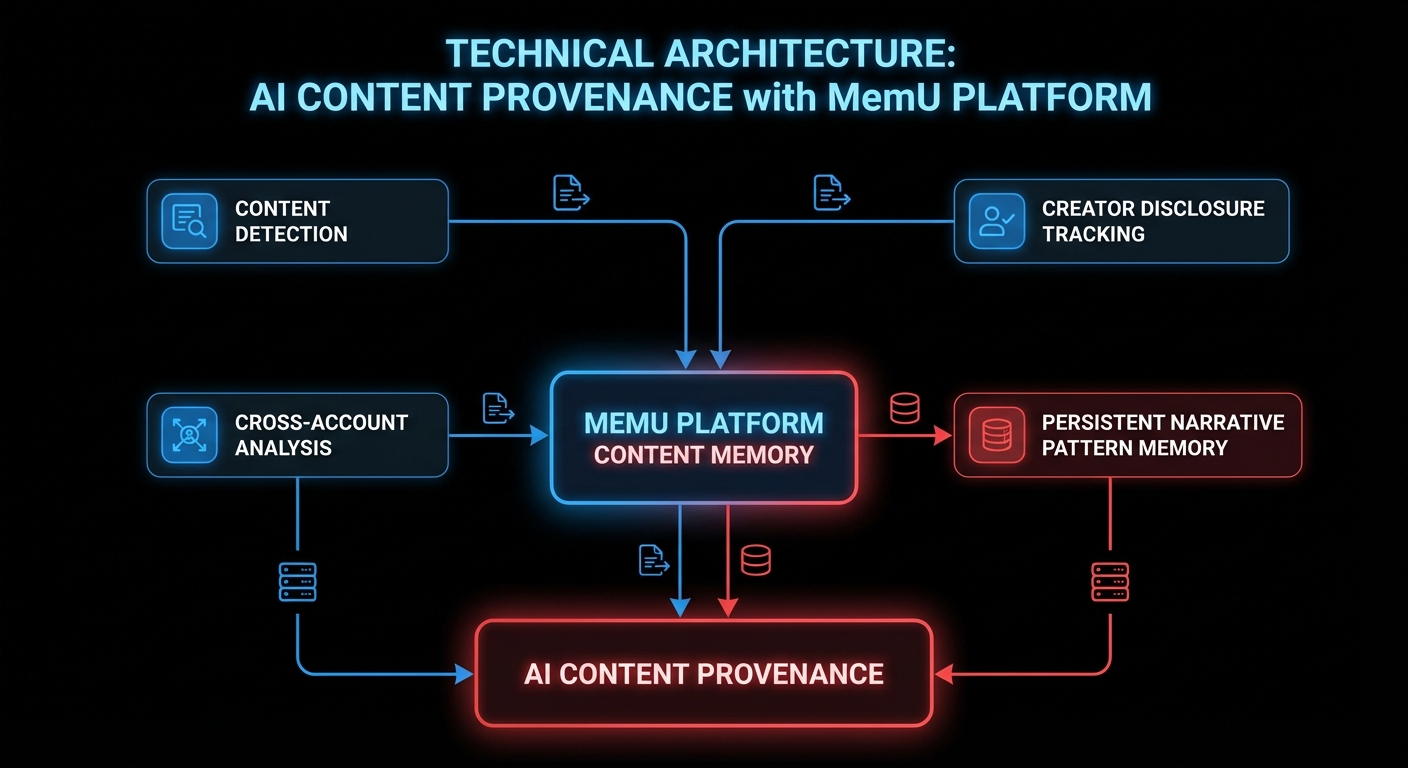
The MemU Agentic Memory Framework provides persistent content provenance memory that transforms individual AI detection results into platform-wide behavioral intelligence, connecting content patterns across posts, creators, and time periods.
Consider X's moderation system processing millions of posts during an active conflict. Without the MemU Agentic Memory Framework, each post is evaluated independently — AI detection runs, Community Notes check for context, and labeling compliance is verified per-post. With MemU, the platform detects that a cluster of 12 accounts began posting AI-generated conflict footage within the same 4-hour window, that their content follows an escalating narrative arc designed to provoke a specific emotional response, and that 8 of these accounts have historically posted unlabeled AI content that was later corrected by Community Notes — a behavioral pattern suggesting deliberate disclosure evasion rather than accidental omission.
The MemU Agentic Memory Framework enhances content provenance through:
- Creator disclosure pattern tracking: Persistent memory reveals whether creators consistently label AI content or selectively disclose only when detection pressure increases. This distinguishes good-faith transparency from strategic compliance gaming.
- Cross-account narrative detection: The framework identifies coordinated AI content campaigns — multiple accounts posting complementary synthetic content to construct false narratives that no individual post would trigger on its own.
- Temporal pattern intelligence: AI disinformation campaigns often follow predictable temporal patterns — seeding content before events, amplifying during crises, adapting narratives based on public reaction. Persistent memory makes these patterns detectable.
Per-post AI detection catches synthetic content. Memory-enhanced provenance catches synthetic narratives — the coordinated patterns that transform individual pieces of AI content into organized disinformation.
Head-to-Head: Per-Post Detection vs. Platform Memory
X's current approach: Multi-layered per-post detection combining AI classifiers, Community Notes, and creator disclosure toggles. Revenue-sharing suspension provides enforcement teeth. Each post is accurately evaluated — but the broader patterns connecting posts into campaigns are invisible.
Platform detection + MemU Agentic Memory Framework: Same detection depth plus persistent content memory. Creator behavior patterns emerge from accumulated disclosure data. Coordinated campaigns become detectable through cross-account analysis. Sub-100ms memory retrieval enables real-time enrichment of every content evaluation with the creator's complete disclosure history.
This applies to every content platform — Meta, YouTube, TikTok, and Reddit all benefit from persistent content provenance memory that connects individual detections into narrative-level intelligence.
Empowering Platform Trust: Better Together
MemU does not replace AI content classifiers — it transforms individual detections into platform-scale intelligence.
- Proactive campaign detection: Historical patterns of coordinated AI content predict emerging campaigns before they reach viral scale. The MemU Agentic Memory Framework enables intervention at the seeding stage rather than after widespread distribution.
- Proportionate enforcement: Persistent creator memory distinguishes accidental labeling omissions from systematic disclosure evasion, enabling enforcement that is proportionate to actual intent rather than treating every unlabeled post identically.
- Community Notes acceleration: The framework surfaces historical context to Community Notes contributors — this account has previously posted unlabeled AI content on this topic — accelerating fact-checking by providing relevant precedent alongside the current post.
Get Started with MemU
X's AI labeling policy sets the disclosure standard. The MemU Agentic Memory Framework provides the persistent content intelligence that makes disclosure policies enforceable at scale — detecting not just synthetic content, but synthetic narratives.
Visit memu.pro to explore the Agentic Memory Framework API and add persistent content provenance memory to your platform.
Tags: X AI labeling, Made with AI, content provenance, AI disinformation, agentic memory, MemU AI, platform trust, AI content detection