xAI's Macrohard Wants AI Agents to Run Entire Companies — But Who Remembers What the Team Decided?

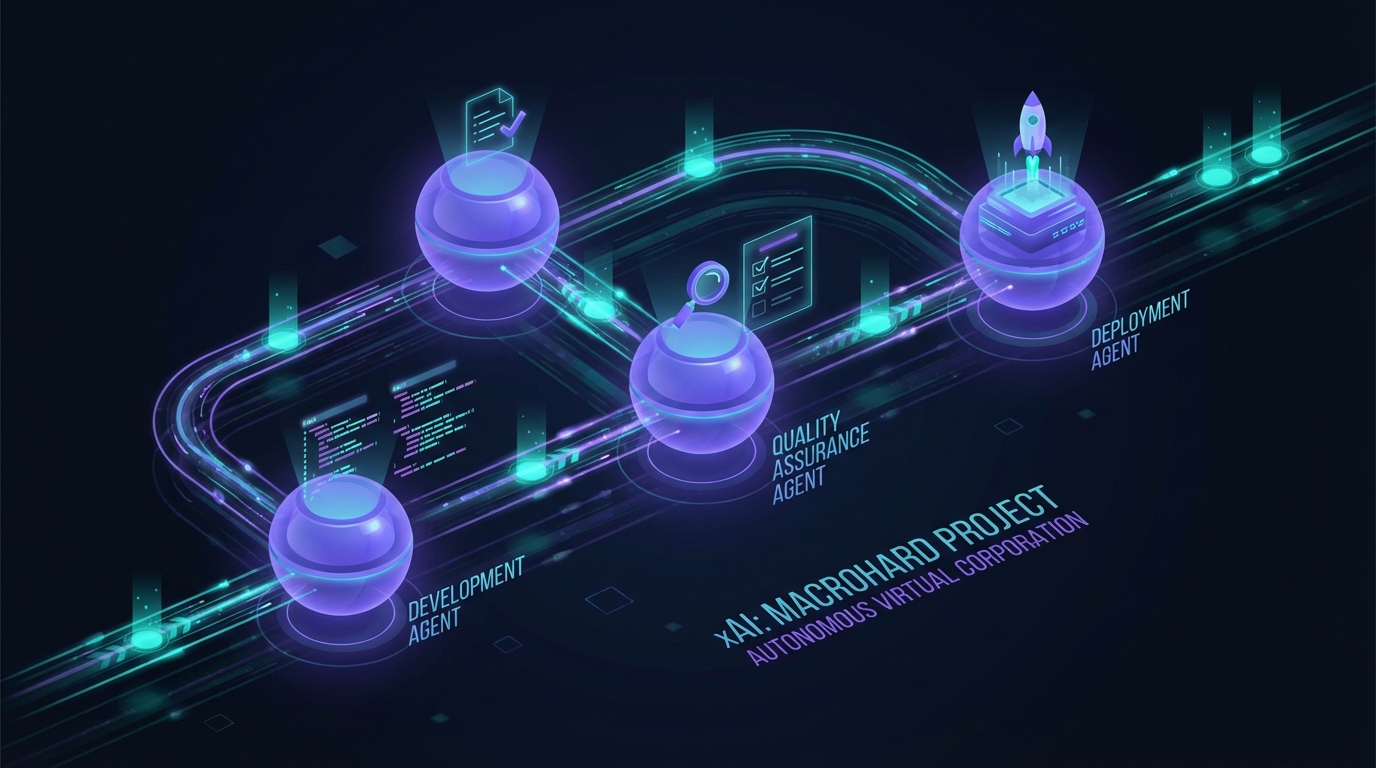
Elon Musk's xAI just announced the most ambitious AI agent project yet. Macrohard — part of xAI's February 2026 reorganization following the SpaceX merger — aims to build autonomous AI agents that simulate entire software companies. Spec features, write code, run tests, ship products, iterate based on feedback. End to end. No humans in the loop.
The name is deliberately provocative (a tongue-in-cheek reference to Microsoft), but the ambition is real. xAI reorganized into four divisions — Grok, Coding, Imagine, and Macrohard — after several co-founder departures. With the combined xAI-SpaceX-X entity valued at $1.25 trillion and an IPO expected, Macrohard represents xAI's bet that autonomous agent teams are the next frontier beyond individual coding assistants.
But orchestrating a team of AI agents to run a company-like operation exposes a fundamental infrastructure question: how do autonomous agent teams maintain institutional memory?
Macrohard: What Autonomous Agent Teams Promise
The Macrohard vision goes beyond code generation. Individual AI coding assistants — Copilot, Cursor, Claude Code — help developers write code faster. Macrohard wants to replace the organizational structure around coding: product managers who define requirements, developers who implement, QA engineers who test, release managers who ship.
This isn't entirely new territory. CrewAI, AutoGen, and LangGraph enable multi-agent workflows. But Macrohard's scope is unprecedented — orchestrating agents that collectively operate as a coherent organizational unit, making decisions that cascade across functions.
The xAI infrastructure backing this is substantial. Grok powers the language intelligence. The Imagine division provides visual capabilities. The Coding division handles technical implementation. Macrohard sits on top as the orchestration layer that coordinates these capabilities into autonomous workflows.
The critical question: what happens to decisions over time? A human software company accumulates institutional knowledge — design decisions, architectural trade-offs, customer feedback patterns, deployment lessons. This knowledge lives in documentation, meeting notes, Slack history, and human memory. An AI agent company needs equivalent infrastructure — and today's multi-agent frameworks don't provide it.
How Multi-Agent Systems Handle Shared Context Today
Current multi-agent frameworks pass context between agents through message queues, shared state objects, or orchestration layers. Agent A completes a task, produces output, and Agent B receives that output as input for the next step. The pipeline works for linear workflows.
The limitation is temporal. Today's pipeline execution has access to today's context. But the architectural decision made two sprints ago? The customer feedback pattern identified last month? The deployment lesson from a failed release three weeks back? These exist only if someone explicitly includes them in the current pipeline's context.
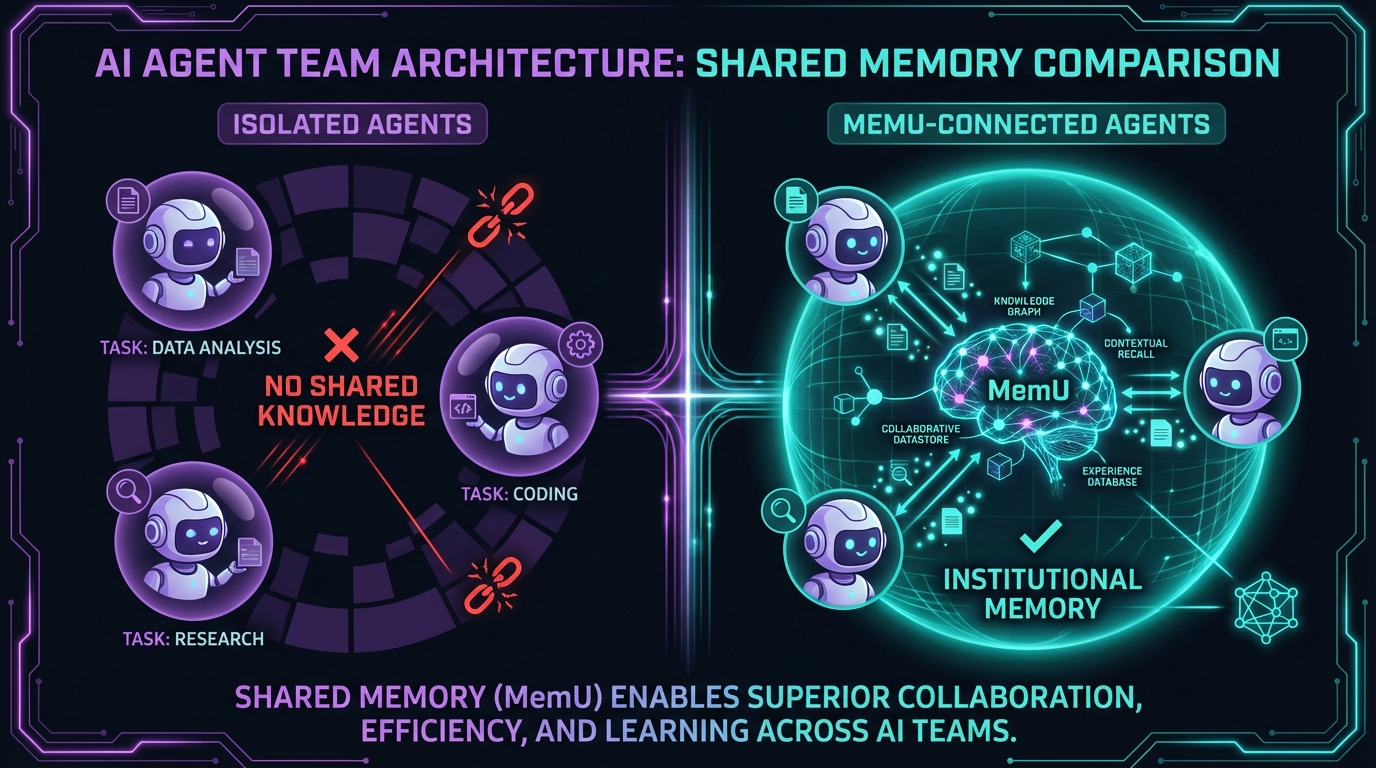
Multi-agent systems lack institutional memory by design. Each pipeline execution starts with whatever context the orchestration layer provides. There's no persistent knowledge base that accumulates lessons, patterns, and decisions across executions. For a "virtual software company," this means no corporate memory — the AI equivalent of a team with total amnesia between sprints.
CrewAI and AutoGen offer task-level memory within execution runs. LangGraph provides state management for graph-based workflows. But none provide the persistent, queryable institutional memory that makes organizations intelligent over time.
The MemU Agentic Memory Framework: Institutional Memory for Agent Teams
The MemU Agentic Memory Framework provides the institutional memory layer that multi-agent systems like Macrohard need. Rather than starting each execution from orchestration context alone, MemU gives agent teams access to accumulated organizational knowledge.
Consider a Macrohard-style agent team managing a product. The PM agent specs a feature. The developer agent implements it. The QA agent catches a regression. With standard orchestration, this knowledge exists only in the current pipeline. With the MemU Agentic Memory Framework, every decision, every regression, every customer feedback pattern becomes queryable context for future executions — the PM agent learns what feature patterns cause regressions, the developer agent remembers architectural constraints, the QA agent knows where bugs cluster.
The architecture enables institutional memory through three mechanisms:
- Cross-agent knowledge sharing: The MemU Agentic Memory Framework allows every agent in the team to contribute to and query shared organizational memory. The PM's product decisions become context for the developer. The developer's technical constraints inform the PM's future specs.
- Decision history: Architectural decisions, trade-off analyses, and rationale persist as structured memory. When a new decision arises, agents can query why previous choices were made.
- Pattern accumulation: Bug patterns, deployment issues, customer feedback themes, and performance bottlenecks accumulate over time. Agent teams become smarter with each sprint rather than resetting.
MemU gives autonomous agent teams what human organizations build over years — institutional memory that makes every future decision more informed.
Integration works with any multi-agent framework: the MemU Agentic Memory Framework provides API endpoints that agents call to store decisions and retrieve relevant organizational context.
Head-to-Head: Stateless Orchestration vs. Memory-Backed Teams
Standard multi-agent orchestration: Message passing, shared state, pipeline context. Works for individual execution runs. But agent teams can't learn across runs — each sprint starts from orchestration context, not accumulated experience.
Multi-agent + MemU: Same orchestration capabilities plus persistent institutional memory. Previous decisions inform current ones. Organizational knowledge accumulates. Retrieval across 10,000+ memory entries with sub-100ms latency. Agent teams develop genuine expertise over time.
Macrohard provides the vision of autonomous agent companies. The MemU Agentic Memory Framework provides the institutional memory that makes that vision operationally viable.
Empowering Agent Teams: Better Together
The MemU Agentic Memory Framework isn't a replacement for multi-agent orchestration — it's the memory layer that makes agent teams function like real organizations.
- Sprint continuity: Agent teams carry forward lessons, decisions, and patterns across sprints. What failed last time informs what to try this time.
- Onboarding new agents: When a new agent joins the team (or replaces one), it inherits accumulated organizational knowledge immediately.
- Audit and accountability: Decision history is queryable. Why was this architecture chosen? What trade-offs were considered? The institutional record exists.
Adding institutional memory takes a single integration per agent. The MemU Agentic Memory Framework handles the complexity — your agent teams just get smarter over time.
Get Started with MemU
Macrohard represents the frontier vision for autonomous AI: agent teams that operate as coherent organizations. Whether xAI achieves this specific vision or not, the trajectory is clear — multi-agent systems are evolving from pipeline tools to organizational infrastructure.
The next step is giving those organizations memory. Teams that learn from every execution. Decisions that draw on accumulated experience. Organizations where institutional knowledge compounds rather than resets.
The MemU Agentic Memory Framework provides that foundation. Drop-in integration means you can add institutional memory to any multi-agent setup. Structured knowledge graphs capture the relationships between decisions, outcomes, and patterns. And retrieval scales to support years of accumulated organizational intelligence.
Visit memu.pro to explore the Agentic Memory Framework API, or check out the open-source repository on GitHub to start building institutional memory into your agent teams today.