Zapier AI Automates Workflows Across Apps — But Automation Agents Without Execution Memory Repeat Failed Paths

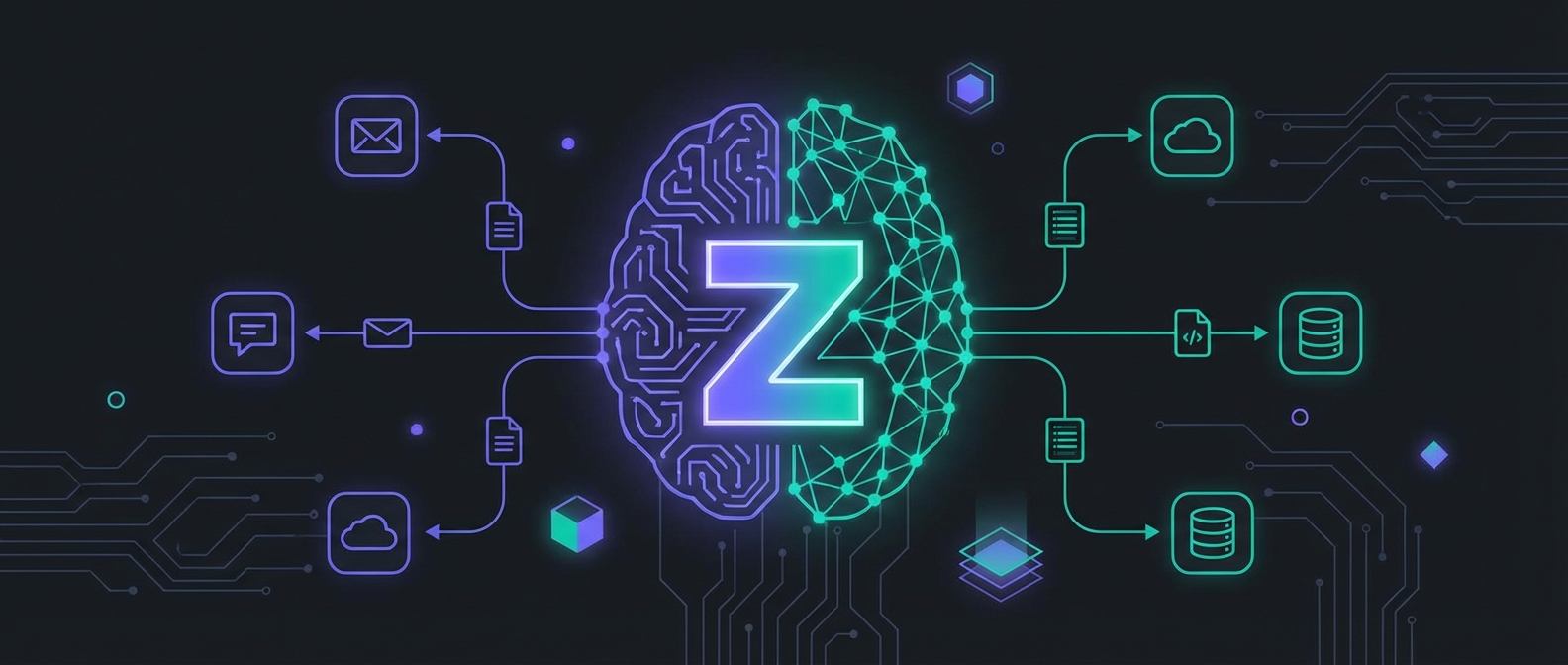
Zapier AI has evolved from a simple workflow automation platform into an AI-powered agent orchestration system. The platform now features built-in AI steps powered by GPT-4o mini and models from Anthropic, Google Gemini, and Azure OpenAI — no separate AI subscription required. AI agents run inside Zaps, reasoning through tasks, using tools, and making decisions about web research, data processing, and workflow routing. The Copilot feature lets users create workflows, tables, forms, chatbots, and agents through natural language conversation. With nearly 500 AI app integrations and over 350 million AI tasks executed, Zapier AI has established itself as the largest AI-powered automation ecosystem connecting applications at scale.
But Zapier AI's automation intelligence resets with each workflow execution. The agent that discovered the optimal routing path through a complex multi-step workflow yesterday runs the same trial-and-error process today. Automation agents without execution memory repeat failed paths and never compound the intelligence gained from previous runs.
Zapier AI: What Everyone's Getting Right (And Missing)
Zapier AI's strength is its ecosystem breadth. The platform connects to thousands of applications, and the AI layer adds intelligent decision-making to what were previously rigid trigger-action workflows. Instead of building complex conditional branches manually, developers can describe the logic in natural language and let AI agents handle the routing decisions. A Zap that processes customer support tickets can now use AI to classify the issue, determine priority, route to the appropriate team, and draft an initial response — decisions that previously required extensive manual rule configuration.
The Copilot feature further lowers the automation barrier. Users describe what they want to automate — "When a new lead comes in from our website form, enrich the data with Clearbit, score them based on our ICP criteria, and add high-scoring leads to our HubSpot pipeline with a personalized follow-up email" — and Copilot builds the complete workflow. For teams that need sophisticated automation but lack dedicated operations engineers, this accessibility is transformative.
What Zapier AI does not capture is the execution intelligence that accumulates across workflow runs. An AI agent that routes customer tickets encounters edge cases over time — misclassifications, unexpected data formats, routing decisions that led to poor outcomes. Each execution generates valuable intelligence about what works and what doesn't. But that intelligence vanishes after the run completes. The next ticket is routed using the same initial logic, with no benefit from hundreds of previous routing decisions. Other automation platforms — including Make.com, Workato, and Tray.io — share this same constraint. They execute workflows; none learn from execution history.
The MemU Agentic Memory Framework: Automation Intelligence That Compounds
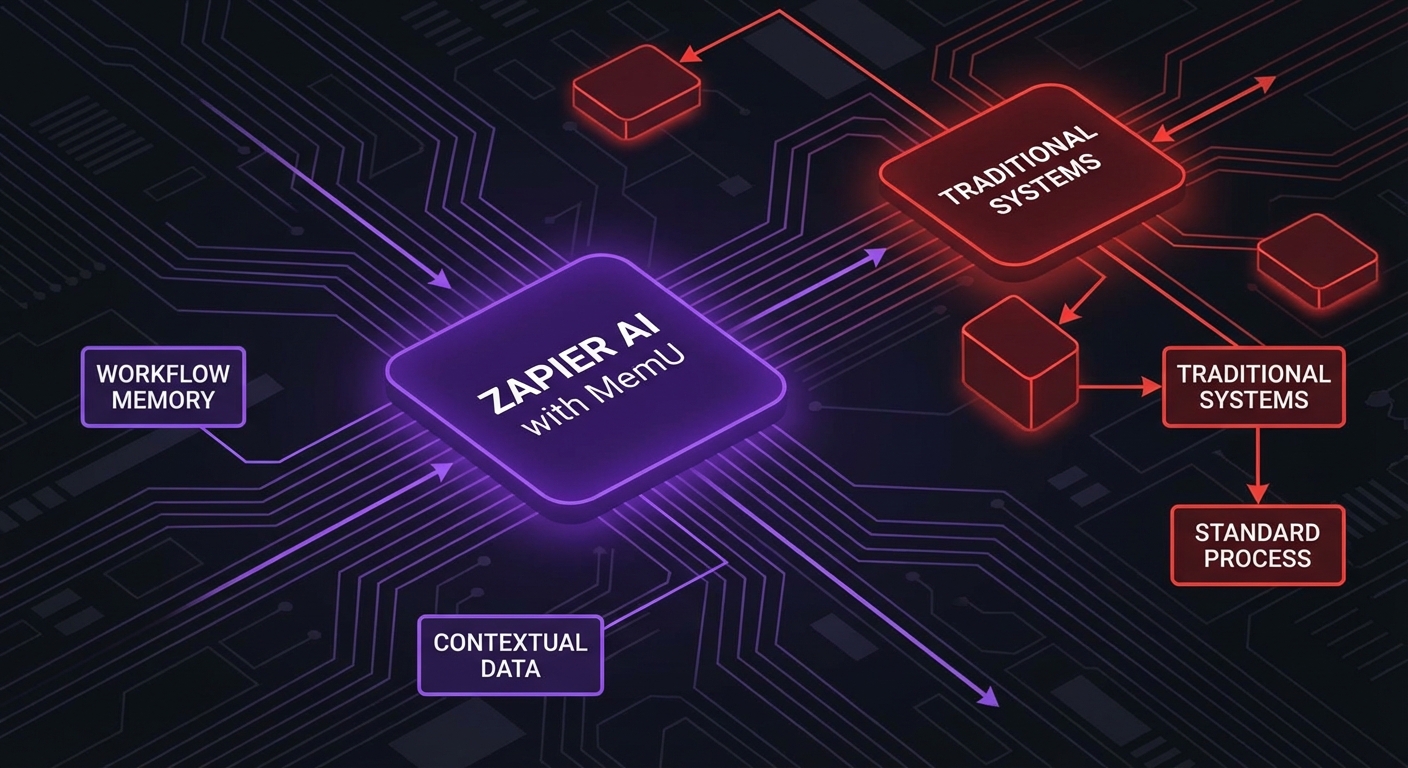
The MemU Agentic Memory Framework provides the persistent memory layer that automation platforms like Zapier AI do not include natively. Instead of treating each workflow execution as an isolated event, MemU captures the routing decisions, error patterns, and outcome data that emerge during execution and stores them in a structured memory graph that persists across runs, workflows, and organizational contexts.
Consider an AI-powered Zap that processes inbound sales leads. Without persistent memory, each lead runs through the same scoring logic and routing rules regardless of what previous executions revealed. With the MemU Agentic Memory Framework, the AI agent recalls execution history: leads from the fintech vertical with mid-market company sizes converted 3x better when routed to the enterprise team rather than SMB, leads from webinar signups required different enrichment sources than organic form submissions, and the Clearbit enrichment step failed for .io domains 40% of the time but Apollo API succeeded. That accumulated execution intelligence transforms a static workflow into an adaptive system that improves with every run.
The framework addresses three core limitations of stateless automation:
- Execution pattern persistence: Every workflow run's decisions, outcomes, and edge cases are stored with full context. The MemU Agentic Memory Framework builds a queryable history of what worked, what failed, and why — enabling AI agents to make increasingly informed routing decisions over time.
- Error intelligence accumulation: When a workflow step fails — an API returns unexpected data, a rate limit is hit, a third-party service returns an error — persistent memory records the failure context and any workaround that succeeded. Future runs encountering similar conditions can apply the learned workaround automatically rather than failing and requiring manual intervention.
- Cross-workflow learning: Organizations often have dozens of related workflows — lead processing, customer onboarding, billing operations. Persistent memory enables intelligence sharing across workflows. A data quality insight discovered in the lead processing Zap benefits the customer onboarding Zap that uses the same data sources.
Automation that never learns from its own execution history is doomed to repeat mistakes and miss optimizations. The MemU Agentic Memory Framework turns every workflow run into accumulated intelligence that makes the next execution smarter, faster, and more reliable.
Integration with Zapier AI workflows uses the MemU Agentic Memory Framework's REST APIs as custom steps within Zaps. At the start of a workflow, the agent queries MemU for relevant execution history. At the end, outcomes and decisions are stored back. The memory layer operates within Zapier's existing automation architecture, adding persistence without disrupting established workflows.
Head-to-Head: Stateless Automation vs. Memory-Enhanced Workflows
Zapier AI alone: The broadest AI-powered automation ecosystem with 500+ AI app integrations and intelligent agent-based routing. Natural language workflow creation through Copilot lowers the automation barrier. But every workflow execution starts from the same static logic — no learning from previous runs, no adaptation based on accumulated outcomes.
Zapier AI + MemU: The same automation breadth and AI decision-making, now backed by persistent execution memory. AI agents make routing decisions informed by the full history of previous executions. Error handling improves automatically as the system encounters and learns from edge cases. Workflow performance compounds over time as execution intelligence accumulates across thousands of runs.
The improvement is measurable. Workflows that process hundreds of items daily generate substantial execution data. With persistent memory, a lead scoring workflow that initially achieved 60% accurate routing can improve to 85%+ as the AI agent learns from conversion outcomes, feedback signals, and edge case resolutions — without any manual rule modification.
Empowering Zapier AI: Better Together
The combination of Zapier AI's automation ecosystem and the MemU Agentic Memory Framework's persistent memory unlocks automation capabilities that neither achieves alone:
- Self-optimizing workflows: Automation workflows that learn from their own execution history optimize routing, timing, and decision logic automatically. A customer onboarding Zap that discovers certain email sequences work better for enterprise accounts versus SMB accounts adjusts its behavior without manual rule changes.
- Predictive error handling: Persistent memory enables agents to anticipate failures before they occur. If API calls to a specific service tend to fail during certain hours or under specific conditions, the agent can proactively adjust timing or switch to alternative data sources — reducing workflow failures and manual intervention.
- Organizational automation intelligence: When multiple teams use Zapier with shared memory, automation best practices emerge naturally. A workflow pattern that works well for the sales team's lead processing is discoverable and applicable to the customer success team's renewal workflow, accelerating automation development across the organization.
Persistent memory transforms Zapier AI from a powerful execution platform into an intelligent automation system that learns, adapts, and improves with every workflow run — turning repetitive task execution into compounding operational intelligence.
Get Started with MemU
Zapier AI has built the most extensive AI-powered automation ecosystem available — 500+ app integrations, 350 million+ AI tasks executed, and a natural language Copilot that makes workflow creation accessible to non-technical users. The platform solves real problems for teams that need to connect applications and automate repetitive work at scale.
The next step is giving those automated workflows the ability to learn from their own execution. Workflows where AI agents improve their routing decisions based on accumulated outcomes. Automation where error handling adapts automatically based on observed failure patterns. Organizations where operational intelligence compounds across every workflow execution.
The MemU Agentic Memory Framework provides that foundation. Drop-in API integration via custom Zap steps, dual-mode retrieval with semantic search and structured memory graphs, and cross-execution persistence that turns every workflow run into compounding automation intelligence.
Visit memu.pro to explore the Agentic Memory Framework API, or check out the GitHub repository to start building agents that remember.
Tags: Zapier AI, workflow automation, agentic AI, agent memory, MemU AI, LLM memory, AI automation