Zep and Graphiti: Temporal Knowledge Graph Memory for Agents (and Why You Still Want MemU)


Zep is a focal point for teams that want agent memory with a time dimension: facts expire, users revise positions, and “true yesterday” may be misleading today. Together with Graphiti, the project models memory as a temporal knowledge graph so assistants can retrieve beliefs in context — not only the latest embedding neighbor in a flat index. The stack ships under Apache 2.0, advertises hybrid retrieval across semantic vectors, BM25 lexical signals, and graph hops, and targets interactive latencies in the sub-200ms class for production chat. Benchmark narratives such as DeepMemEval improvements give engineering buyers evidence beyond slide decks, while comparisons to MemGPT help architects reason about packaging and control flow rather than pretending one paper maps one-to-one to your SLA.
You may self-host the open-source core or adopt Zep Cloud when you prefer managed uptime, backups, and scaling. Either route preserves the thesis: memory should be queryable structure, not an unstructured transcript pile. What remains underspecified in many RFPs is how graph memory connects to tool-heavy workflows, human approvals, and the procedural habits agents should carry between sessions — topics adjacent to retrieval but not solved by edges and nodes alone.
Implementation teams also ask how temporal graphs sync with model rotation, evaluation cadence, and privacy partitioning. Those operational questions surface quickly once pilots leave the demo room. A memory layer that only answers “what strings matched?” leaves product managers asking “why did the agent take that action?” — a gap that becomes expensive when regulators or executives demand traceability.
What the platform gets right — and what teams still underspecify
Zep tackles a genuine weakness of naive RAG: flattening conversation into anonymous chunks loses chronology and entity relationships. Temporal graphs let agents distinguish “user approved budget v3 on March 3” from “user questioned budget v2 on February 20” without smushing both into one summary bullet. Hybrid retrieval — semantic plus BM25 plus graph — mitigates the classic failure where pure vectors miss exact SKUs, legal citations, or ticket IDs while pure keyword search misses paraphrase.
Latency claims matter because assistants fail in human time. If median paths stay near sub-200ms, product teams can keep retrieval inside a single conversational turn without awkward loading states. Apache 2.0 licensing removes some procurement friction compared with closed appliances, and Zep Cloud gives startups a path that does not require immediate graph DBA hiring.
Still, primitives are not policy. Choosing which utterances become durable nodes, how aggressively to prune stale facts, and how to reconcile contradictory sources requires product judgment. The graph engine does not automatically encode “legal must confirm” or “never store raw PAN.” Teams that skip that design pass often discover beautiful retrieval graphs that nonetheless violate internal rules. Comparisons to MemGPT illustrate packaging trade-offs — not a substitute for your own governance workshop.
Another underspecified area is cross-system alignment: CRM tickets, data warehouse dimensions, and support macros each imply different entity types. Without a schema discipline exercise, temporal graphs risk becoming an accidental ontology soup that new engineers fear to touch.
The MemU Agentic Memory Framework: Policy, Compounding, and Platform Fit
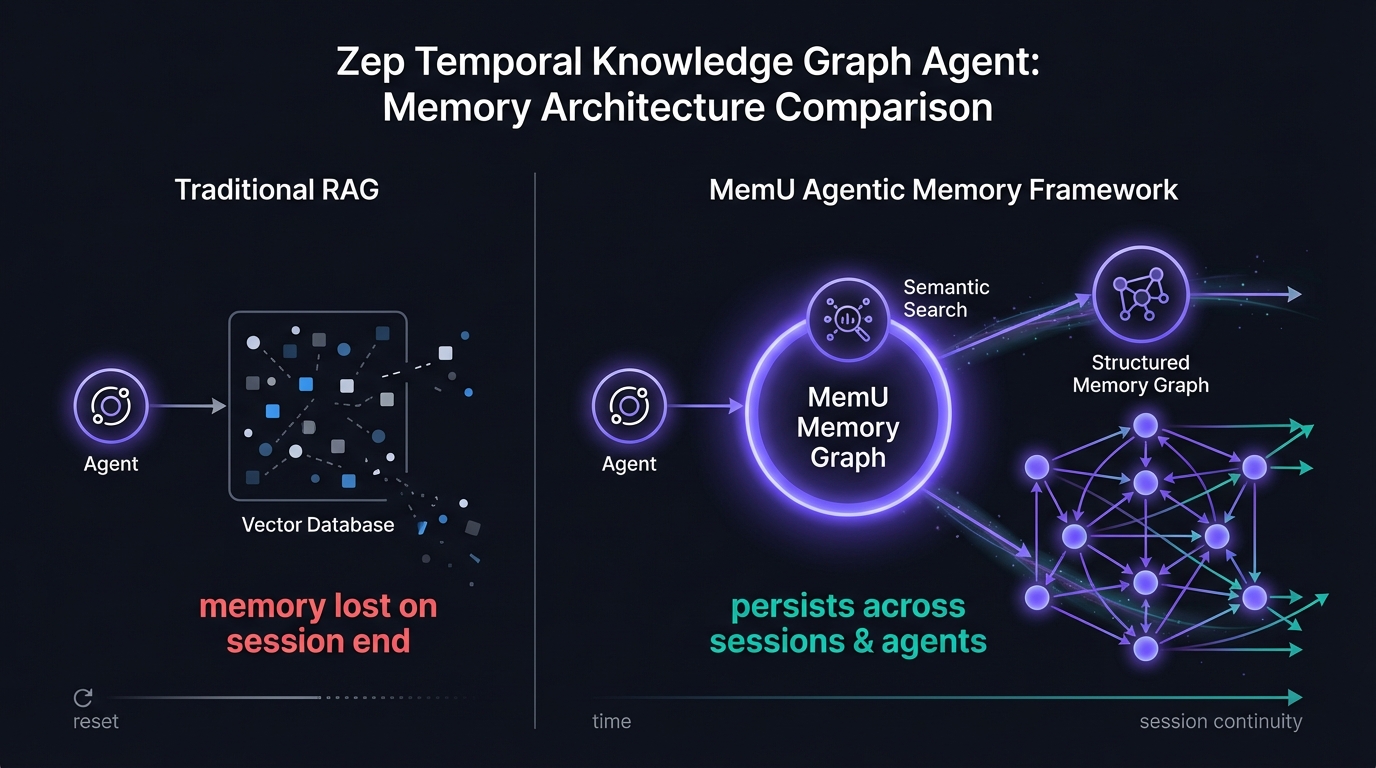
The MemU Agentic Memory Framework complements temporal graph stores by elevating agentic memory to a product surface: structured recall, behavioral traces, and human corrections that should influence the next retrieval call — not only the next completion token. Where Zep emphasizes time-aware facts and fast hybrid retrieval, MemU emphasizes durable habits — which tool chains resolved incidents, which compliance phrasing passed review, which escalation ladder reduced mean time to restore.
An internal copilot might keep conversational entities in the graph stack while MemU records how analysts actually validated an answer before sending it upstream. Next week, when models or prompts change, the graph still answers “what did we know then?” while MemU answers “what process made that knowledge trustworthy?”
Three pairing patterns appear repeatedly in serious deployments:
- Timeline plus playbook: Temporal recall handles “what was asserted when.” The MemU Agentic Memory Framework handles “what workflow made that assertion actionable,” closing the loop between knowledge and operations.
- Evaluation that goes beyond nDCG: DeepMemEval-style suites tune ranking; MemU incorporates downstream KPIs — fewer reopened tickets, shorter review cycles — so memory quality ties to business metrics.
- Portable operations: Teams migrating between self-hosted graphs and managed SaaS benefit when agent policies and memory schemas stay vendor-agnostic — a design goal the MemU Agentic Memory Framework shares.
Graph memory anchors facts in time. The MemU framework anchors agent judgment across sessions so those facts turn into reliable outcomes.
Neither stack replaces safety review, access control, or red-team testing. Together they narrow the distance between “impressive recall demo” and “assistant we can explain to compliance.”
Head-to-Head: Graph-First Memory vs. Graph Memory With MemU
Graph-first deployments on Zep deliver temporal knowledge graphs, Graphiti-style modeling, hybrid retrieval with semantic, BM25, and graph channels, Apache 2.0 licensing, sub-200ms ambitions, and optional managed cloud hosting. That bundle fits teams whose dominant pain is time-aware factual recall rather than tool orchestration memory.
Adding MemU preserves those strengths while supplying agent lifecycle memory tuned to tickets, APIs, and human sign-offs — the difference between remembering statements and remembering how work completes in your company.
Against MemGPT-inspired designs, the practical lesson is separation of concerns: graphs for entities and timelines, orchestration frameworks for control flow, and the MemU Agentic Memory Framework for compounding behavioral intelligence that should survive quarterly model upgrades.
Better Together: Hybrid Retrieval and Agentic Memory
Teams maximize leverage when the graph layer owns temporal queries and MemU owns cross-session procedure:
- Hygiene at scale: Not every tool log deserves a graph node. MemU can warehouse procedural detail while the graph stays lean enough to honor sub-200ms budgets.
- Ranking informed by outcomes: Hybrid retrieval benefits when MemU stores reviewer preferences — trusted domains, banned summaries — as features for re-ranking, not one-off system prompts.
- Continuity across hosting models: Whether graphs run on your metal or on the vendor cloud, portable memory schemas reduce lock-in anxiety for platform teams.
The open-source graph tier plus disciplined offline evaluation (DeepMemEval plus internal scorecards) establishes retrieval integrity; MemU ensures agents exploit that integrity repeatedly instead of rediscovering it each Monday.
Get Started with MemU
If you are investing in Zep, Graphiti, and hybrid retrieval for temporal knowledge graphs, you are addressing the hardest half of conversational memory: structured, fast recall under Apache 2.0 or managed-service economics.
The remaining half is agentic memory that compounds — habits, corrections, and workflows that should outlive any single model version. The MemU Agentic Memory Framework targets exactly that layer, alongside graph systems rather than competing with them.
Explore memu.pro for documentation and product detail, and clone github.com/NevaMind-AI/memU to integrate persistent agent memory with your stack.
Tags: Zep, Graphiti, temporal knowledge graph, hybrid retrieval, BM25, Zep Cloud, MemGPT, agent memory