Zig.ai Introduces Outcome-Based Agentic Sales Execution — But Sales Agents Without Cross-Org Persistent Memory Cannot Compound Deal Intelligence


Zig.ai launched on March 10, 2026, with three million dollars in funding led by super{set}, introducing an agentic sales execution platform that fundamentally rethinks how enterprises pay for AI in sales workflows. Rather than per-seat licensing that charges for access regardless of value, Zig embeds AI agents directly into sales workflows with outcome-based billing — organizations pay only when agents successfully complete defined tasks, verified through system logs. Pricing tiers range from pay-as-you-go at 25 cents per execution with 100 included, through Growth at 2,250 dollars per month covering 300 executions for 10 to 50 reps, to custom Enterprise plans. Founded by Steve Ancheta, Zig eliminates the license bloat plaguing enterprise software by aligning cost directly with demonstrated agent value.
But outcome-based billing measures whether agents complete tasks — not whether agents improve at completing them. Zig claims its agents learn from interactions and build organizational memory. Yet agentic sales execution without cross-organizational persistent memory creates agents that may learn within a single deal cycle but cannot compound intelligence from hundreds of cycles into systematic improvements. An agent that completes an outreach task earns its fee, but the strategic knowledge gained — what messaging resonated, which objection handling converted, what timing influenced engagement — evaporates before the next cycle begins.
Agentic Sales Execution: What Zig.ai Gets Right (And What It Misses)
Zig's outcome-based pricing addresses a legitimate friction point in enterprise AI adoption. Traditional per-seat licensing creates misalignment where vendors profit from access rather than results. By tying billing to verified task completion, Zig forces its platform to demonstrate value at every interaction — a pricing architecture that naturally selects for agent effectiveness because unprofitable executions cost the vendor without generating revenue.
The embedding approach is architecturally sound. Rather than building another standalone sales tool requiring context-switching, Zig inserts agents directly into existing workflows. This reduces adoption friction and ensures agents operate with full process context rather than incomplete information passed between disconnected systems. For agentic sales execution, workflow-native operation is essential because sales interactions are inherently contextual and sequential.
The verification mechanism through system logs provides accountability most AI sales platforms lack. When Zig claims a task completed successfully, that claim is backed by verifiable evidence rather than self-reported metrics. This transparency builds the trust necessary for enterprises to delegate meaningful operations to autonomous agents, knowing billing accuracy can be independently confirmed.
The limitation is learning depth. Zig describes agents that learn from interactions, but effective agentic sales execution at scale requires cross-organizational intelligence spanning hundreds of deals, multiple product lines, diverse buyer personas, and evolving market conditions. Compounding intelligence across an organization's full sales breadth — where enterprise deal patterns inform mid-market strategy, where objection handling transfers across verticals, where seasonal timing patterns emerge only from multi-quarter analysis — requires persistent memory transcending any single deal or execution cycle.
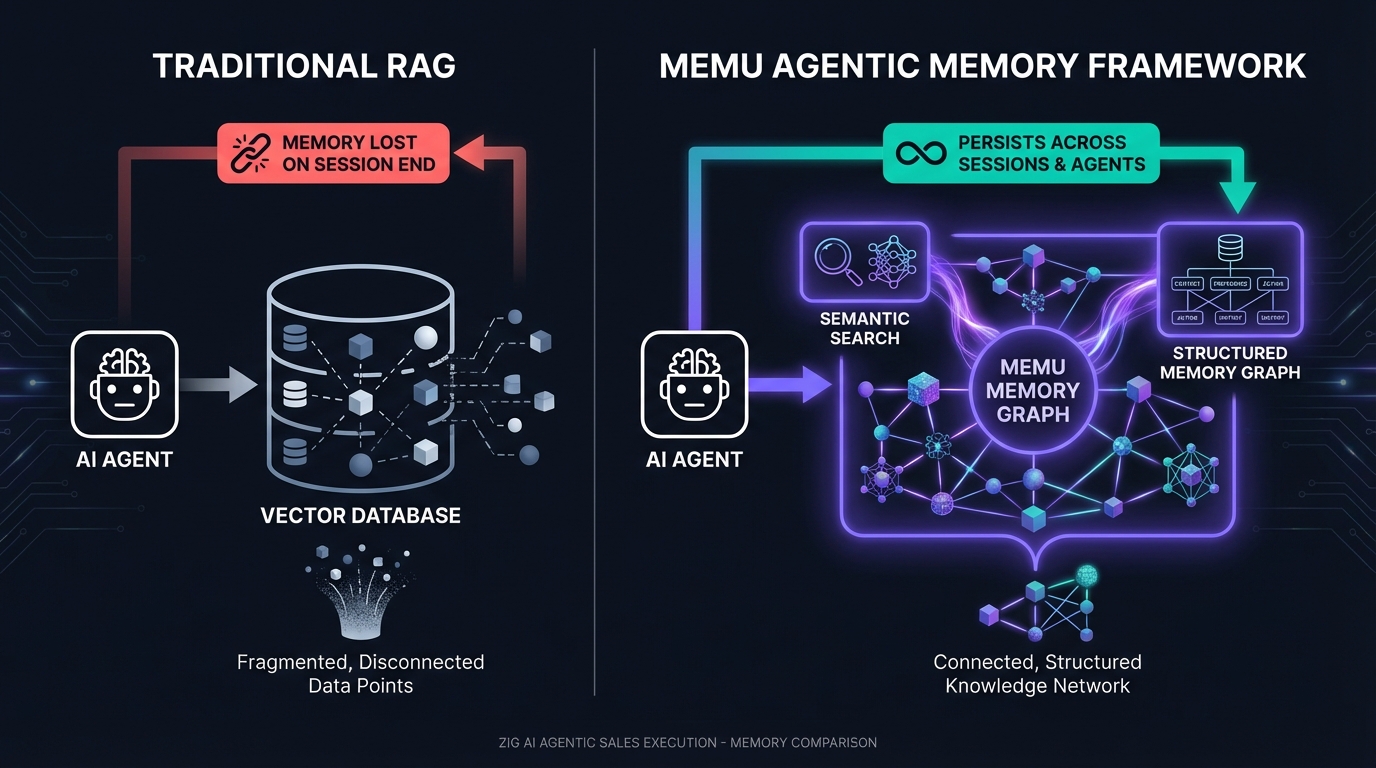
The MemU Agentic Memory Framework: Persistent Intelligence for Sales Execution
The MemU Agentic Memory Framework transforms agentic sales execution from task completion into intelligence accumulation. Where Zig agents execute individual tasks and earn outcome-based fees, MemU ensures every completed task deposits strategic intelligence elevating all future tasks — creating a compounding effect where agents grow measurably more effective with every interaction across the entire organization.
Consider a sales organization with thirty reps across three verticals using Zig for outreach, follow-up, and scheduling. Over six months, agents complete thousands of executions. During this period, agents implicitly discover that manufacturing prospects respond best to ROI messaging on Tuesday mornings, healthcare buyers require compliance documentation before engaging, and financial services prospects receiving case studies convert at twice the rate. With MemU, these patterns persist as organizational intelligence every agent applies automatically. Without persistent memory, each outreach starts from the same generic baseline — agents complete tasks but never compound the strategic intelligence those completions generate.
The MemU Agentic Memory Framework provides capabilities enhancing agentic sales execution:
- Deal pattern persistence: Every execution generates strategic data — which approaches converted, which messaging fell flat, which timing optimized response rates. MemU captures these as structured sales memories agents query when planning outreach, enabling data-driven strategy based on organizational evidence rather than generic best practices.
- Cross-vertical intelligence transfer: Strategies working in one vertical often transfer with modifications to adjacent verticals. MemU identifies transferable patterns and surfaces them in similar contexts — enabling new vertical expansion to benefit from accumulated intelligence rather than rebuilding knowledge from zero.
- Outcome quality compounding: Zig's billing verifies task completion; MemU tracks outcome quality — not just whether a meeting was scheduled but whether it converted, whether the deal progressed, and whether the outcome justified the approach. This quality loop enables optimization for downstream results rather than immediate completion.
Outcome-based billing proves agents complete tasks. The MemU Agentic Memory Framework ensures agents complete tasks better every time — building organizational sales intelligence compounding with every execution across every rep, vertical, and quarter.
Head-to-Head: Zig.ai vs. Other Sales Execution Platforms
Zig.ai alone: Agents embed in workflows, complete defined tasks, and bill only for verified outcomes. The pricing model eliminates license bloat and system logs provide transparency. But each execution operates with limited historical context — agents complete today's task without systematic access to intelligence from yesterday's thousand completions, proving transaction-level value but unable to demonstrate compounding organizational value.
Zig.ai + MemU Agentic Memory Framework: Every verified execution deposits intelligence future executions build upon. Agents apply accumulated knowledge to every outreach and follow-up — selecting strategies with proven records for the specific prospect profile, vertical, and timing. Persistent memory increases success rates, generating more billable completions from fewer attempts while delivering measurably better results for the sales organization.
Compared to other agentic sales execution platforms — Apollo AI, Outreach, Salesloft, HubSpot AI agents — Zig offers the most aligned pricing through outcome-based billing. But all share the same intelligence limitation: agents executing tasks without compounding cross-organizational intelligence. MemU uniquely provides a persistent layer transforming individual completions into organizational learning elevating every future interaction.
Selling Smarter: Better Together
MemU does not replace Zig's agentic sales execution platform — it ensures every completed execution contributes to growing organizational intelligence:
- Pricing optimization: Outcome-based billing rewards successful executions; MemU increases success rates by equipping agents with historically proven strategies — creating a virtuous cycle where persistent memory generates more billable outcomes while improving quality for customers.
- Rep enablement: Zig supports 10 to 50 reps at the Growth tier; the MemU Agentic Memory Framework ensures intelligence from any rep's interactions benefits the entire team — new reps start with accumulated expertise of the organization's top performers rather than learning through costly trial and error.
- Market adaptation: Sales strategies must evolve as markets shift; MemU captures market signals across all interactions, detecting changes in prospect behavior and messaging effectiveness — enabling proactive strategy adaptation rather than discovering shifts through declining success rates.
Get Started with MemU
Give your sales agents persistent memory to transform agentic sales execution from individual task completion into organizational intelligence compounding with every interaction. The MemU Agentic Memory Framework integrates with any sales platform — one API, instant persistence, zero changes to existing workflows. Visit memu.pro to explore the Agentic Memory Framework API, or check out the GitHub repository to start building agents that remember.
Tags: Zig.ai, agentic sales execution, outcome-based billing, AI sales agents, sales automation, persistent deal intelligence, organizational memory, MemU AI