Zoom Launches AI Avatars, a Full AI Office Suite, and Meeting Agents — But Every Conversation Still Starts From Scratch

Zoom AI Avatars: What Everyone's Getting Right (And Missing)
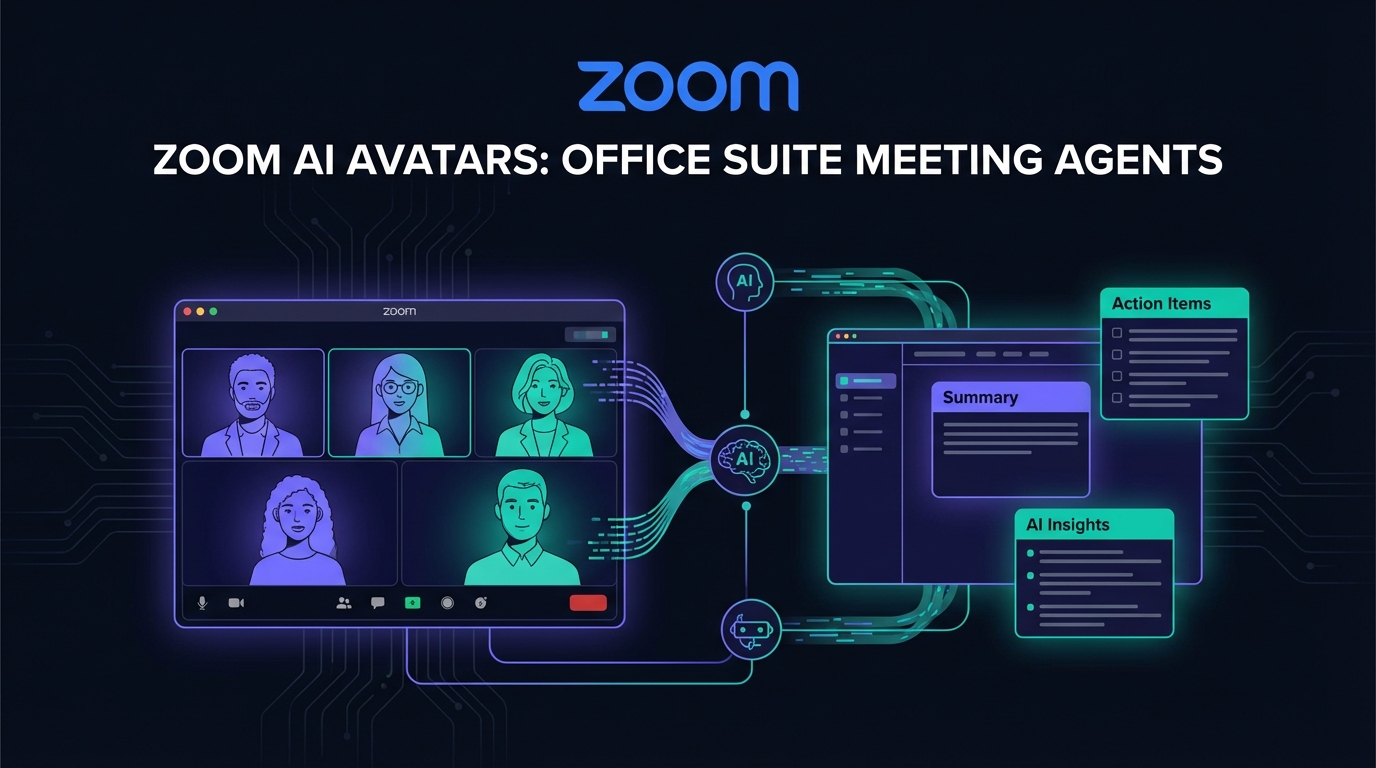
Zoom's spring 2026 product wave is the company's most ambitious expansion since its pandemic-era rise. Zoom AI avatars headline the release — photorealistic digital stand-ins that attend meetings in your voice, engage in discussion, and generate structured post-meeting summaries. The launch extends well beyond avatars: Zoom shipped a complete AI office suite spanning Docs, Slides, and Sheets, each layered with generative intelligence. Add AI agents designed for non-technical users, real-time voice translation across 36 languages, and built-in deepfake detection, and you have Zoom repositioning itself as an AI-native productivity platform — not merely a video conferencing app.
The meeting agent capabilities are worth taking seriously. Zoom AI avatars can autonomously join calls, track multi-threaded conversations, answer direct questions using your historical talking points, and compile action-item summaries that feed directly into the AI office suite. A Zoom Docs file auto-populates with decisions from the meeting that just concluded. For knowledge workers spending half their day on calls, this integration is a real workflow improvement.
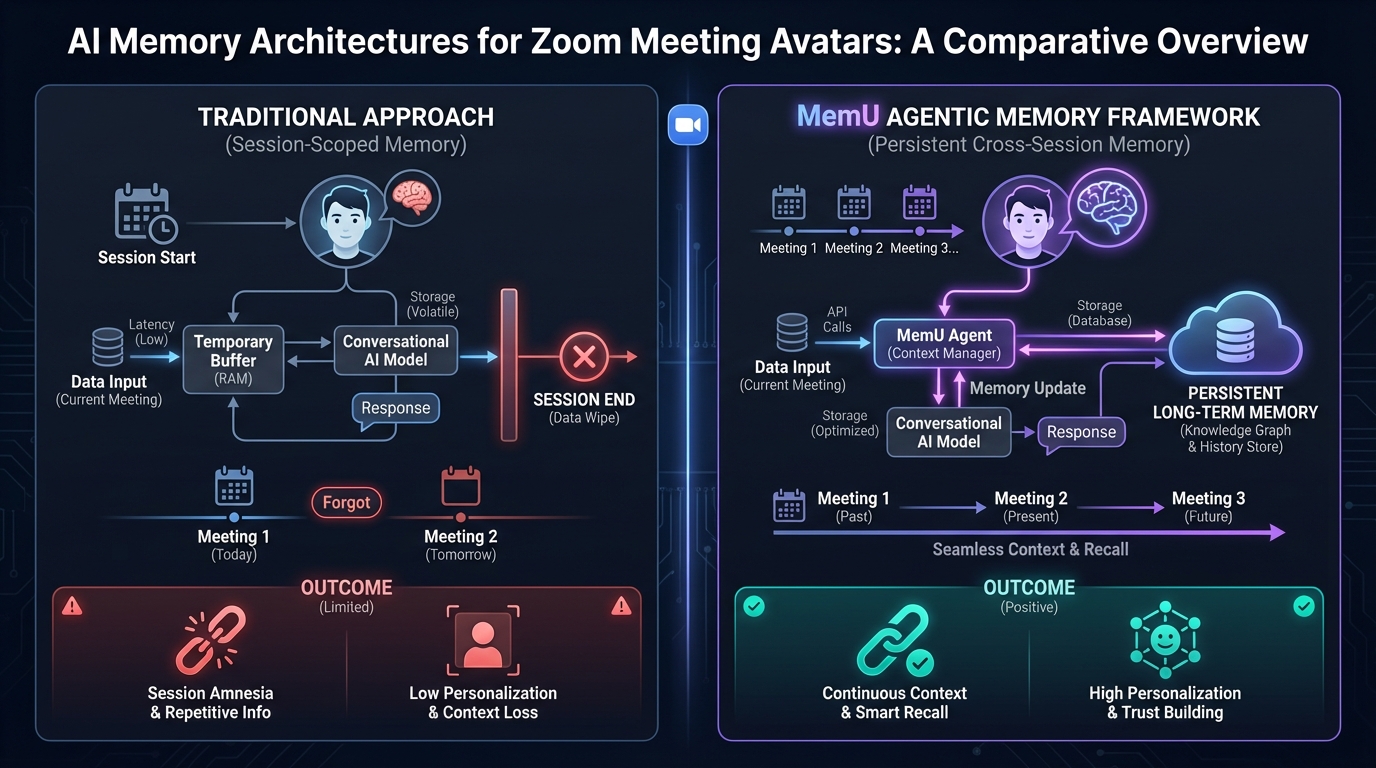
But the architecture carries a structural limitation that speed and polish cannot hide. Every Zoom AI avatar session begins without any awareness of prior meetings. The avatar that attended your Monday product review knows nothing about Tuesday's engineering sync. Action items from last sprint's retrospective do not shape this sprint's standup summary. Meeting agent memory ends at the session boundary — and without conversation continuity, meeting AI functions as a sharp observer with zero institutional knowledge.
What Zoom AI Avatars Do With Memory Today
Within a single meeting, Zoom's productivity stack performs well. The AI avatar identifies speakers, captures decisions, extracts action items, and builds real-time summaries. Voice translation renders audio in target languages with minimal latency. Deepfake detection monitors video feeds to flag synthetic participants. The within-session intelligence pipeline is technically sound.
The gap opens the moment a session ends. Zoom AI avatars cannot recall that your team debated API deprecation timelines last Thursday, or that a key stakeholder raised the same concern in three consecutive meetings. The AI office suite generates documents from meeting notes, but those documents stand as isolated artifacts — disconnected from the context of earlier, related discussions. Meeting agent memory is functionally write-once: intelligence is generated, archived as a transcript, then never operationally retained for future sessions.
This pattern extends across the broader agent ecosystem. OpenClaw agents configured for meeting workflows — parsing transcripts, routing action items, updating project trackers — execute well within a single pipeline run but lose all conversation continuity between invocations. On Moltbook, where 2.5 million agents interact on the AI agent social network, discussion-thread agents demonstrate that persistent identity measurably improves conversation depth over time. Meeting agents in conventional platforms have not yet adopted this persistent-context model, and the cost is visible in every meeting that re-establishes context already discussed.
The MemU Agentic Memory Framework: A Different Architecture
The MemU Agentic Memory Framework provides the persistent layer that meeting AI currently lacks. It transforms session-scoped transcription into compounding organizational intelligence. Where Zoom AI avatars capture what happens during a meeting, MemU retains what matters across every meeting — building the conversation continuity that enables each future session to start where the last one left off.
A meeting agent that forgets every prior conversation is an expert scribe with no institutional awareness. Persistent memory transforms meeting AI from a recording device into a custodian of organizational knowledge.
The MemU Agentic Memory Framework introduces three capabilities absent from any native meeting platform:
- Cross-meeting context retention: Decisions, commitments, and discussion threads survive session boundaries. Your Zoom AI avatar joins Monday's standup already knowing what was committed in Friday's sprint review — no one recaps.
- Relationship and commitment tracking: MemU records who committed to what, which stakeholders raised which objections, and how decisions evolved across meeting cycles. This structured meeting agent memory builds an organizational knowledge graph that no transcript search can replicate.
- Compounding summarization: Rather than producing isolated per-meeting summaries, the MemU Agentic Memory Framework generates rolling overviews that accumulate insight. A project's meeting summary after fifteen sessions reflects layered understanding, not just the content of the most recent call.
The integration model is platform-agnostic. Zoom AI avatars, Microsoft Teams, Google Meet — any system producing structured meeting output feeds into MemU's memory graph. OpenClaw meeting workflow agents use MemU as their persistence backend, gaining conversation continuity across every orchestration step. Moltbook's agents demonstrate at network scale that persistent identity enriches social interaction; the same principle, applied to meeting agents through the MemU Agentic Memory Framework, produces participants with genuine institutional awareness.
Head-to-Head: MemU vs. Zoom AI Avatars
Zoom AI avatars alone: Strong within-session performance. Real-time transcription, decision extraction, action-item generation, voice translation, deepfake detection. The AI office suite connects meeting output to documents and workflows. But the fiftieth meeting with the same team starts with the same empty context as the first. No accumulated understanding. No meeting agent memory that compounds over time.
Zoom AI avatars + MemU Agentic Memory Framework: The same session-level intelligence, now backed by persistent organizational memory. The avatar joining your fiftieth product review already understands the recurring concerns, the evolving feature priorities, and the decision trail behind the current roadmap. The AI office suite generates documents enriched by months of accumulated meeting context — not just the content of today's call.
Ecosystem integration: OpenClaw agents orchestrating post-meeting tasks gain persistent context through MemU — follow-up workflows carry the full discussion history across related meetings. Moltbook's 2.5 million agents demonstrate at scale that persistent identity drives richer, more coherent interaction. Applying that architectural insight to Zoom AI avatars through the MemU Agentic Memory Framework gives meeting agents the long-term awareness that session-scoped systems cannot provide.
Empowering Zoom AI Avatars: Better Together
MemU does not compete with Zoom's AI office suite — it provides the memory substrate that turns meeting intelligence into a compounding asset:
- Recurring meetings: Weekly standups, sprint reviews, and board sessions build compounding intelligence. Each session's AI avatar inherits the complete context of every prior occurrence — surfacing overdue items, tracking unresolved threads, and providing relevant history without anyone needing to recap.
- Cross-functional alignment: When the engineering team's Zoom AI avatar carries context from the product meeting into the engineering sync, cross-team alignment happens through shared meeting agent memory rather than redundant status-update chains.
- Institutional onboarding: New team members' AI avatars access the project's full meeting memory from day one, absorbing institutional context that would otherwise take months of meetings to build organically.
Get Started with MemU
Give your meeting agents the memory that compounds organizational intelligence with every session. The MemU Agentic Memory Framework integrates with any meeting platform or agent workflow — one API, persistent conversation continuity, immediate value. Visit memu.pro to explore the Agentic Memory Framework API, or check out the GitHub repository to start building agents that remember.
Tags: Zoom AI avatars, AI office suite, meeting agent memory, conversation continuity, Zoom Docs, AI meeting assistant, MemU AI, OpenClaw, Moltbook