Aider Leads Open-Source AI Coding With 100+ Model Support — But Multi-Session Learning Remains Unsolved


Aider has become the most popular open-source AI coding CLI, and for good reason. It supports 100+ LLM models, integrates natively with git for automatic commits, and provides autonomous code modification that works with any codebase. The bring-your-own-API-key model means developers aren't locked into any single provider. With an 8/10 autonomy rating and 8/10 ease of use in the 2026 CLI tools comparison, Aider occupies a sweet spot between power and accessibility that neither Claude Code nor Codex CLI matches for open-source developers.
The git integration is particularly notable. Aider creates clean, atomic commits for each change, making it easy to review, revert, or cherry-pick AI-generated modifications. The repository-map feature gives the AI a structural understanding of the codebase, enabling changes that respect cross-file dependencies. For developers who value transparency and control, Aider's approach — AI proposes, git records, developer reviews — is the gold standard.
But Aider shares a limitation with every other coding CLI: each session is independent, and the AI rebuilds its understanding of the project from scratch every time.
Why Developers Choose Aider
Aider's appeal centers on three properties: model flexibility, git workflow integration, and open-source transparency. Model flexibility means developers can use Claude, GPT-4, Gemini, Llama, Mixtral, or any model accessible via API. As model capabilities improve or pricing changes, developers switch models without changing their workflow. No vendor lock-in, no subscription required beyond the API costs.
The git integration transforms AI coding from a conversation into an auditable process. Every change Aider makes is committed with a descriptive message. The developer can review diffs, run tests, and decide which changes to keep. This workflow is fundamentally different from copy-paste coding assistants — Aider works within the developer's existing version control process rather than parallel to it.
Open-source transparency builds trust. Developers can inspect how Aider constructs prompts, how it manages context, and how it interacts with the codebase. Security-conscious organizations can audit the tool before deploying it. Community contributions keep the project evolving rapidly — features that took proprietary tools months to ship often appear in Aider within weeks.
The Multi-Session Challenge
Aider's session model is stateless by design. Start a new session, and the AI loads the repository map, analyzes the relevant files, and begins work. This approach is clean and predictable — there's no hidden state that could cause unexpected behavior. But it means that every session repeats the codebase analysis phase, and none of the AI's learned understanding persists.
For a developer working on the same project daily, this creates a recurring cost. The first 10-15 minutes of each session are spent re-establishing context: explaining the project structure, reminding the AI about architectural decisions, and re-describing the coding conventions. Over a week, that's 50-75 minutes of repeated context-setting — time that could be spent on actual development.
The model flexibility that makes Aider powerful also compounds the problem. If a developer switches from Claude to GPT-4 mid-project, the new model has zero knowledge of what the previous model learned. Even within the same model, Aider's session independence means that yesterday's insights about the codebase are gone. The repository map provides structural understanding, but not the experiential knowledge that accumulates through interaction.
What Project Memory Enables for Aider
With persistent project memory, Aider would start each session with accumulated knowledge: the project's architecture, common patterns, known issues, and the developer's preferences. The context-setting phase shrinks from minutes to seconds. The AI remembers that the project uses a custom middleware stack, that the database layer has specific query patterns, and that the developer prefers functional components over class components.
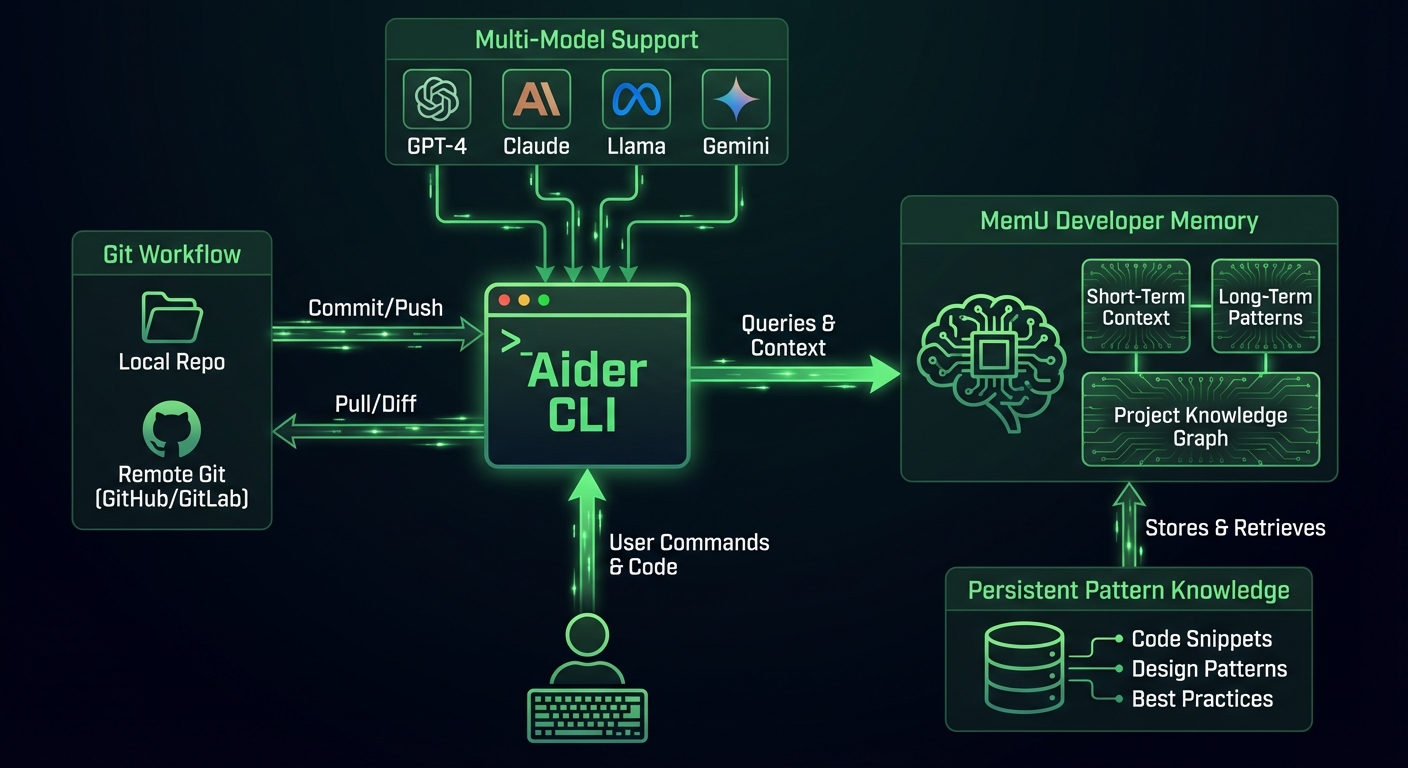
Cross-model memory is particularly valuable for Aider users. A developer who uses Claude for complex refactoring and GPT-4 for rapid prototyping would have both models access the same project memory. Claude's deep architectural analysis informs GPT-4's implementation work. GPT-4's implementation discoveries are available to Claude's next refactoring session. The developer gets the best of both models with shared context.
The git integration becomes even more powerful with memory. The AI understands not just the current state of the codebase but its evolution — why certain architectural decisions were made, which approaches were tried and abandoned, and what the next planned changes are. This transforms Aider from a tool that modifies code into an assistant that understands the project's trajectory.
How MemU Adds Memory to Aider
MemU provides the persistent memory layer that connects Aider sessions across time and models. Each session's interactions — the codebase insights, the developer's preferences, the successful patterns and failed approaches — are persisted in MemU. Before each new session, Aider retrieves relevant memories, starting with full project context rather than a blank repository map.
For Aider's multi-model users, MemU provides the cross-model knowledge bridge. Memories generated by any model are available to every other model. The developer's accumulated project knowledge is preserved regardless of which API key is active. This is the missing piece that makes model flexibility truly powerful — not just choosing the best model for each task, but ensuring every model benefits from every other model's work.
Aider provides the open-source coding workflow. MemU provides the persistent memory. Together, they create an AI development experience that improves over time — exactly what developers need from a tool they use every day.
Get Started
Give your open-source AI coding tool a persistent memory. Explore MemU at memu.pro and on GitHub.