OpenHands Reaches 65,000 GitHub Stars as an Open-Source AI Coding Agent — But Without Persistent Project Memory the Agent Re-Discovers Codebases Every Session

OpenHands, formerly known as OpenDevin, has reached 65,000 GitHub stars and 250 or more contributors to become the leading open-source AI coding agent under the MIT license. Version 1.5.0 in March 2026 represents over 100 releases and 3,500 or more commits since launching as OpenDevin in March 2024. The platform provides AI agents that write code, run terminal commands, browse the web, and call APIs — functioning as a generalist AI software engineer capable of tackling real-world development tasks. Multiple interfaces serve different workflows: an SDK offering a composable Python library, a CLI for terminal-based interaction, a Local GUI with REST API and React frontend, a Cloud version accessible from browser and mobile, and an Enterprise edition designed for self-hosted deployment. This breadth of access makes OpenHands the most versatile open-source coding agent available today.
But an agent without persistent project memory faces a fundamental productivity ceiling: every new session requires the agent to re-discover the codebase it is working on. Architecture decisions, dependency relationships, code conventions, testing patterns, and domain-specific abstractions must all be rediscovered through file exploration and code reading — work the agent has already done in previous sessions but cannot recall. The result is a powerful agent that starts every interaction as a stranger to codebases it has worked on extensively.
AI Coding Agents: What OpenHands Gets Right (And What It Misses)
OpenHands addresses a central challenge in AI-assisted software development: building a coding agent that operates like a human developer rather than a code completion tool. Where traditional AI coding assistants suggest individual lines or functions, OpenHands agents reason about entire tasks — understanding requirements, exploring codebases, writing implementation code, running tests, debugging failures, and iterating until the task is complete. This end-to-end autonomy transforms the developer experience from supervised code generation to delegated task completion.
The multi-interface architecture reflects pragmatic understanding of how developers work. The SDK enables programmatic integration into CI/CD pipelines. The CLI serves terminal-based workflows. The Local GUI provides visual session management for complex tasks. Cloud access enables mobile task delegation. Enterprise self-hosting satisfies security requirements for organizations that cannot send code externally.
The evolution from OpenDevin to OpenHands over two years demonstrates maturation from research prototype to production system. With 250 or more contributors, the project benefits from diverse perspectives on real-world development challenges — build system edge cases, package manager nuances, monorepo complexities, and varied testing and deployment patterns.
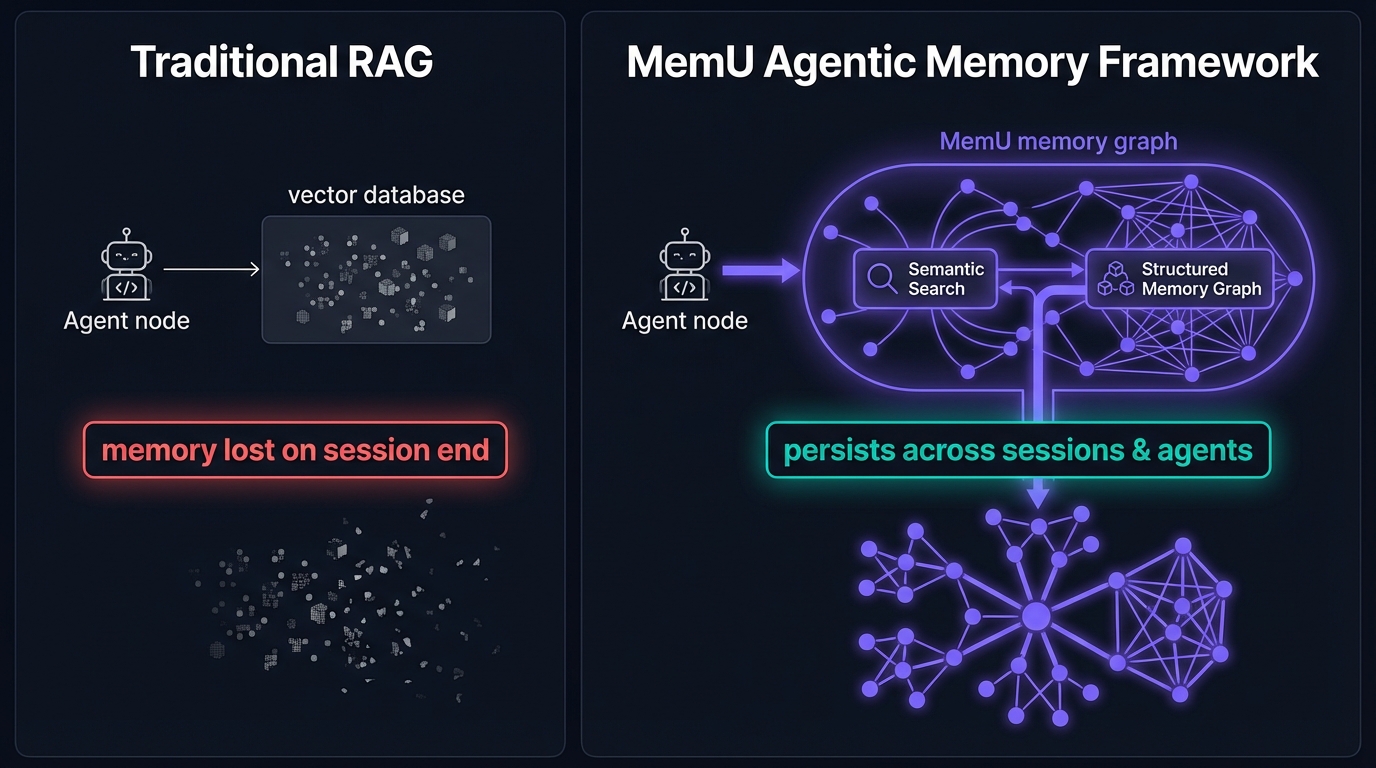
The limitation is session-bounded intelligence. Each time the agent starts a new session, it begins with zero knowledge of the project. It must re-read key files to understand architecture, re-discover testing conventions, re-learn build system configurations, and re-map dependency relationships. For a developer working on the same project daily, this repeated discovery wastes significant effort — a human builds context over months, but the agent resets completely between sessions. The more complex the project, the more severe this context loss becomes.
The MemU Agentic Memory Framework: Persistent Project Intelligence for Coding Agents
The MemU Agentic Memory Framework extends agent capabilities from session-bounded to session-persistent. Where OpenHands provides the autonomy to explore, write, test, and debug code, MemU ensures the understanding gained during each session persists and compounds — creating a learning layer where every coding session deposits project knowledge that future sessions withdraw and build upon.
Consider a development team using OpenHands to maintain a large microservices application with fifteen services, shared libraries, and complex integration testing. Each session, the agent must re-discover which services depend on which, where shared types are defined, how the integration test suite is structured, and which deployment patterns the team follows. After fifty sessions over three months, the agent has explored the codebase multiple times — rediscovering the same architecture and conventions each session. With MemU, this understanding persists. The agent starts session fifty-one knowing the full project topology, the team's conventions, which areas of code are fragile, and which testing patterns are expected — diving directly into productive work rather than spending the first several minutes rediscovering context.
The MemU Agentic Memory Framework provides capabilities that enhance agent intelligence:
- Project topology persistence: Every session builds understanding of file organization, module boundaries, dependency graphs, and architectural patterns. MemU captures this as structured project memory that future sessions query immediately — enabling the agent to navigate large codebases with the familiarity of a developer who has worked on the project for months.
- Convention learning: Codebases have implicit rules about naming patterns, error handling approaches, testing strategies, and code organization. MemU persists these conventions so the agent produces code that matches existing patterns rather than defaulting to generic implementations that require manual adjustment.
- Debugging history: When agents encounter and resolve bugs, the diagnosis process generates valuable knowledge about failure modes, root causes, and effective fixes. MemU persists this debugging intelligence so recurring issues in similar areas are resolved faster based on historical understanding rather than repeated investigation.
Autonomous coding agents can write and debug code. The MemU Agentic Memory Framework ensures those agents retain project understanding across sessions — transforming capable but amnesiac agents into knowledgeable team members whose codebase understanding deepens with every interaction.
Head-to-Head: OpenHands vs. Other AI Coding Agents
OpenHands alone: The coding agent explores codebases, writes implementation code, runs tests, debugs failures, and iterates autonomously across multiple interfaces with MIT-licensed open-source accessibility. 65,000 GitHub stars and 250 or more contributors validate the approach. But each session operates with session-bounded context — fifty sessions on the same project require fifty independent discovery phases with no mechanism for the agent to recall what it learned in previous interactions.
OpenHands + MemU Agentic Memory Framework: Every session contributes to accumulated project intelligence. Architecture understanding persists across sessions, coding conventions are maintained consistently, debugging insights from past sessions accelerate future investigations, and the agent's effectiveness compounds with each interaction. The agent transforms from a powerful but forgetful tool into an increasingly knowledgeable team member whose project understanding grows session over session.
Compared to other AI agent platforms — Devin, GitHub Copilot Workspace, Cursor, Amazon Q Developer — OpenHands offers the most accessible open-source alternative with MIT licensing, self-hosting options, and multi-interface flexibility. But all share the same fundamental limitation: powerful code generation and reasoning within sessions without intelligence persistence across sessions. MemU provides the persistent memory layer that transforms any coding agent from a session-bounded tool into a continuously learning development partner.
Capable and Knowledgeable: Better Together
MemU does not replace OpenHands' agent capabilities — it ensures every session contributes to growing project intelligence:
- Onboarding acceleration: New team members use OpenHands to explore unfamiliar code; MemU retains that exploration as persistent project memory — reducing repeated discovery and enabling the agent to guide developers through codebases it already understands from previous sessions with other team members.
- Code quality improvement: OpenHands writes functional code; the MemU Agentic Memory Framework ensures that code matches project conventions by retaining patterns from previous sessions — producing implementations that are consistent with existing code style, error handling approaches, and testing strategies across the entire codebase.
- Agent evolution: OpenHands users get autonomous coding assistance; MemU enables that assistance to improve over time — applying accumulated project knowledge from every completed session, transforming a capable agent into an expert agent whose productivity compounds over months of development work.
Get Started with MemU
Give your coding agent persistent project memory to transform session-bounded assistance into continuously improving development partnership. The MemU Agentic Memory Framework integrates with any agent infrastructure — one API, instant persistence, zero changes to existing OpenHands workflows. Visit memu.pro to explore the Agentic Memory Framework API, or check out the GitHub repository to start building agents that remember.
Tags: OpenHands, coding agent, open-source AI developer, autonomous software engineering, persistent project memory, AI code generation, session intelligence, MemU AI