Turn Your Daily Chaos into Long-Term AI Memory

One day I was chatting with ChatGPT about my work. I told it I’m a backend developer, and I recently started contributing code to a Python CLI tool. I also said I want to build a tool for API testing and docs management, and I will start a prototype in the next few months.
Another time, I suddenly wanted to visit San Francisco. When I told ChatGPT, it started asking what I like. I said food and nature, and I also want to visit some tech companies. My partner likes photography and museums. Then we talked about Muir Woods, vegan restaurants, morning running routes…
Later, because I’m in charge of a big product launch next month, I got very stressed and couldn’t sleep. When ChatGPT heard that, it started talking with me about ways to relax, sleep habits, and how to set boundaries between work and life.
A lot of people enjoy chatting with AI like this — from work to daily life, from hobbies to habits, from ideas to feelings, or just to record inspiration or ask for advice. But when we keep chatting more and more, AI slowly forgets what we talked about last time. It forgets my preferences. Next time I bring up my SF trip, it will ask again what I like. When I talk about my API testing tool idea, it might not remember anything.
This feels frustrating — you’ve probably experienced it too.
Now imagine this:
What if every chat with AI can be auto-organized, sorted, and saved as long-term memory?
What if your ideas, goals, habits, and preferences can become a structured knowledge base?
What if you can look back at past choices, progress, and life stories right inside your chat with AI?
For example, the three chats above could be auto-summarized into different topic files:
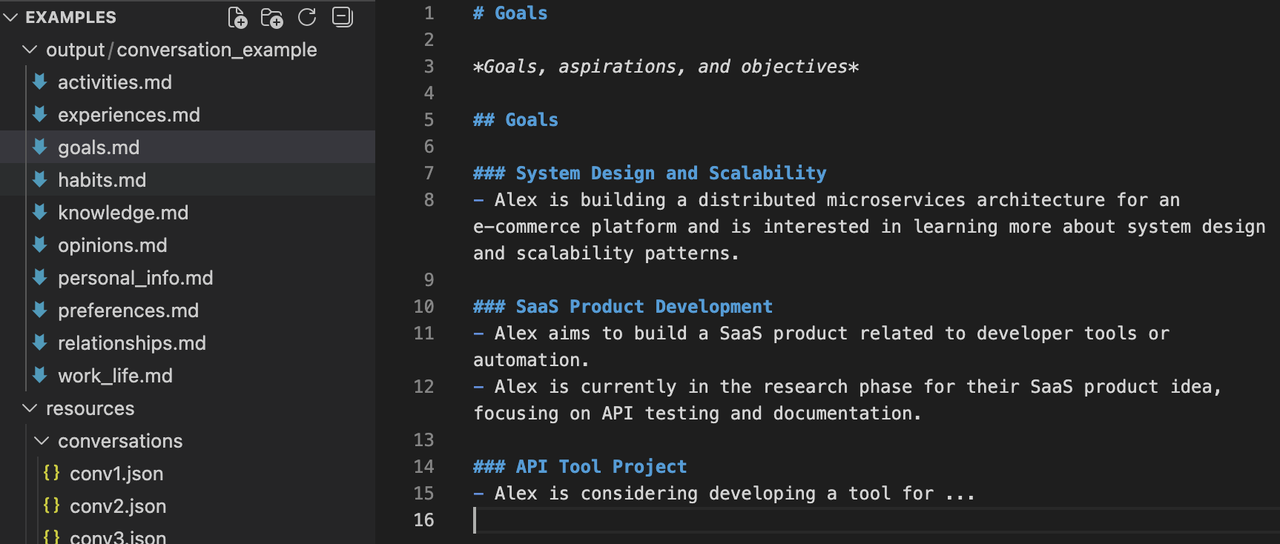
A “goals” file: it knows I’m building a distributed microservices architecture for an e-commerce platform; that I plan to develop a SaaS tool related to developer tools or automation; and that my research focus is API testing and docs.
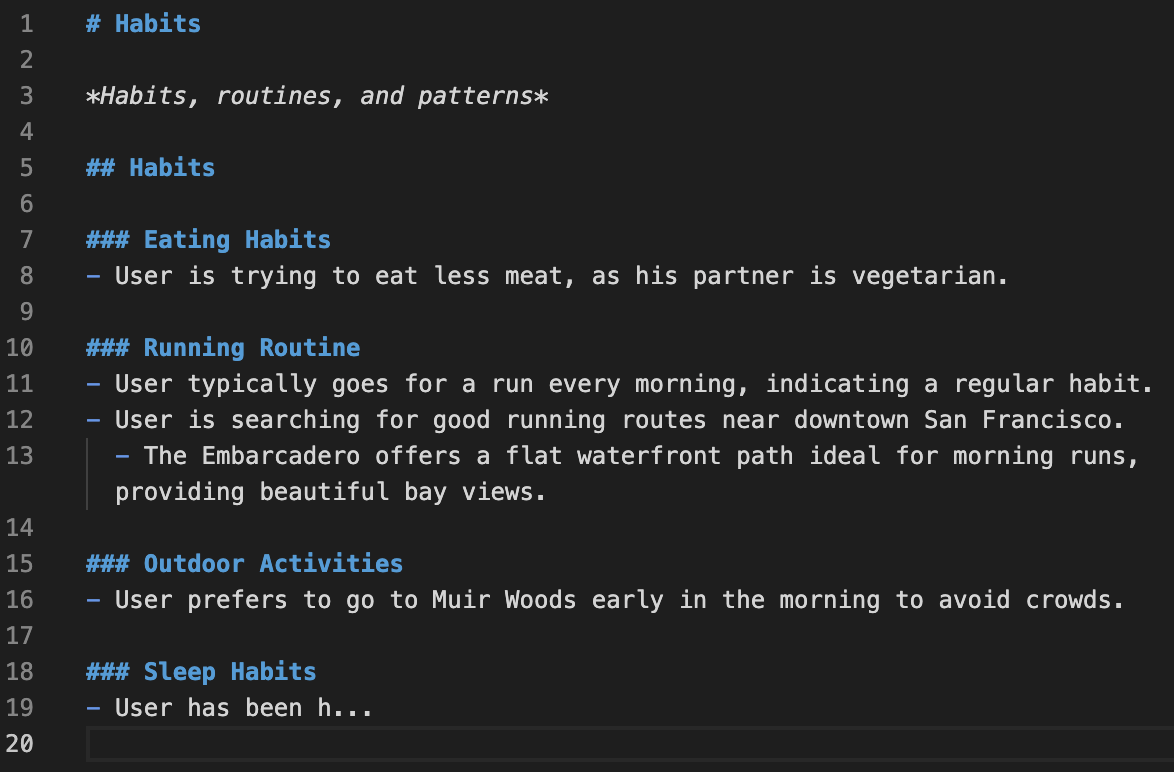
A “habits” file: it notes that I’m trying to eat less meat because my partner is vegan; I like running in the morning; and I prefer visiting Muir Woods early to avoid crowds.
An “opinions” file: it knows I think API testing and docs still need more automation and AI support; I think I need better boundaries between work and life; replying to emails late at night increases my stress; and I should create healthier limits…
……
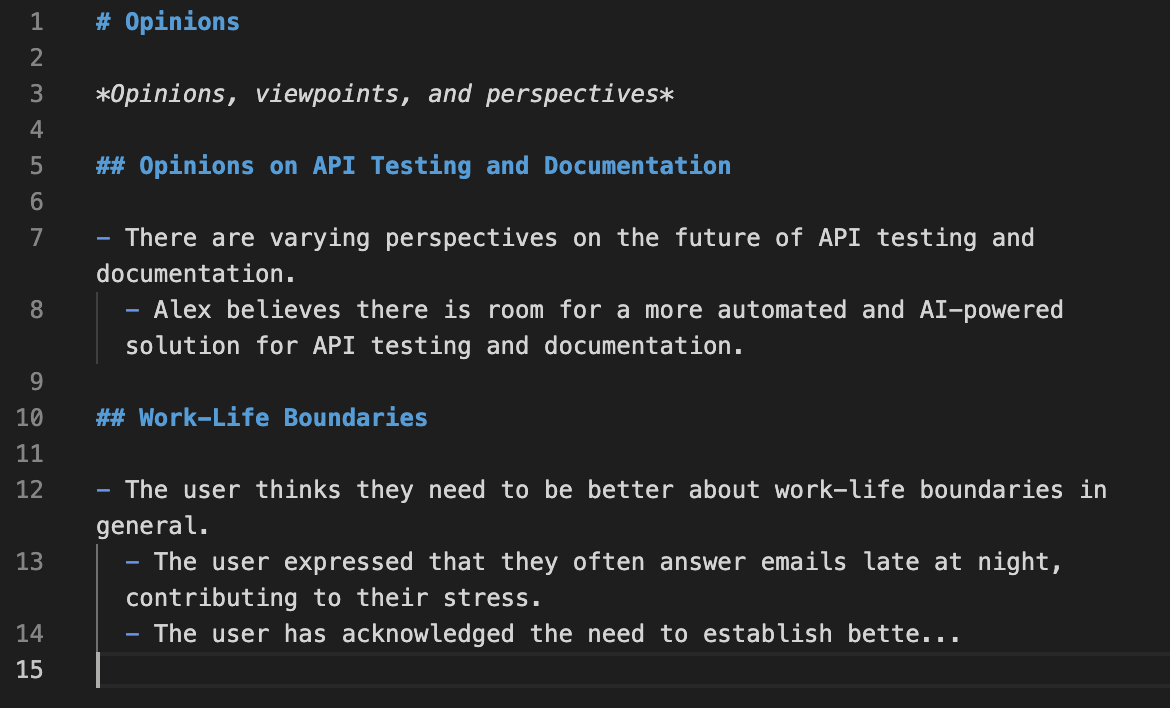
This is exactly what memU does.
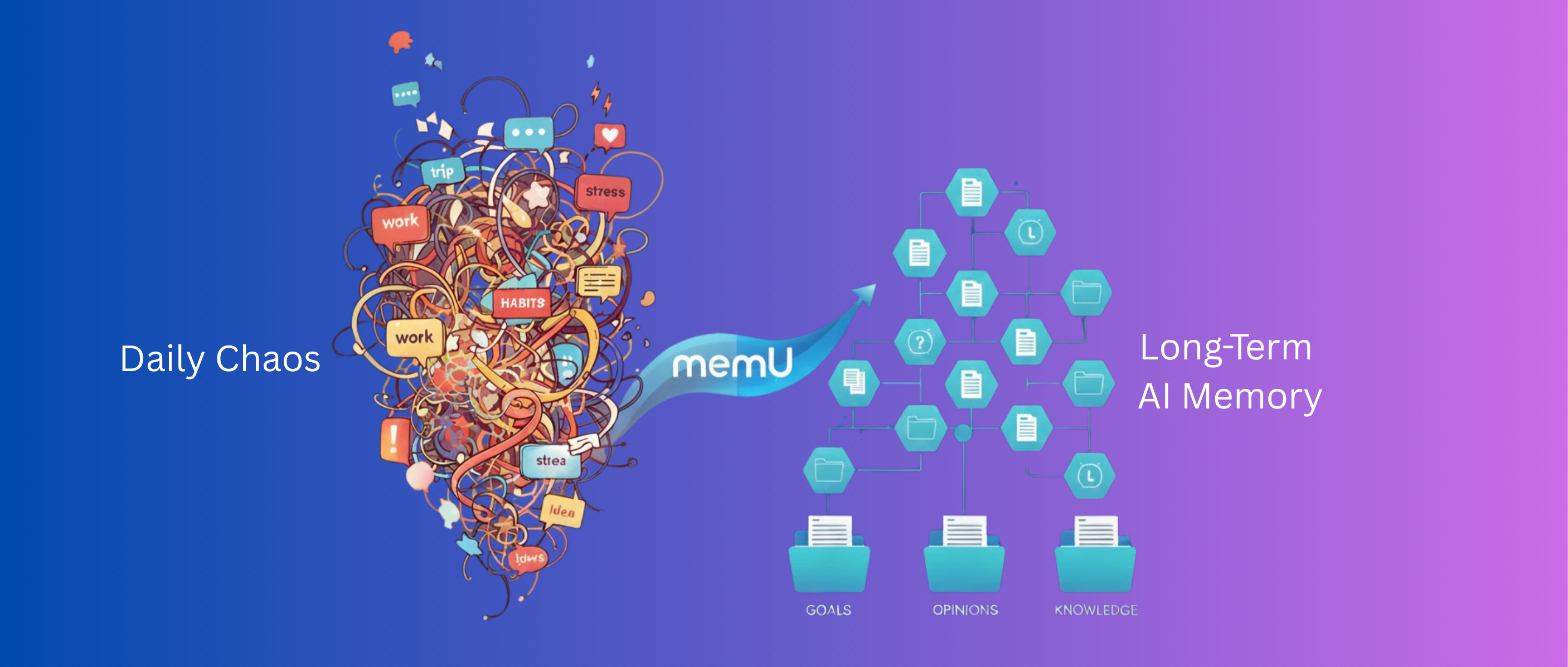
It not only remembers what we talked about — it also turns everything into topic files, so your messy info becomes like your own mini Wikipedia. Every page has its topic, and topics can link to each other. You can drill down and find answers layer by layer.
memU stores memory in human-readable files. The structure and references make the context clear. Files can link to each other like semantic “hyperlinks.” Updating a memory is as simple and safe as editing a document. At the same time, AI can still read, index, and pull up the info whenever you need it.* *In multi-task and multi-modal cases, this lowers the cost for dev and maintenance, and also gives the system stronger long-term memory and explainability.
It becomes a “human-readable + AI-searchable” hybrid memory system.
More importantly, traditional memory frameworks rely on explicit modeling. Developers need to set a few fixed labels in advance, and then all content must be put under those fixed labels. But this doesn’t match real conversations.
Humans don’t talk by “preset categories.” While talking about work, we suddenly jump to travel; while talking about travel, we think of our partner’s preferences; while talking about stress, we bring up sleep, lifestyle, and work boundaries. Human thinking is multi-threaded, jumping, and mixed.
Traditional memory systems with fixed categories lead to two bad results:
- Categories are too broad → everything becomes a blob
- Categories are too narrow → everything becomes fragmented
memU works in a totally different way. The core is a Memory Agent. The LLM auto-classifies the conversation. You can also add your own custom files. The better the LLM becomes, the better the memory summary and classification becomes. No rigid schema. No fixed labels. Just natural memory. This brings several benefits:
- You don’t need to tell it what categories to use
- It auto-creates topics from real conversation patterns
- One piece of info can belong to multiple topics
- It can build links between topics, like a small encyclopedia
This means every chat becomes long-term memory, instead of being forced into a wrong drawer. The three chats we had earlier can be turned into flexible, multi-topic files that are easy to search and recall.
Getting started is simple
Step one: install memU.
pip install memu-py
To help everyone start fast, we made a Quick Example so you can test memory search using both LLM and RAG methods.
from memu.app import MemoryService
import os

async def main():
    api_key = "your-openai-api-key"
    file_path = os.path.abspath("tests/example/example_conversation.json")

    # Initialize service with RAG method
    service_rag = MemoryService(
        llm_config={"api_key": api_key},
        retrieve_config={"method": "rag"}
    )

    # Memorize
    memory = await service_rag.memorize(resource_url=file_path, modality="conversation")
    for cat in memory.get('categories', []):
        print(f"  - {cat.get('name')}: {(cat.get('summary') or '')[:80]}...")

    queries = [
        {"role": "user", "content": {"text": "Tell me about preferences"}},
        {"role": "user", "content": {"text": "What are their habits?"}}
    ]

    # RAG-based retrieval
    print("\n[RETRIEVED - RAG]")
    result_rag = await service_rag.retrieve(queries=queries)
    for item in result_rag.get('items', [])[:3]:
        print(f"  - [{item.get('memory_type')}] {item.get('summary', '')[:100]}...")

    # Initialize service with LLM method (reuse same memory store)
    service_llm = MemoryService(
        llm_config={"api_key": api_key},
        retrieve_config({"method": "llm"})
    )
    service_llm.store = service_rag.store  # Reuse memory store

    # LLM-based retrieval
    print("\n[RETRIEVED - LLM]")
    result_llm = await service_llm.retrieve(queries=queries)
    for item in result_llm.get('items', [])[:3]:
        print(f"  - [{item.get('memory_type')}] {item.get('summary', '')[:100]}...")

if __name__ == "__main__":
    import asyncio
    asyncio.run(main())
If you want to see the exact details, you can run:
export OPENAI_API_KEY=your_api_key
python examples/example_1_conversation_memory.py
And in the EXAMPLES folder, you’ll see the original user + AI conversations, and the memory storage.
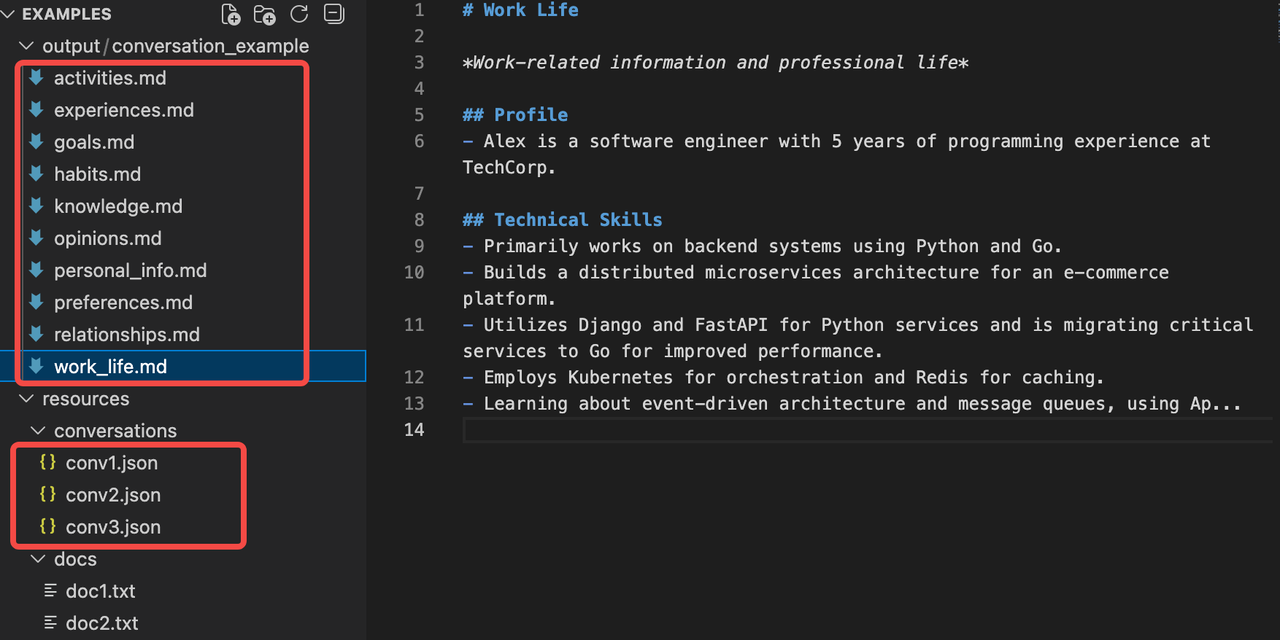
Turning just three chats into topic files is only a small taste of what memU can do. The real value shows when you chat hundreds or thousands of times. When your info becomes huge, messy, and mixed — memU still keeps everything clean, structured, and traceable. Here are the abilities that make this possible:
Precise Topic Categorization
memU helps users build a “multi-dimensional memory library” from lots of conversations. Each topic is separate, clear, and easy to look back on. It can break a user’s chats into different summary files, like personal info, work life, goals, experience, habits, knowledge, preferences, opinions, relationships, and work-life. Even if content overlaps — like work skills, personal interests, and travel plans — memU can extract and store them separately, keeping each topic clean and organized.
Cross-Conversation Memory Integration
memU supports memory across multiple chats, so it can see the full picture of a user’s behaviors, interests, and goals — not just one conversation at a time. It can group related info from different chats into the same topic file. For example, a user’s tech stack, system design interests, and future SaaS product plans can all go into “goals,” “knowledge,” or “work life.” Details about work stress and time management from one chat and another can be merged into “opinions” and “work life.”
Handling Multiple Types of Information
memU doesn’t just remember “facts.” It can also capture a user’s values, preferences, and goals, which gives the AI a base for personalized suggestions. memU can handle many types of info: facts, behaviors, preferences, goals, and opinions.
Context and Conversation Understanding
memU understands the context of your chats, which helps support long-term personalized services — like travel tips, health advice, or career guidance. It can pick up details from conversations, like: Alex’s partner is vegan and loves photography, and Alex wants to hike the Muir Woods in San Francisco. Even small, scattered info — like coffee habits or using your phone before bed — can be stored in files like “habits” or “work life.”
Long-Term Planning and Goal Tracking
memU works like a “personal knowledge and goal manager.” It helps you save ideas and inspirations from daily chats and lets you look back anytime. Short-term plans — like weekend trips or improving sleep — and long-term goals — like building a SaaS product or improving system design — may all go into separate files for easy tracking.
Practicality and Ease of Use
memU isn’t just passive memory; it’s an active info library that supports your decisions in real time. Each topic is its own file, making it easy to check or use in future chats. For example, next time you mention an “API testing tool,” the system can pull info straight from the “goals” or “knowledge” files.
Personalized and Human-Like Memory
memU makes AI chats feel like you’re talking to someone who actually “gets you,” not just a Q&A machine. It can recognize your habits, preferences, and emotional info — like work stress or sleep issues — so next time it can give suggestions that really fit you.
Multi-Scenario Support
memU works across many areas: work, life, travel, health, and more. For example:
- Skills and career → “work life,” “knowledge,” “goals”
- Travel and hobbies → “activities,” “preferences,” “relationships,” “habits”
- Health and lifestyle → “habits,” “opinions,” “work life”
Boosting Self-Awareness and Reflection
memU doesn’t just help AI remember — it helps you understand yourself better and make smarter decisions. With memU’s file structure, you can see a clear view of your skills, interests, goals, and habits. For example, Alex can notice their tech abilities, life habits, sources of stress, and long-term goals all at once.
When you see these auto-generated topic files for the first time, it feels a bit magical.
You realize that all your scattered chats with AI can grow into a real tree. Some branches store your tech thoughts, some your doubts about life, some your late-night ideas. Before, they were like small ephemeral notes, floating in a cache. Now they have structure, links, meaning. It’s like turning your digital self from temporary variables into persistent storage.
If you want to see the code, the architecture, or the Memory Agent behind it, everything is open-source. Feel free to read it, fork it, or build your own memory system:
Bonus
Wonder where the new features will pop up? 🐶